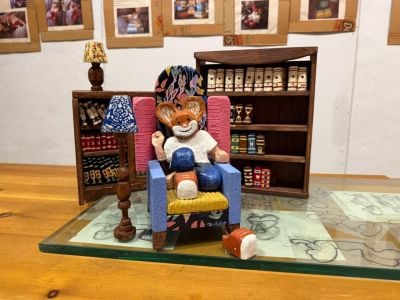
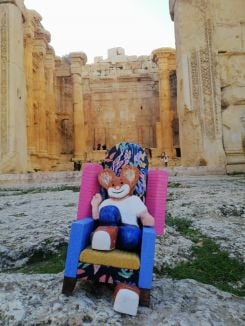
Arturo, a hybrid figure imagined by Zahraa Hammoud, a fragile yet resilient companion at the heart of the exhibition at Zico House. (Credit: Rayanne Tawil/L'Orient Today)






You enter Zico House as if entering a living body. The arches pull you in. The walls shed their skin, and the staircase interrupts your pace with every uneven step. It is not polished, and it does not try to be. Instead, it holds space. For over 30 years, Zico House has done what the city itself often fails to do — offer young artists a place to begin. By the time you reach the second floor, your body is already tuned to fracture.
Then a door opens, and Arturo begins.
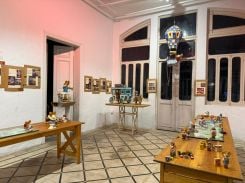
Tables are filled with its different variations, denoting a gradual evolution over time, just as its creator, Zahraa Hammoud has.
On the walls, Arturo’s story unfolds in front of you, articulating themes of joy, love, loss and pain and experiences all too familiar to many Lebanese.
His is a story that of Lebanon.
Birth of a companion
Arturo, half-rabbit, half-mouse is everywhere in the room, repeating himself in different materials, sizes and moods. The earliest versions are small wooden figures, burned and carved by hand. The later ones are made of cardboard — larger, lighter, more fragile. Together, they form a timeline of the character, but also that of his creator, Hammoud.
Hammoud studied fine arts at the Lebanese University, where she has been navigating her practice alongside the country’s collapses. She taught herself pyrography through experimentation. Over the years, Arturo followed her through applications, competitions and attempts to show work abroad — a project that grew not despite uncertainty, but inside it.
“I began sketching at first,” Zahraa says. “Then, I started burning wood, pyrography. I felt alive, even though I wasn’t,” she added softly. From those early gestures, Arturo emerged. “He started from nothing. Then he became my friend.”
On the walls, posters narrate Arturo’s life like chapters. He begins as a tailor — or, as Zahraa insists, a “fashion designer.” Then Lebanon collapses around him. His savings disappear. He protests. He plants food to survive. Desperate and with few other options, he sells flowers on the street. Later, he becomes a mechanic, fixing what can still be fixed. “He knew no one would listen to the protests,” Zahraa says. “So, he tried another way.”
Arturo buys a television to follow the news. On A News TV, a fictional channel created by the artist, he meets Panadol, his lover, named after the brand of painkiller. A bittersweet joke. "It was an innocent love," Zahra says. Later, Panadol moves abroad with a businessman.
Arturo stays in Lebanon, heartbroken. "He couldn't leave," Zahraa puts it simply.
From wood to cardboard, from pain to escape
The exhibition moves with Arturo’s emotional shifts. After heartbreak comes depression. Therapy doesn’t work. Art does, until it doesn’t, and then it returns. “He listens to everything I say,” Zahraa admits. “Arturo was helping me grow up. He was stronger than me.”
As her process evolves, so does the material. “This is the first time I use cardboard,” she says, motioning to a larger version of Arturo next to her. Wood had become too heavy — physically, emotionally. Cardboard allows dreaming. In one scene, Arturo thinks endlessly, even in the bathroom. In another, he reads, discovering that anyone can become a philosopher. “Thinking is resistance,” Zahraa says.
Arturo is not fixed to a single gender. “He’s like a doll,” she explains. “Not male, not female.” Still, she refers to him as “he.” “Maybe he has more freedom than me,” she adds quietly. “It’s easier for him to speak.”
The final scene is both absurd and familiar: Arturo leaving Lebanon in a horse carriage, suspended between fantasy and exhaustion. There is no destination. “He doesn’t know where he’s going,” Zahraa says. “He’s staying here — but also leaving.”
Watching from the background, founder of Zico House, Moustapha Yamout, reflects on the work’s evolution. “This is not only psychological anymore. It has become art,” he says. What Zahraa created, he adds, is not private, even if it began that way. “Although she is doing something special, it is also a general thing.”
Zahraa jokes that Arturo became her therapist. Then she corrects herself. “Therapists care about money, but Arturo actually cares.”
At Zico House, Arturo is no longer hers alone. Visitors linger, speak to him, and recognize themselves in his story. “Arturo is available to anyone who needs him,” Zahraa says. “They smile. They know he experienced this. Like us.”
Arturo stands as a condensed portrait of a generation: stubborn, tired, romantic, still imagining. Zahraa watches as people approach not to take photos, but to talk, to see themselves reflected in the character she brought to life. “Arturo is me,” she says softly. “But he is also all of us trying to survive, to resist and to dream.”
The exhibition runs from Jan. 29 to Feb. 6 at Zico House, Spears Street, Beirut.