






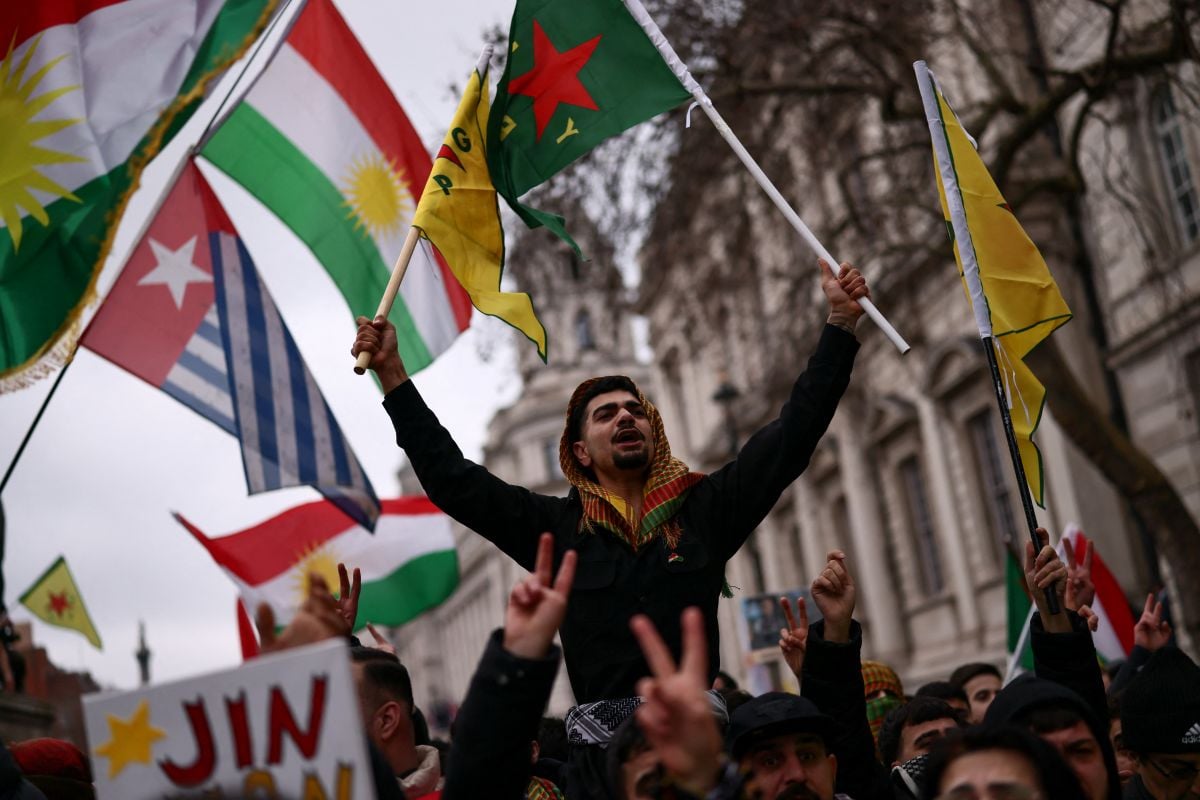
Pro-Kurdish protesters gather on Whitehall for a demonstration in support of Syrian Kurds, following recent military clashes between the Syrian army and Kurdish forces, in London, Britain, Jan. 25, 2026. (Credit: Jack Taylor/ REUTERS)






After months of fighting and stalled negotiations, Damascus and the Kurdish forces announced a deal Friday to gradually bring Kurdish forces and administration under Syrian state control, a move welcomed by Washington and Paris.
The “comprehensive” deal significantly limits Kurdish autonomy, as the new Islamist government seeks to assert authority over all of Syria.
The United States, which had previously supported the Syrian Democratic Forces (SDF) against IS but shifted its stance following the arrival of President Ahmad al-Sharaa in late 2024, called the agreement a “historic step” in Syria’s unification.
French President Emmanuel Macron congratulated both sides and pledged that France would fully support implementation.
The agreement comes after the SDF, dominated by the SDF, suffered recent territorial losses to the Syrian army. Under the deal, Syrian security forces will deploy to the Kurdish autonomous region, established during the civil war (2011–2024) in northern and northeastern Syria.
Some concessions are included for the Kurds: the SDF will remain organized as a division within the Syrian army, split into three brigades, with Kurdish commanders. Kurdish forces in the Kobani enclave will form a brigade within the army. The autonomous administrations will be integrated into state institutions, with civil employees retaining their positions.
Experts note that the agreement remains unclear on key issues of administrative and security decentralization. A government source said the state will take control of all civil and government institutions and border posts with Turkey and Iraq. The agreement also establishes a permanent cease-fire.
Kurds highlighted that the U.S. and France are guarantors of the deal, promising to monitor the process, though they criticized Washington for previously signaling that the SDF’s anti-IS mission was over. France has reportedly made “considerable diplomatic efforts” to secure the deal.
The agreement follows a Syrian offensive in early January that pushed Kurdish fighters out of two districts in Aleppo and from Raqqa and Deir Ezzor, accelerated by the defection of Arab fighters within the SDF. President Sharaa also issued a decree granting national rights to the Kurdish minority, including official status for the Kurdish language alongside Arabic.
Despite the deal, some remain wary. A local shopkeeper in Qamishli commented, “We do not trust this government. Look at what they did in Damascus, Sweida, and along the coast.”

 8 p.m. recap: Israel again threatens Beirut’s south suburbs; 2 ships hit near Hormuz; Riyadh football matches canceled