


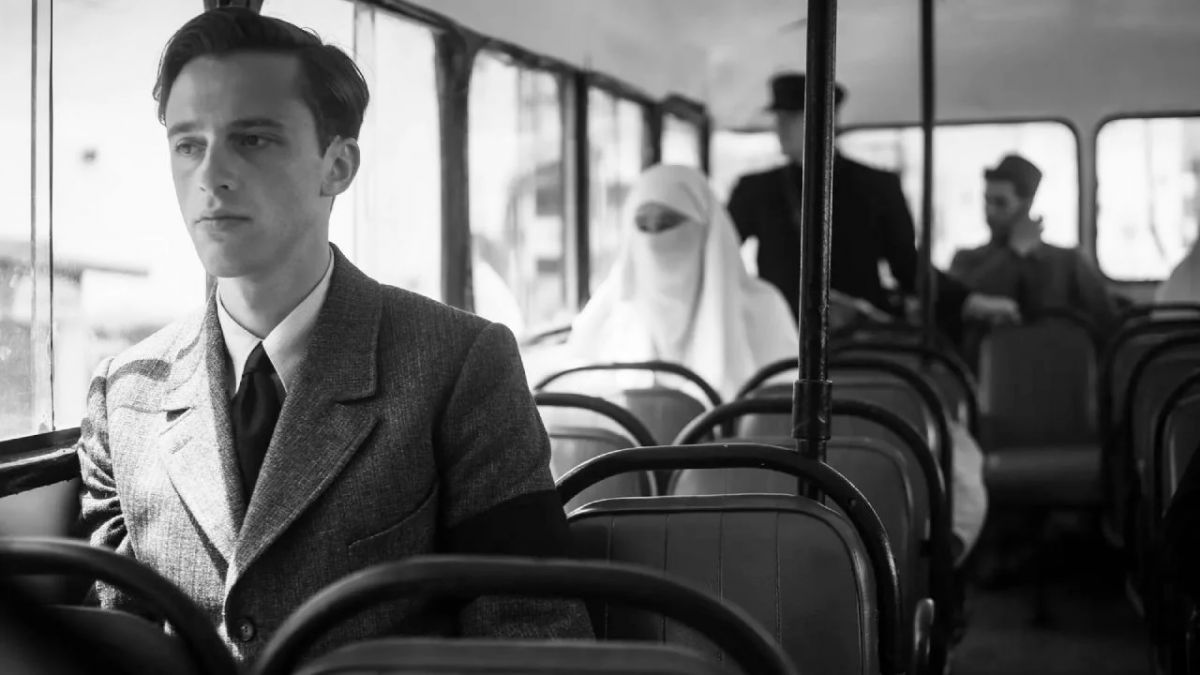
In "The Stranger," Benjamin Voisin plays Meursault, an indifferent passenger on an Algiers bus in an image that evokes off-screen colonial inequality. (Credit: Gaumont Distribution)






It is neither the absurd, nor Benjamin Meursault, nor even Albert Camus himself that Francois Ozon chooses to place at the center of "The Stranger." His boldest — and most political — move is in fact to bring the colonial context in which the story unfolds fully into the spotlight. By returning Camus’ novel to occupied Algeria in the early 1940s, the French filmmaker subtly but radically shifts perspective: what had long been read as a universal existential tale also becomes, directly, the account of violence exerted on a land and bodies made invisible.This is the precise starting point of the film now screening in Lebanese theaters. And it’s from this point that Ozon offers a contemporary reading, carried by a classic cinematic language, of Camus’s philosophy on existence and the absurd — never separating it from its...
It is neither the absurd, nor Benjamin Meursault, nor even Albert Camus himself that Francois Ozon chooses to place at the center of "The Stranger." His boldest — and most political — move is in fact to bring the colonial context in which the story unfolds fully into the spotlight. By returning Camus’ novel to occupied Algeria in the early 1940s, the French filmmaker subtly but radically shifts perspective: what had long been read as a universal existential tale also becomes, directly, the account of violence exerted on a land and bodies made invisible.This is the precise starting point of the film now screening in Lebanese theaters. And it’s from this point that Ozon offers a contemporary reading, carried by a classic cinematic language, of Camus’s philosophy on existence and the absurd — never separating it from...
