


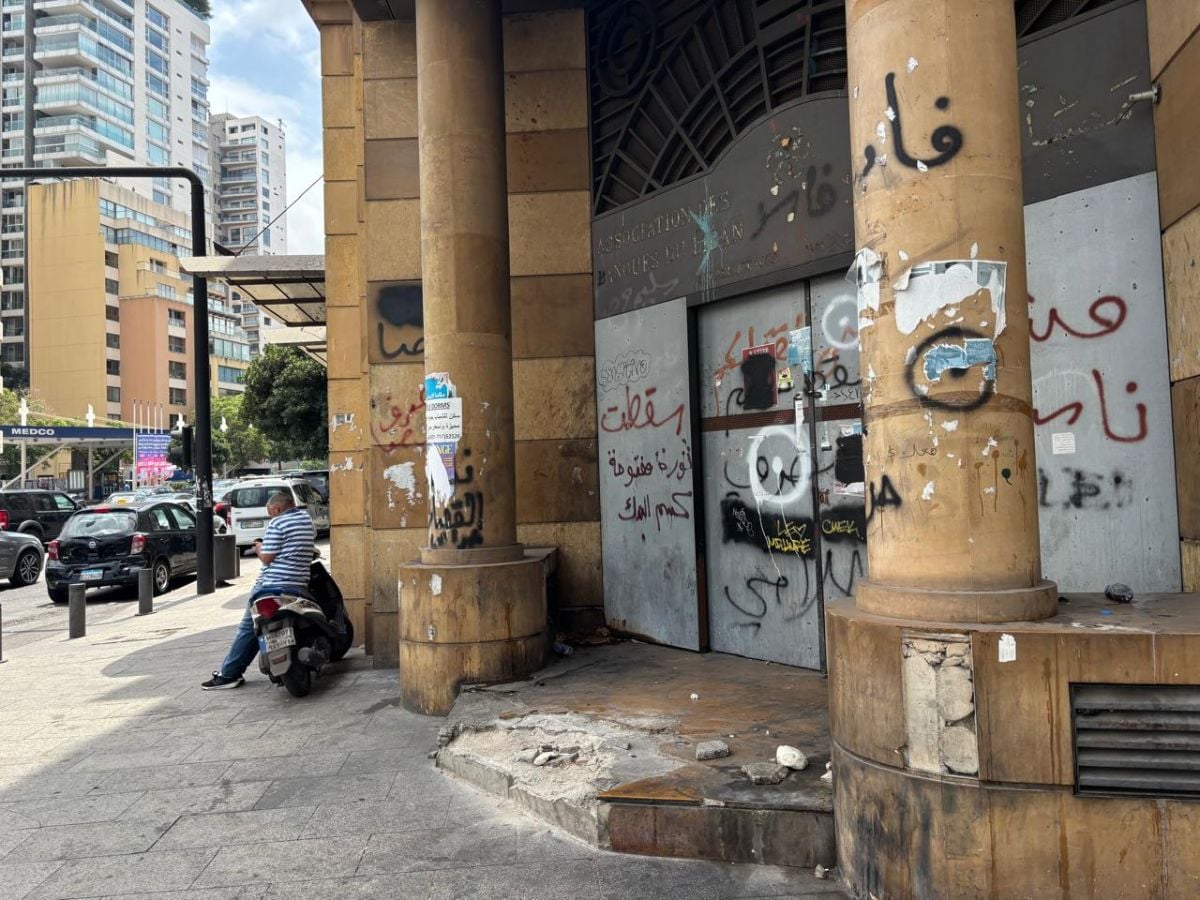
The entrance to the ABL headquarters in Beirut, Aug. 7, 2025. (Credit: Philippe Hage Boutros/L’Orient Today)






The United States welcomed the "reform steps being undertaken by Prime Minister Nawaf Salam’s government, including the Cabinet’s approval of the gap law, which helps restore the confidence of international financial institutions, including the World Bank and the International Monetary Fund, in the Lebanese economy and support its recovery," the U.S. embassy in Lebanon said in a statement Wednesday.
"These reforms are considered important steps toward restoring confidence in the Lebanese banking system, and positive steps forward that serve Lebanon’s long-term interests, and help attract international investments," the embassy concluded in its short statement.
However, commenting on the same law, Lebanese Forces (LF) MP Sethrida Geagea, said on Wednesday that the approach to the law "cannot be superficial or rushed; rather, it must be serious, responsible, and aimed at achieving a real outcome that restores people’s deposits and relaunches the economic cycle."
"The Lebanese Forces were among the first to call for a financial restructuring law, but not in any form," she added in a post published by the LF on X.
"What is required is a law that restores deposits while simultaneously reestablishing order in public finances, in the Central Bank of Lebanon, the banking sector, and across the economy as a whole."
The “Strong Republic” bloc of the LF said Tuesday that it held a lengthy remote meeting to prepare amendments to the law, reiterating its opposition to the law's text.
In December, the government approved the financial gap draft law, tackling the return of deposits, after reviewing provisions that were still pending. The draft law was then signed by President Joseph Aoun and sent to Parliament which will debate the law and add any necessary amendments at a date still unknown.
The draft law plans for for the full repayment of deposits under $100,000 within four years, and sets up a debt-for-bond swap with maturities of 10, 15 and 20 years, guaranteed 80 percent by the Banque du Liban (BDL, central bank) and 20 percent by the banks. For the first time since the beginning of the crisis, the plan explicitly assigns responsibility to the state.
Salam admitted that the law was not perfect but called it “a fair step toward restoring rights.” The draft has faced widespread criticism, particularly from banks, which argue that it effectively paves the way for the sector's liquidation rather than its stabilization, as well as by those who had hoped that it would offer stronger guarantees in terms of the return of deposits.

 7 p.m. recap: Sharaa in Riyadh; Qassem signals openness to cooperation; Ben-Gvir: ‘We demolish, again and again’