


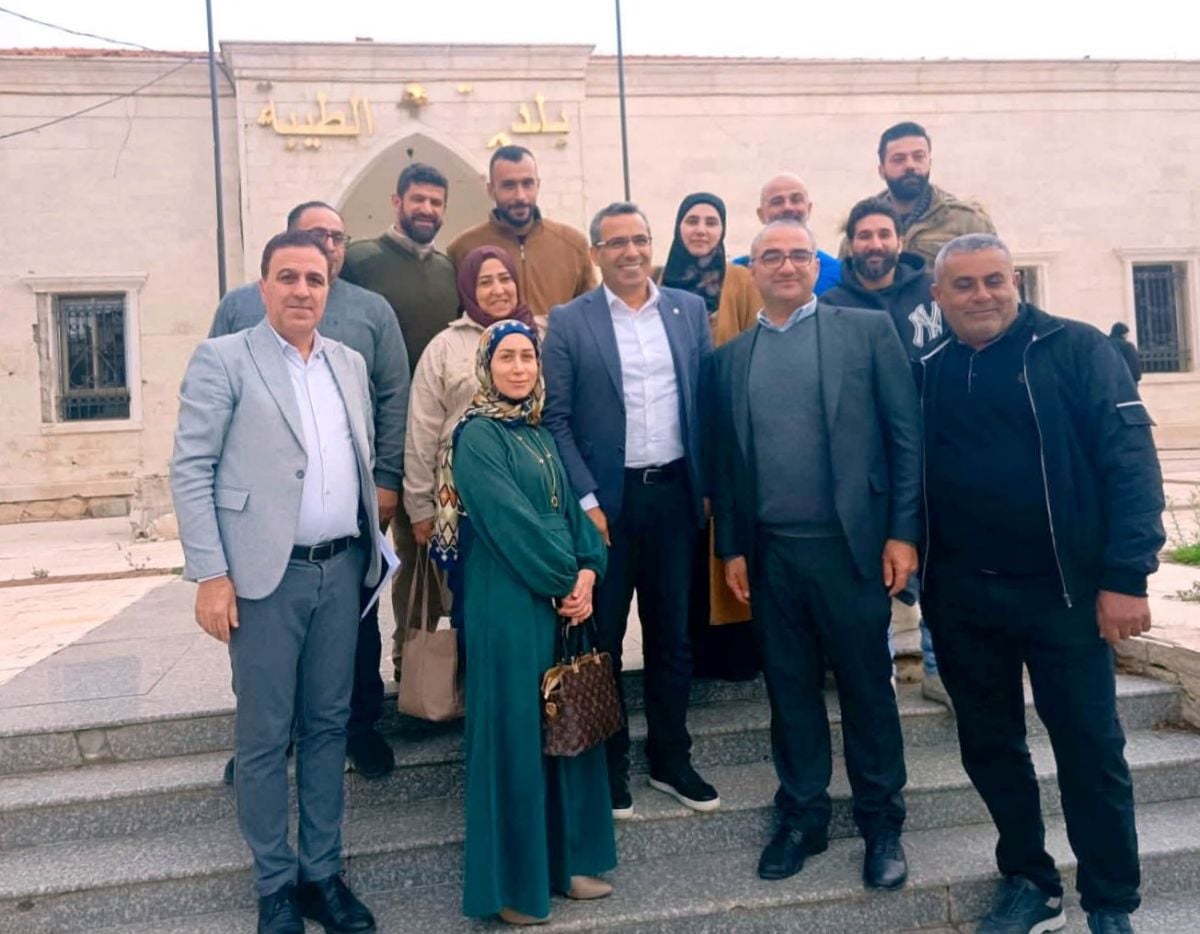
Agriculture Minister Nizar Hani touring several towns in south Lebanon on Dec. 9, 2025. (Credit: Agriculture Ministry/X)






BEIRUT — On a tour of several towns in south Lebanon, still under Israeli fire despite the cease-fire, Agriculture Minister Nizar Hani on Tuesday reaffirmed the state's commitment to supporting the region, calling it “a pillar of national food security,” and announced a “gradual and comprehensive approach” to assist farmers.
“The state remains firmly committed to supporting the South, which is a key pillar of national agricultural production,” Hani said, as the government has been repeatedly accused of neglecting the area.
He said his ministry “will adopt a gradual and comprehensive approach to support farmers affected by Israeli attacks, until the full rehabilitation of fields and orchards and the complete resumption of the production cycle.”
Accompanied by the United Nations humanitarian coordinator in Lebanon, Imran Riza, Hani began his tour at the Bint Jbeil Serail, where an extended meeting was held with MPs Ayoub Hmayed and Ashraf Baydoun and local officials.
In the same district, they then visited Aitaroun, where they toured a dairy factory, recently restored after an Israeli strike destroyed it during the recent war between the Israeli army and Hezbollah. The delegation then planted olive saplings as part of a seedling distribution project for local farmers.
The tour continued to the Marjayoun district, where they visited Taybeh, Odaisseh and Kfar Kila. Hani inspected damaged olive groves and heard from farmers and landowners as part of efforts to craft a compensation and orchard rehabilitation plan.
Large tracts of land in south Lebanon were set ablaze by Israeli strikes and incendiary shelling. Olive groves were also destroyed by the Israeli army, either by strikes or during its ground invasion that began in September 2024.
Riza said the visit “was an essential opportunity to hear directly from the local community, especially mayors and farmers, about their priorities and needs.” He reaffirmed “the U.N.’s commitment to Lebanon and its people,” stressing that “support for the agricultural sector is inseparable from other essential pillars of stability, such as access, security and education.”
While reiterating the U.N.’s backing for affected areas, he said efforts “continue despite all challenges, in full coordination with the government, to strengthen the recovery pathway.”
Despite the cease-fire that took effect on Nov. 27, 2024, south Lebanon remains under daily Israeli fire, including drone strikes, ground incursions, machine-gun fire and home demolitions. Israel baselessly claims its attacks target Hezbollah infrastructure and fighters, and it refuses to withdraw from its positions in south Lebanon as long as the group remains armed.
 Israeli army carries out demolition at Jabal Amel School in Houla as strikes continue