


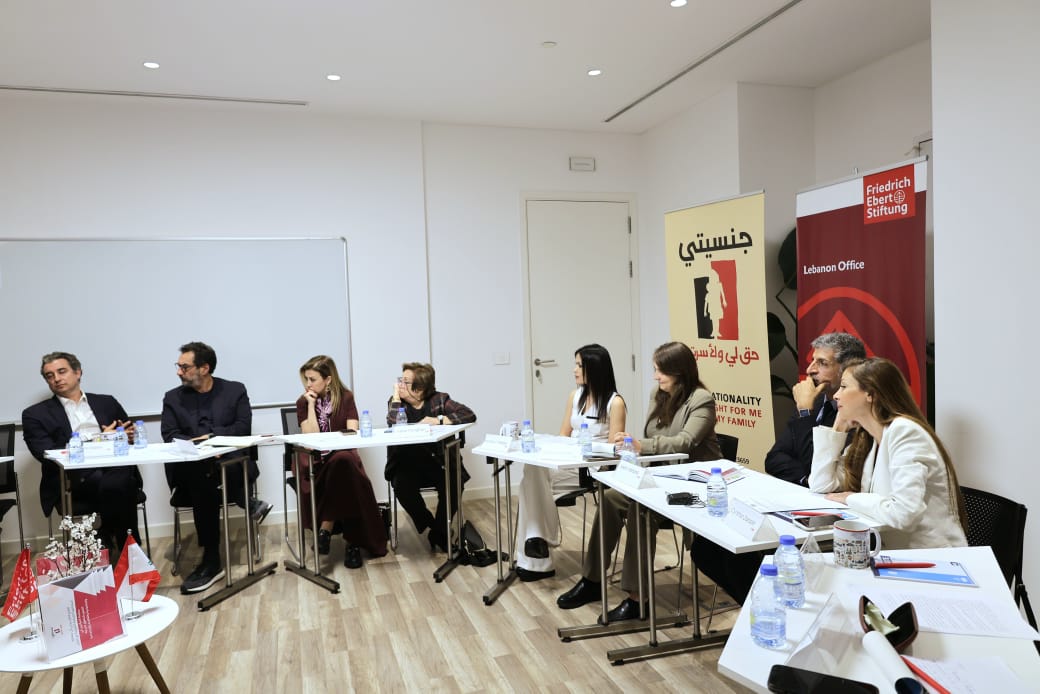
View of the meeting that brought together parliamentarians and activists regarding the nationality law. (Credit: provided by the campaign "My Nationality Is a Right for My Family and Me")






Several members of Parliament took part in a consultative meeting on Monday, organized by the "My Nationality Is a Right for My Family and Me" campaign, to promote a just and equitable amendment to the nationality law, which prevents Lebanese women from passing their nationality to their children and foreign husbands.
The meeting, held at the Friedrich Ebert Foundation offices in Beirut, aimed "to press for the inclusion of the proposed amendment [to the nationality law] under double urgency on Parliament's agenda," according to a statement. This amendment proposal was put forward last October by MP Cynthia Zarazir (Protest movement).
Zarazir, who attended the meeting on Monday, stressed the need "to remove this issue from the realm of political quarrels."
"This is a matter of fundamental human rights, and Parliament must treat it as a social and humanitarian priority," she said.
MPs Halima Kaakour, Wadah al-Sadek, and Marc Daou (Protest movement) were also present, alongside Karima Chebbo, director of the campaign, and several lawyers and civil society activists. MPs Ibrahim Mneimneh (Protest movement) and Oussama Saad (Popular Nasserist Organization) were represented by staff members.
Chebbo called for a unified discourse on human rights and for stepped-up joint efforts between parliamentarians, civil society and stakeholders in order to achieve a fair law that "reflects the values of equality that every Lebanese man and woman aspires to, guarantees justice for all, and allows for active citizenship."
"What unites today's participants is the deep conviction that nationality is a right and that justice is not achieved by exceptions or partial solutions, but through clear legislation guaranteeing full equality between women and men," she added.
Under the law, Lebanese women do not have the right to pass their nationality to children born to a foreign father, or to their spouse. Children born to a foreign father and a Lebanese mother are deprived of certain rights, particularly regarding education or employment and must obtain residency permits to live in Lebanon.
 Israeli army carries out demolition at Jabal Amel School in Houla as strikes continue