

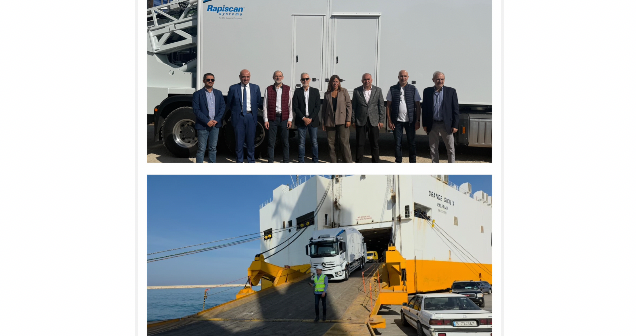
At the port of Tripoli, the operation to unload the scanner. (Credit: NNA)






NORTH LEBANON — The ship "Grand Sicilia" arrived Friday at the Port of Tripoli from Beirut carrying an ultra-sophisticated scanner aimed at modernizing customs inspections, boosting revenue, and enhancing security at Lebanon’s ports, the state-run National News Agency (NNA) reported.
The scanners aim to combat customs evasion, increase Treasury revenue, and guarantee the rights of port employees, are intended for inspecting containers and trucks for imports and exports. Upon the ship’s arrival, the device was unloaded in its designated area, under the supervision of port customs, administrative, and security services.
A similar operation took place Thursday for two of these state-of-the-art devices at the Port of Beirut.
The chairman of the board of the Port of Tripoli, Iskandar Bandali, vice-chairwoman Sara Charif, board member Simon Abdel-Massih, and port director Ahmed Tamer visited the port Friday morning at the site of the newly unloaded scanner.
CMA CGM executive director Charley Derzi presented the new equipment’s technical features, operational abilities, and service timeline.
Bandali emphasized that “the arrival of this machine constitutes a ‘qualitative and exceptional advancement long awaited,’” estimating that it “will take the Port of Tripoli to a higher level in terms of advanced security and customs standards, and will strengthen transparency, integrity, and governance in work mechanisms.”
He noted that “this achievement will consolidate the position and reputation of Lebanese ports regionally, as well as their commitment to meeting the highest safety and security standards.”
The acquisition, installation, and maintenance of these scanners, as well as the integration of their systems into port and customs operations, are the responsibility of the French shipping group CMA CGM, which already manages Tripoli’s container terminal and signed the contract for this new project in July.
“Every container entering or leaving the country will be subject to strict monitoring,” Transport and Public Works Minister Fayez Rasamny said while visiting the Port of Beirut.
“These new scanners can inspect up to 100 containers per hour, compared to only 40 per day with the current equipment,” said Finance Minister Yassine Jaber — which oversees customs, the authority responsible for inspection and control at the port — on Thursday.
He specified that “by processing just 50 to 60 containers, the gain is considerable, speeding up customs clearance and ensuring goods traceability.”
He also promised “the upcoming implementation of an artificial intelligence program to analyze and store the images for six months and send copies to destination countries.” Jaber and Rasamny had both visited the Port of Beirut during the day to examine the newly installed scanners.

 7 p.m. recap: Netanyahu seeks mastermind behind Flydubai incident; Washington sanctions 2 French nationals; Ben Gvir's 'I want to kill you' threat