



In the heart of the Sertão, young cowboy Taislan rides his motorcycle through the Catimbau valley. (Photo provided by Fred Jordão)






The photography exhibition "The Paths of a New Sertão" is on show at the Brazilian Cultural Center Guimarães Rosa until Dec. 5, on Mondays, Wednesdays and Fridays from 10 a.m. to 5 p.m., and Tuesdays and Thursdays from 10 a.m. to 8 p.m.
This is a story of barren lands and greenery, of modern times and history, of globalization and tradition, of wealth and poverty, of nomadism and rootedness. Contrasts that also intersect. It's a story of the Sertão, a region in Brazil's Northeast, the hinterland where rural life and technology meet without confrontation. A story told through 56 photos by self-taught Brazilian photographer Fred Jordão, who grew up between the sea and the reddish inlands, currently exhibited at Beirut's Brazilian Cultural Center Guimarães Rosa.
Where the light tames the drought
The Northeast of Brazil, both a political region and a defined natural territory, is a creation a little over a century old, shaped jointly by politicians, historians and artists. This "invention of the Northeast" has left behind the image of a barren land and a people subjected to endless suffering, submitted to both the violence and mysticism of nature.
The recurring droughts of the Brazilian semi-arid zone — made visible by the rise of press photography at the beginning of the 20th century — revealed cracked earth and gaunt faces, which soon came to personify the entire Northeast in the national imagination.
Exposed to climate change and technological evolution, it seems to find a way to reconcile opposing forces by adapting new technologies to a stripped-down way of life, notably with the spread of water reservoirs that counter drought; a lifestyle that escapes time and space.

Where the light meets humanity
Fred Jordão is captivated by these contrasting landscapes that have marked his gaze since childhood. His lens captures what he calls "the dignity of daily life." His photos radiate with a clear light and tell the slow transformation of a Brazil often forgotten, where traditions cling to the cracks of time.
"Brazil is a country flooded with oblique sunlight because of its position relative to the equator, and the Sertão, long reflecting an arid image, today dresses in colors that people crave and that my photos illustrate," says the artist, who emphasizes the importance of this region for the country’s future.
The exhibition The Paths of a New Sertão (Veredas de um Novo Sertão) is inspired by the literary heritage of João Guimarães Rosa, a physician and icon of Brazilian literature and diplomacy. His 1950s masterpiece, Grande Sertão: Veredas (The Devil of Guimarães Rosa to pay in the backlands), helped transform the Sertão into a space of journey, struggle, silence and mystery — a territory where human existence unfolds in all its epic and poetic dimension.
The original title refers to veredas, the small paths that cross over wetlands, forming a labyrinth network where a stranger can easily get lost and where there is no single path to a specific place. Every path interconnects in such a way that any road can lead anywhere. In short, escaping the other is impossible.
A Sertão of memory and metamorphosis
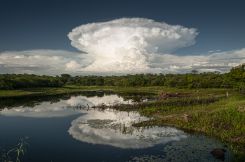
While the central lands feel the effects of agribusiness, the Northeast’s Sertão positions itself as a land of family agriculture and renewable energy. Despite these changes, the region preserves centuries-old traditions arriving from Africa and elsewhere — “the civilization of leather,” the work of small farms, unique rural architecture, leather clothing, and customs that welcome new techniques without being overwhelmed by them.
A link between past and future. An ecological lesson that Jordão advocates: "how to use the tools at our disposal while staying close to nature and simplicity," he explains.
Over the past three decades, Jordão has set out on the paths of this balance between the 21st-century world and the symbolic universe of the 20th. In his viewfinder: imagination, the fantastic, and a calligraphy that redefines the Sertão as a territory of light, color, and shape, where simplicity and harshness coexist with intensity and beauty.
"The country's metropolises and the Sertão have monopolized attention; it seemed important to me to shed light on this hinterland that calls us to our roots and its symbolism of resilience," says Jordão.
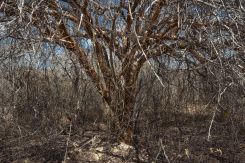
The Sertão, this expanse alternating between drought and lush green, is home to the Caatinga, a unique ecosystem changing with the seasons. Jordão explores there the visible and the invisible. Like the writer, he doesn't see the Sertão as a land of deprivation, but as a space of humanity, resistance and mystery — a place where life is invented according to the landscape.
Unlike the South, which abandoned the old Brazil in return for the material benefits of industrialization, the Northeast and "its peoples, who are primitive, have things to teach us in the process of modernization," confides Jordão.
His work, a kind of poetic cartography, lies on the border between reality and symbolism, where photography invites introspection and engraves the course of lives. Deeply attached to his region, Fred does not photograph to denounce but to understand: to understand how people inhabit drought, how beauty and harshness can rhyme, how memory is woven between dust and light.
In this Sertão, motorcycles have replaced horses, solar panels have risen among the cacti, but the blending of cultures persists, against a backdrop of a plural Brazil breaking with all stereotypes. "The Paths of a New Sertão" is more than an exhibition: it's an immersion in a land long believed to be frozen, a journey into deep Brazil, this Sertão which, in Guimarães Rosa's words, "is within us as much as it surrounds us."
A true visual treat, the exhibition can be discovered on a purely aesthetic level or reinterpreted in an intellectual dimension rooted in its literary connotation, making it accessible to all.
This article was originally published in French on L'Orient-Le Jour.
