


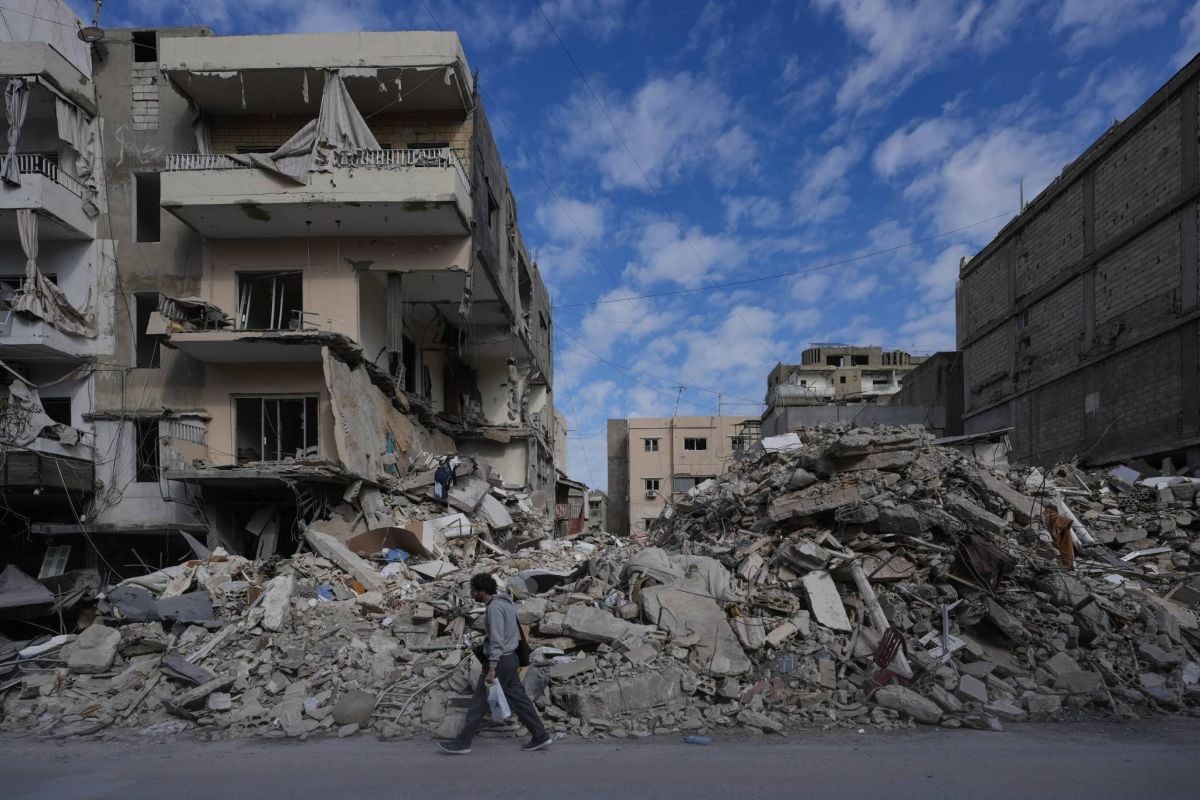
A man walks past damage caused by Israeli attacks in Tayr Debba (Sour), Nov.30, 2024. (Credit: Mohammad Yassin/L'Orient-Le Jour Archive photo)






SOUTH LEBANON — A World Bank (WB) delegation visited the southern Lebanese coastal city of Sour on Sunday to assess the damage caused by Israeli strikes, including a major hit on the local water station that has left more than 100,000 residents without reliable access to water. The international financial institution reaffirmed its commitment to help rehabilitate the critical infrastructure.
The delegation included 11 senior officials, among them Jean-Christophe Carret, director of the WB's Middle East division; Abdelaziz al-Mulla, the institution’s Middle East representative; and Enrique Armas, director of its Lebanon office.
"Despite ongoing Israeli aggression, the municipality of Sour, together with Civil Defense teams, the Islamic Mission Scouts Association [a rescue group affiliated with the Amal Movement] and first responders from the Disaster Management Unit of the Federation of Sour Municipalities, have ensured water distribution via tanker trucks until a temporary solution can be implemented after the war," said Sour Deputy Mayor Alouane Charafeddine. He noted the municipality is working with the South Lebanon Water Establishment, UNICEF and the International Committee of the Red Cross.
A temporary connection network with external water sources currently pumps about 5,000 cubic meters per day, compared with the destroyed station’s 14,000-cubic-meter capacity, Charafeddine said. The municipality also thanked the United Nations Development Programme (UNDP) for funding $840,000 toward partial reconstruction of the station.
The World Bank delegation said it plans to support damaged water stations across southern Lebanon, as part of its ongoing reconstruction program in the country.
Tarek Barakat, head of the regional branch of the South Lebanon Water Establishment in Sour, said "temporary" fixes have "partially restored the network," but capacity remains limited, particularly given the large number of displaced residents. Clashes between Hezbollah and Israel, which escalated from September through November 2024, have forced many southerners to flee their homes. And with many having lost their homes in Israeli attacks, several remain displaced.
Throughout the war, Israeli strikes have repeatedly targeted water infrastructure across southern Lebanon, leaving dozens of villages without access to clean water. In a report published last winter, the World Bank estimated that Lebanon suffered roughly $14 billion in damage and losses during the last war.

 7 p.m. recap: Netanyahu seeks mastermind behind Flydubai incident; Washington sanctions 2 French nationals; Ben Gvir's 'I want to kill you' threat