


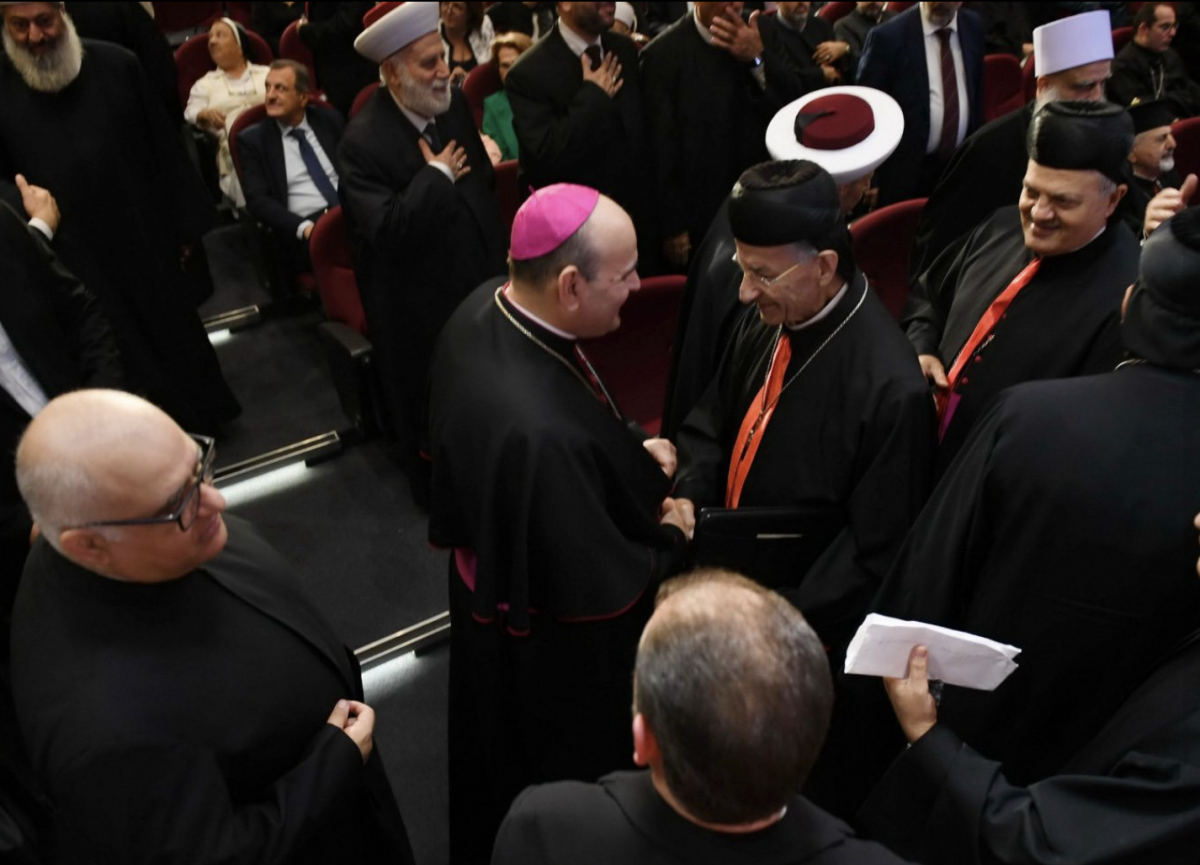
Maronite Patriarch Bechara Rai in Bkirki during a ceremony commemorating the 60th anniversary of the Nostra Aetate (‘In Our Time’) declaration, on Nov. 8, 2025. Photo published on the patriarch’s Facebook account.






Maronite Patriarch Bechara Rai declared on Saturday that the Catholic Church ‘’looks upon the Muslim religion with respect and esteem,’’ on the occasion of the 60th anniversary of the promulgation of the Nostra Aetate (‘’In Our Time’’) declaration by the Second Vatican Council in 1965. He noted that the declaration has found ‘’fertile ground’’ in Lebanon, even if ‘’the path remains long,’’ according to the official National News Agency (NNA). The Nostra Aetate declaration, whose third section is dedicated to Islam, marked a turning point in the Church’s relationship with other religions, calling for openness and dialogue with them.
The patriarch presided over the commemoration in Bkirki alongside Lebanon’s leading Muslim religious figures or their representatives: the Druze Sheikh Akl Sami Abi al-Mona ; the representative of the Republic’s Mufti, Sheikh Abdel Latif Deriane ; the Mufti of Tripoli and the North, Sheikh Mohammad Imam ; the representative of the Vice President of the Supreme Shiite Council, Sheikh Ali Khatib ; the Mufti of Sour and Jabal Amel, Sheikh Hassan Abdallah ; and the representative of the President of the Alawite Council of Lebanon, Sheikh Ali Kadour, along with Sheikh Ahmad Assi.
‘’The approval of this declaration reflects the Church’s advanced awareness of its mission, based on promoting unity and love among people,’’ the patriarch said in his speech. He recalled that ‘’the Church looks upon the Muslim religion with respect and esteem, as well as the many points it shares with Christianity: faith in one God, veneration of Christ and his mother Mary, and the spiritual treasures it contains.’’
According to the patriarch, ‘’Lebanon has been and continues to be fertile ground for the growth of the seeds of this declaration: the covenants and commitments of Islamic-Christian relations have been renewed here, increasingly framed within constitutional structures that reinforce the National Pact [1943] and consolidate coexistence between the Lebanese communities of both religions.’’
Cardinal Rai nevertheless noted that ‘’despite the spiritual progress inspired by the declaration and Lebanese initiatives highlighting the unity of its sons, Christians and Muslims alike, and their steadfast attachment to Lebanon, the path remains long.’’ He specifically pointed out that ‘’the absence of a national initiative to reconcile memories after the wars remains one of the main obstacles to building a state of citizenship, where all Lebanese share a common belonging.’’
He concluded by explaining that Saturday’s meeting is ‘’part of the Church’s historic role and its fidelity to Lebanon, the ‘country of the message,’ while also serving as a testimony to Islamic-Christian coexistence in its civilizational dimensions: living and walking together to build justice and peace,’’ and ‘’prepares for the upcoming visit of Pope Leo XIV to Lebanon.’’
Lebanon as a ‘’message,’’ reflecting its Islamic-Christian coexistence (particularly in political and institutional terms), is a phrase used by Pope John Paul II during his visit to the country on May 10–11, 1997. Pope Leo XIV is expected in Lebanon from Nov. 30 to Dec. 2, 2025, and will be the fourth pope to visit the country after Paul VI, John Paul II and Benedict XVI. During their visits, the three pontiffs emphasized in turn the necessity of cooperation between Christians and Muslims in Lebanon.
On their side, the Muslim dignitaries all stressed ‘’the importance of spreading the principles of the declaration regarding interreligious dialogue, and implementing them to strengthen Islamic-Christian relations and the experience of coexistence in Lebanon,’’ according to NNA.

 7 p.m. recap: Netanyahu seeks mastermind behind Flydubai incident; Washington sanctions 2 French nationals; Ben Gvir's 'I want to kill you' threat