





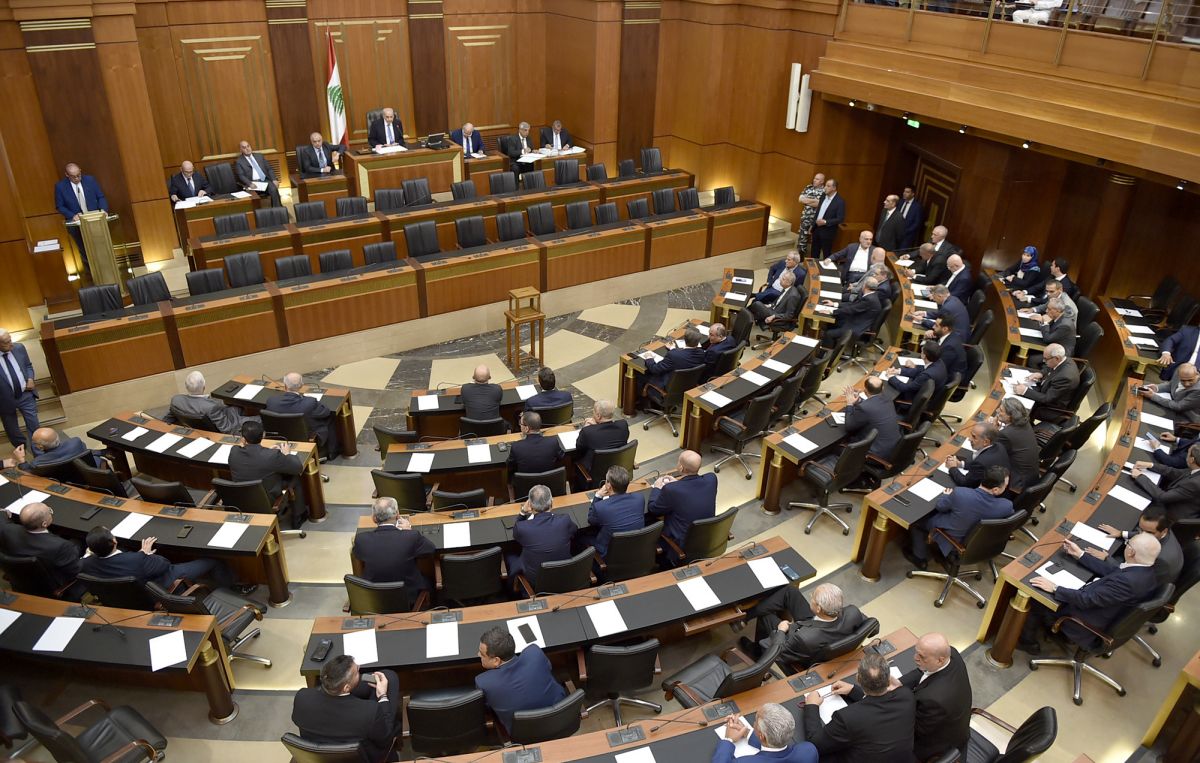
The Lebanese Parliament in session, Oct. 21, 2025. (Credit: Ali Fawaz/Lebanese Parliament)






The Lebanese Forces (LF) made their decision as early as Sunday night: Their MPs will not participate in Tuesday's parliamentary session, which is notably set to adopt an emergency assistance plan for Lebanon.
This decision was made by the Christian party after an "extraordinary" meeting in Maarab, to protest Parliament Speaker Nabih Berri's refusal to include the hotly debated issue of expatriate voting in the agenda for the upcoming legislative elections.
The LF asserted that attending the session would amount to "submitting to the tyranny" of Berri.
In its statement, the "Strong Republic" parliamentary bloc denounced Parliament as "a hostage in the hands of its speaker, who uses it as his private property."
"He opens and closes the doors of Parliament at his whim, decides what will be debated and what will be shelved," the group said, calling these practices a "coup against the Constitution, Parliament's bylaws and accepted customs."
‘Marginalizing the diaspora's voice’
Recalling that a draft law with double urgency — which must therefore be discussed directly in a plenary session without passing through committees — relates to the repeal of Article 112 of the 2017 electoral law, the group criticized Berri’s refusal to discuss it.
This article, which was not implemented in the 2018 and 2022 elections, provides for the addition of six parliamentary seats reserved for the diaspora, on top of the 128 MPs.
The LF and several allies are calling for its repeal so that expatriates can vote for the 128 mainland MPs.
The Amal-Hezbollah alliance and the Free Patriotic Movement (FPM) want it to be implemented as written.
The LF accuses opponents of amending the law of seeking to avoid a protest vote from the diaspora.
Their refusal to repeal this article, they say, aims to "marginalize the voice of expatriates."
According to the LF, Article 112 gives the six additional seats a "symbolic" value that does not reflect the "real weight" of emigrants.
"The government has itself recognized the impossibility of distributing these seats among continents and organizing valid elections" on this matter.
The Interior Ministry has launched preparations for the vote, and the Foreign Ministry has opened expatriate voter registration. The Foreign Ministry, run by the LF, has submitted a bill to suspend Article 112.
In this context, participating in Tuesday’s legislative session would amount to "submitting to the tyranny exercised by Nabih Berryi over Parliament," the statement added, calling on all MPs "not to legitimize the paralysis of Parliament."
On Thursday evening, the speaker said in an interview with Lebanese channel MTV that amending the electoral law was aimed at "isolating" the Shiite community in Lebanese politics, prompting criticism from some of his fiercest detractors.
‘Defending the Constitution’
The Kataeb party also announced that it would boycott the parliamentary session after a meeting of its political bureau.
The party condemned recent statements by Berri, who said that reintroducing the electoral law project aimed to "isolate a community," calling these comments "dangerous and unacceptable in both form and substance."
The party stated that "the right of hundreds of thousands of expatriate Lebanese of all faiths and regions to decide their country's fate is not sidelining anyone, but rather the fulfillment of the Constitution and equality among all Lebanese. Those trying to isolate a community from the rest of the Lebanese are those who reject the logic of the state and equality and cling to their weapons."
Several anti-Hezbollah MPs also said they would boycott the session, including Michel Moawad, who justified his decision as an "act of defense of the Constitution and the rights of Lebanese expatriates."
For her part, Najat Aoun, who comes from the protest movement, said she would not attend the session "in objection to the policy of paralyzing parliamentary life, the repeated refusal to put an urgent draft law on the agenda in violation of Article 110 of the rules of procedure, and the undermining of the will of the majority of MPs."
Lawmakers in favor of amending the electoral law have already boycotted legislative sessions twice, leaving the planned agenda pending.
That agenda notably includes opening a line of credit in the 2025 budget to finance salaries of retired public sector workers, as well as a bill regarding an agreement between Lebanon and the International Bank for Reconstruction and Development (IBRD) to implement the Lebanon Emergency Assistance Project (LEAP).
Several other bills and proposals, particularly on reforms demanded by donor countries, such as tax evasion and a review of the 2017 law on public-private partnerships, are also due to be debated on Tuesday.

 7 p.m. recap: Iran warns Egypt, Israeli soldiers vote in south Lebanon, Haret Hreik responds to Kataeb