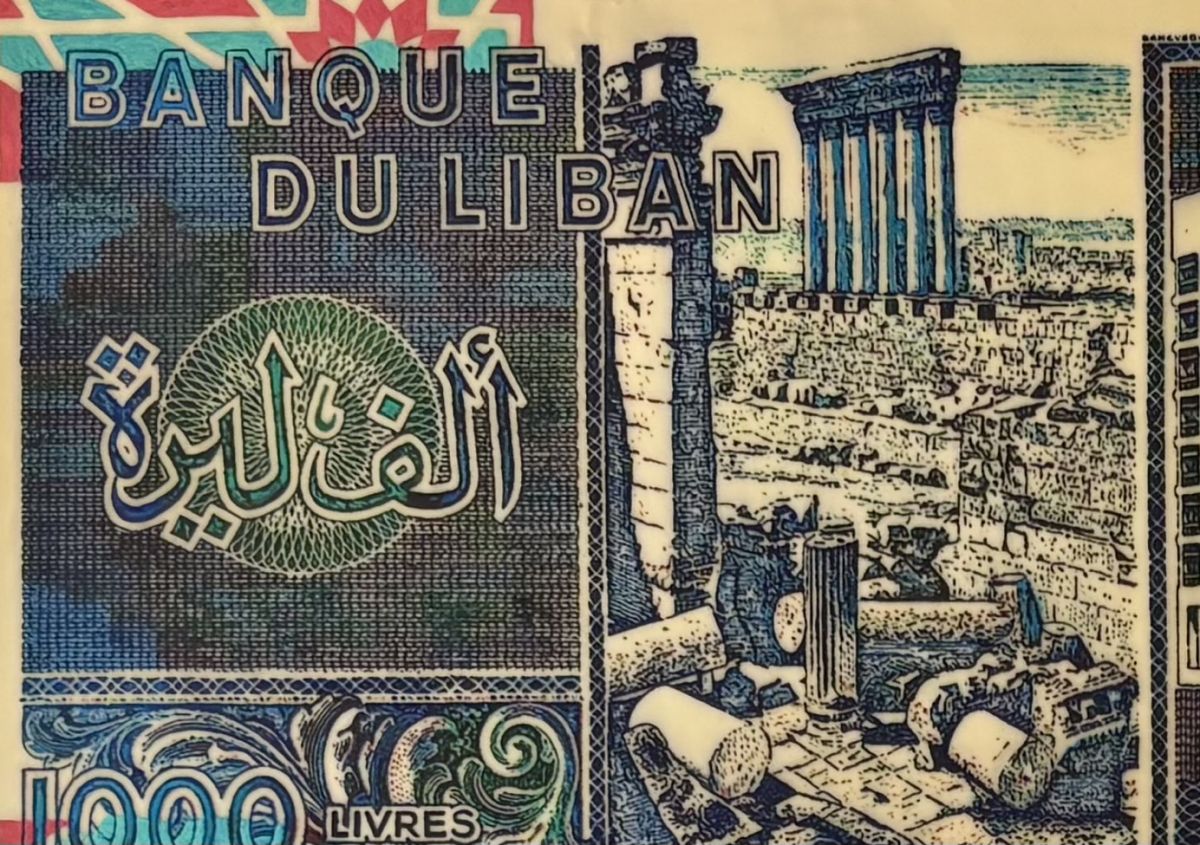
Detail of a decorative panel depicting the first version of the 1,000 Lebanese liras banknote, which began to be issued in the late 1980s, in the entrance hall of the main building of the Banque du Liban. (Credit: Photo by Philippe Hage Boutros/L'Orient-Le Jour)






Over the past six years, numerous experts and independent observers outlined potential plans to address the issue of tens of billions of dollars in deposits frozen by technically insolvent Lebanese banks since late 2019, one of the main symptoms of the country’s deep financial and economic crisis.
Garbis Iradian, chief economist for the Middle East at the Institute of International Finance (IIF) — an association representing more than 400 international banks — has recently joined the debate with a five-year plan.
His proposal centers on two rarely discussed options: using the country’s gold reserves and introducing a new Lebanese lira.
“This study has not yet been published by the IIF. It will be refined over the coming weeks, with publication expected by the end of November,” Iradian said. He maintains that his seven-pillar plan could enable the recovery of around $80 billion in old deposits — that is, funds frozen since the crisis and not classified as “fresh money” — by 2030.
The proposal is not meant to replace an International Monetary Fund (IMF) assistance program, which remains contingent on broader reforms and is seen as crucial for attracting foreign financing to support Lebanon’s recovery and the reconstruction of areas devastated by last year’s conflict between Hezbollah and Israel as well as the recurring cease-fire violations on behalf of Israel.
The plan also assumes the disarmament of Hezbollah and the establishment of a lasting peace with Israel as preconditions.
Gold reserves that have tripled
The first two pillars of the plan focus on leveraging the sharp increase in the value of Lebanon’s gold reserves, which have nearly tripled in six years due to the surge in global prices.
“As of October 2025, Lebanon’s gold reserves amounted to more than $37 billion, representing over 110 percent of the country’s projected 2025 GDP,” Iradian said.
“When combined with foreign currency reserves of $11.8 billion, Lebanon’s total official reserves rank among the highest in the world relative to GDP.”
Iradian finds it “incomprehensible” that Lebanon’s 286 tons of gold — the second-largest stock in the region after Saudi Arabia — have not yet been mobilized.

According to him, these reserves could “generate liquidity without increasing debt, serve as a buffer during crises, and restore confidence through a non-inflationary repayment mechanism.”
Iradian first proposes selling $14 billion worth of gold, or about 100 tons, in 2026. The proceeds from the sale would be transferred to commercial banks so they could repay small depositors through monthly installments spread over 12 months.
Iradian said this measure would allow the recovery of most deposits.
The second pillar would authorize the central bank, Banque du Liban (BDL), to place an additional $16 billion in gold abroad to generate a recurring return of 5 or 6 percent, or even 7 percent, to finance future obligations.
A lira worth 100,000
The third pillar is even more unusual, as it calls for a monetary reform involving the partial repayment of deposits in “new Lebanese Lira,” each equivalent to 100,000 old liras.
Integrated into a broader program supported byIMF that would include fiscal consolidation, restructuring BDL, inflation targeting and legal safeguards, the new currency would be introduced with clear convertibility rules and a public information campaign, the economist argues.
Once the new Lebanese lira is introduced, he calls for using it to pay out six billion dollars a year to depositors. This would amount to the “lirification” of $30 billion in deposits over five years if the exchange rate remains roughly stable, but with a currency backed by gold reserves and by an improvement in the balance of payments. Iradian believes these factors would be enough to persuade depositors to convert their original dollar deposits.
In theory, these first three pillars would allow the recovery of more than $40 billion in deposits over five years, nearly half of it in 2026. The remaining pillars, for the most part, draw on less original solutions.
New audit of the central bank
The fourth pillar calls for a campaign led by civil society to identify and repatriate $9 billion illicitly transferred abroad since 2019, often linked to politically exposed figures and insider networks.

The economist acknowledges that this would require international cooperation, asset-tracing agreements and strict judicial oversight.
Iradian deems it essential to carry out a new forensic audit of the central bank, more comprehensive than the one conducted in recent years by Alvarez & Marsal, along with another audit targeting the country’s commercial banks.
The fifth pillar focuses on improving the profitability of state-owned enterprises through partial privatizations and strategic partnerships that could generate about eight billion dollars over four years starting in 2026.
The sixth pillar aims to raise nine and a half billion dollars between 2027 and 2030 through several series of dollar-denominated government bonds called “diaspora Eurobonds,” with no further details provided on maturities or yields.
Iradian assumes that by then, the country will have already cleared part of its liabilities after defaulting on more than $30 billion in conventional Eurobonds in March 2020.
The seventh and final pillar relies on generating sustainable budget surpluses without increasing tax rates, through improved collection and efforts to combat tax evasion, a process already under way at the Finance Ministry in cooperation with the IMF.
This article was translated from L'Orient-Le Jour by Sahar Ghoussoub.