






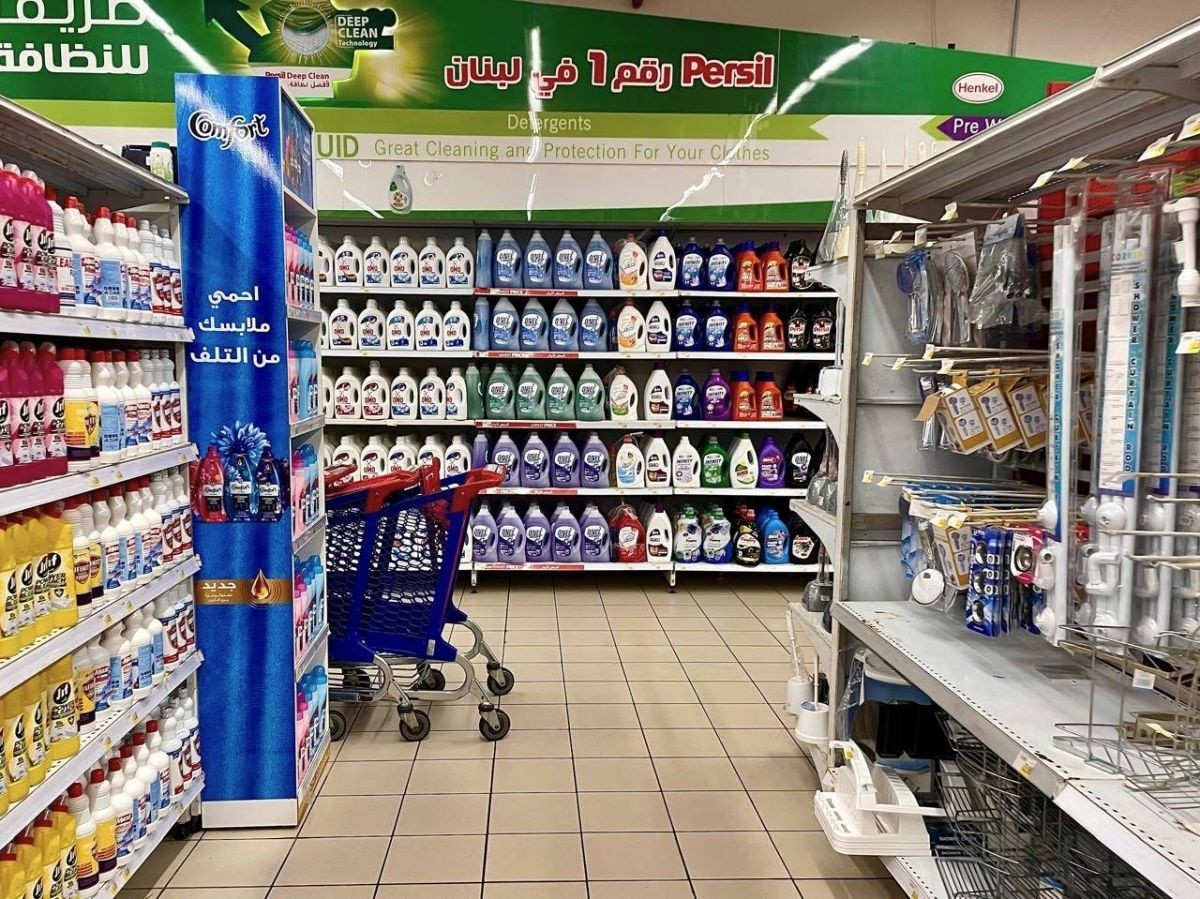
Inside a supermarket in Beirut. (Illustrative photo/P.H.B.)






President of the Syndicate of Food Importers Hani Bohsali said in a statement relayed by the National News Agency (NNA) that "what is being spread about significant increases in food prices does not reflect the reality of Lebanese markets."
"Reports published on food price inflation rates are inconsistent, including among international references. Some cite high rates that are not based on on-the-ground reality," he insisted, without citing specific numbers. He had conveyed this message for the first time late last week while speaking to the news site Lebeconomy.com.
Acknowledging that some prices have increased due to the strengthening of the euro against the dollar in recent months (trading between $1.15 and $1.20 per euro since June, according to market data), "as well as the rise in certain global food raw material prices and the sharp increase in operational costs in various sectors," he nevertheless assured that prices have not exploded as some media outlets suggest.

An article published earlier this month by the daily al-Akhbar reported a 21.4 percent rise in food inflation in Lebanon over the past eleven months, stating it was one of the highest increases recorded for any country during that period. The MTV channel, whose editorial line is diametrically opposed to that of al-Akhbar, also published at least two articles on its news site regarding price hikes, and in Monday’s article, cited the same figure attributed to the World Bank (WB).
"Annual food price inflation is about 20 percent, according to data from the Central Administration of Statistics (CAS). The World Bank uses these official figures. Neither the World Bank nor the IMF has its own estimates," Garbis Iradian, chief economist for the Middle East and Central Asia Department, explained to L’Orient-Le Jour.
The latest CAS figures cover the period up to the end of August, and the next update, covering September, is expected in the second half of October. According to CAS’s latest figures, the rise in Lebanon’s consumer price index slowed in August (+0.56 percent monthly), but remains high (+14.24 percent year-over-year). The sub-index measuring prices of food and non-alcoholic beverages rose by 3.40 percent monthly and 23.55 percent annually. In July, these rates were +2.33 percent and +21.88 percent, respectively. In June, -0.70 percent and 20.79 percent.
Bohsali, for his part, asserts that the market actually saw "a price increase between 1% and 3% during the summer, especially in July and August — two months of high tourist activity — which is perfectly normal and should not be exaggerated, as it results from temporary price pressures due to strong demand during this period."
"The syndicate closely monitors price hikes to avoid abuses by some retailers," he added, noting that "major brands and well-known companies do not engage in arbitrary price hikes; on the contrary, strong competition among them helps keep prices to a minimum." In principle, it is the Consumer Protection Directorate, attached to the Ministry of Economy, that is responsible for monitoring prices.
