





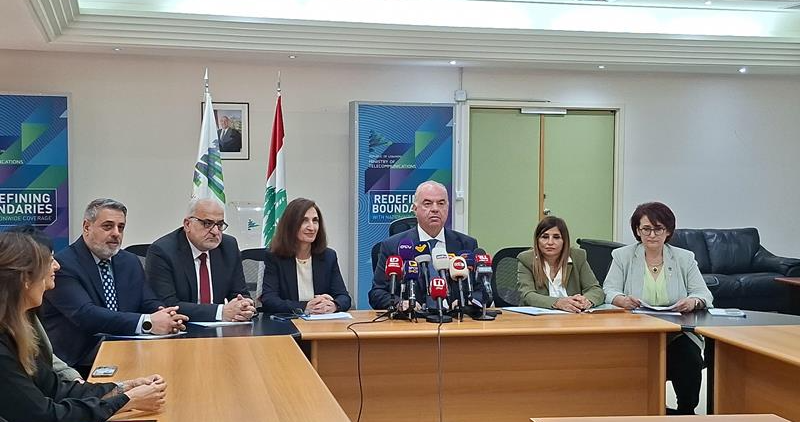
Telecommunications Minister Charles Hage, alongside members of the Regulatory Authority of the sector, on Oct. 6, 2025. (Credit: National News Agency)






Telecommunications Minister Charles Hage has officially launched the work of the sector's regulatory authority, whose members were appointed last month by the Cabinet after a period of more than 20 years of waiting.
This authority is the cornerstone of the 2002 law reorganizing telecommunications in Lebanon, aiming to improve governance and pave the way for the privatization of the sector. Its formation had been stalled largely due to sectarian rivalries. Members serve a non-renewable five-year term.
"Today, we are faced with an opportunity not to be missed. The task is vast and the challenges are many. The Lebanese have long awaited the return of authority so that it can restore balance, fairness, and competition in a sector dominated by the proliferation of unauthorized networks," the minister said.
Among the announced projects are improving access to the Internet at "fair and reasonable prices" through fiber optics, fixed wireless networks and satellites, in partnership with the private sector and plans for new undersea and land cables to improve the quality of communications in the country.
The authority's president, Jenny Gemayel, meanwhile, assured that it "is committed to working independently, in accordance with the highest standards of transparency, professionalism and respect for the law, in order to protect consumer rights, promote fair competition, encourage innovation, attract investments and ensure fair and balanced access to digital services throughout the country, without exception."
The Cabinet also approved, on Sept. 11, authorization for Starlink to provide satellite internet access across the Lebanese territory using satellites of the American company SpaceX, founded by Elon Musk. Until now, Lebanon has primarily relied on undersea and land cables for its internet connection, and internet distribution remains a state monopoly under Law No. 431 of 2002, which grants the Lebanese state exclusive internet rights and is handled solely by Ogero, as well as the Alfa and Touch operators.
The mobile network is shared between two joint-stock companies, MIC 1 (Alfa) and MIC 2 (Touch), which, since September and October 2020, respectively, have both returned to state management, having previously been managed by Egyptian operator Orascom since 2009 and Kuwaiti operator Zain since 2004. The public operator, Ogero, manages the fixed network.

 Evening recap: Netanyahu announces West Bank offensive; 7 killed in Jordan church shooting; tents burned in south Lebanon
 US strike on Iran this weekend? ‘Absolutely,’ says Barrack; ‘I have no idea,’ says Trump