


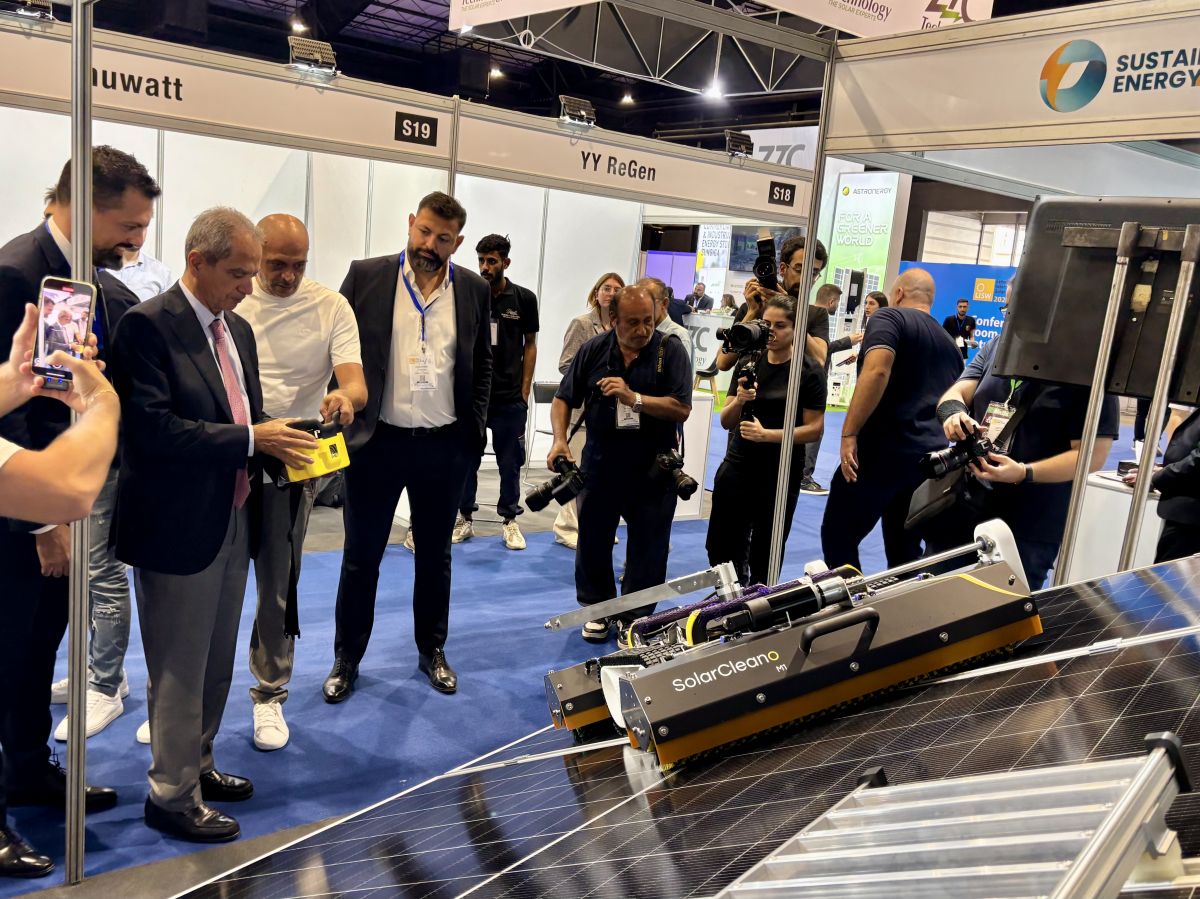
Energy Minister Joe Saddi operating a solar panel cleaning robot at the LISW exhibition in Beirut on Sept. 24, 2025. (Credit: Philippe Hage Boutros)






BEIRUT — Energy Minister Joe Saddi and Industry Minister Joe Issa-Khoury on Wednesday opened the third consecutive edition of the Lebanon International Solar Week, held at the Seaside Arena in Beirut through Friday.
More than forty exhibitors, mainly suppliers of photovoltaic installations and other related equipment, are present at this event to showcase the latest developments in a Lebanese sector that has radically changed over six years of economic crisis.
"Everything related to renewable energy is extremely strategic for Lebanon. We must continue to develop it, and the recent formation of the sector's regulatory authority will encourage investments on a larger scale," Saddi told L’Orient Today.
"Last year, the expo attracted 4,600 visitors, both businesses and individuals. We hope to do at least as well this year," said Elias Khoury, director of Promo Team, the event's organizer since 2022. Among the scheduled conference topics: microgrids, the impact of heat on photovoltaic panels, and the role of women in the energy sector.
Nearly all brands specializing in photovoltaic installations represented at the event are Chinese, but at least one Indonesian company is also participating. Over time, the systems have become more efficient and less expensive.

According to figures from the Lebanese Center for Energy Conservation (LCEC), installed capacity before 2021 stood at 100 megawatts (MW). It now exceeds 1,500 MW, not including solar water heaters — with actual output amounting to about a third of that total, due to the intermittent nature of production.
The vast majority of these installations are private and small-scale, but the state is working to encourage the development of larger solar parks. On Wednesday, Saddi signed power purchase agreements (PPAs) with French shipping giant CMA CGM, whose sister company Merit Invest had previously obtained three licenses to build solar farms of 15 MW each in Lebanon.
This signing revived a project that began in 2022 but was delayed by the crisis and security situation. Another project, however, remains stalled: The extension of the Beirut River Solar Snake (BRSS), which has yet to find a developer despite a call for tenders launched a year ago.

 7 p.m. recap: Sharaa in Riyadh; Qassem signals openness to cooperation; Ben-Gvir: ‘We demolish, again and again’