


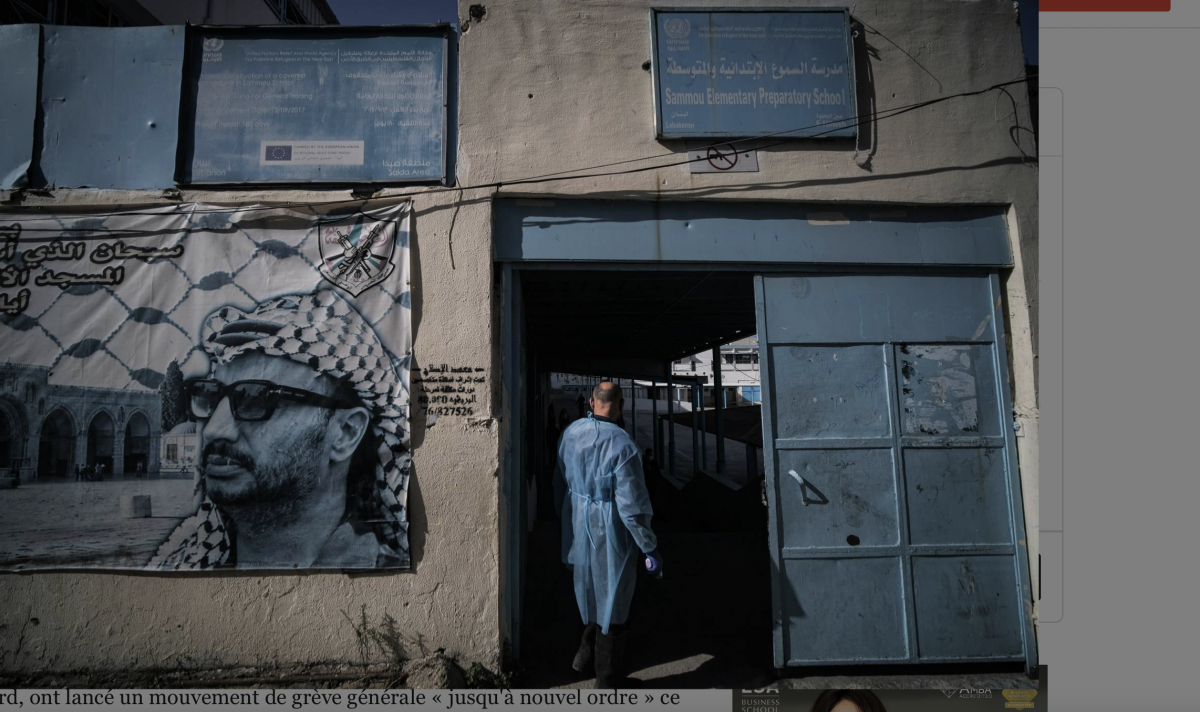
The entrance to a UNRWA school in a Palestinian camp in Lebanon. (Credit: João Sousa/L’Orient Today archives.






BEIRUT — As the strike continues in the Palestinian refugee camp of Beddawi in northern Lebanon, launched Monday to protest certain UNRWA services, the United Nations Relief and Works Agency for Palestine Refugees, held a meeting Wednesday between Ramez Dimashkieh, president of the Lebanese-Palestinian Dialogue Committee, Dorothee Klaus, director of UNRWA affairs in Lebanon, and teh Interior Minister Ahmad Hajjar.
Hajjar, to “follow up on key issues related to the situation of Palestinian refugees in Lebanon,” according to the state-run National News Agency (NNA).
The meeting addressed, in particular, the issue of issuing biometric identity cards, as well as the fees related to legal and judicial procedures. Dimashkieh emphasized “the importance of ongoing coordination with the Interior Ministry and Municipalities to improve the living conditions of Palestinian refugees at all levels.”
At the beginning of June, the director of the Lebanese-Palestinian Dialogue Committee, Nadine Marouk, told L’Orient Today that Palestinians currently have “cardboard documents that can be easily forged,” and that efforts were underway to replace them with biometric identity cards.
'Ongoing indifference to demands'
On Wednesday, the camp residents announced in a statement “the continuation of the closure and open-ended strike at all UNRWA facilities in the Beddawi camp, except for health services, in the face of ongoing indifference to the demands of our population, the continued marginalization by UNRWA management, and the irresponsible behavior of its representative.”
The statement said the strike would continue “until legitimate demands are met, first and foremost the division of classes based on 40 students per class,” calling on residents to “join the movement and act collectively to claim the rights denied by UNRWA management.”
On Monday, residents also denounced “overcrowded classes” and called for the reversal of a decision to increase the number of students per class to 50, when “the ceiling had previously been set at 43 by agreement with the Palestinian teachers’ union.”
That ceiling was judged “excessive,” given the “small size” of classrooms. Other demands of the strikers include medical transfer procedures for patients and social affairs.
The strikers added that the agency administration was shifting “unjust American and Zionist pressure being exerted on UNRWA” onto Palestinian refugees inside Lebanon, especially in the camps, instead of “finding practical solutions and working to build an alternative network of international support.”
For its part, UNRWA sent a statement to L’Orient Today emphasizing that its essential services remain operational “despite its critical financial situation.” According to the statement, “there has been no reduction in health services” and “26 medical centers across Lebanon continue to provide free, general and specialist consultations, as well as essential medicines.
Regarding the education sector, UNRWA stated that “temporary arrangements have been put in place at a school in Sour, bringing together students from two institutions into a single building, solely to ensure that no one is left behind and that all students can continue their education without interruption, while the Agency works to secure a new school facility.”
“Textbooks, school supplies, and other essential materials have been secured, and their distribution to schools is already underway,” the statement continued, adding that “UNRWA schools in Lebanon are preparing to reopen and welcome more than 37,000 students (the total number of students served by the agency across the country) for the 2025/26 academic year.”
“These essential services continue despite the Agency’s severe financial crisis, as it manages its budget on a month-to-month basis while intensifying fundraising efforts to keep its schools open and health centers operational,” the statement concluded.
Refugees also have access to subsidized hospitalization in 32 partner hospitals,” the agency added. As for education, UNRWA said “the agency’s schools in Lebanon are preparing to reopen and welcome more than 37,000 students for the 2025/26 school year.”
It is not uncommon for Palestinian refugee camps to resort to strikes to voice their opposition to UNRWA decisions. In February, Palestinian refugees closed UNRWA centers, offices and schools in various camps in Lebanon, including its main headquarters in Beirut, in response to what they described as the organization’s indifference to their demands regarding the “arbitrary” suspension of five teachers since October 2024.

 1 p.m. recap: Salam in Nabatieh; up to 10,000 more US troops heading to Middle East