


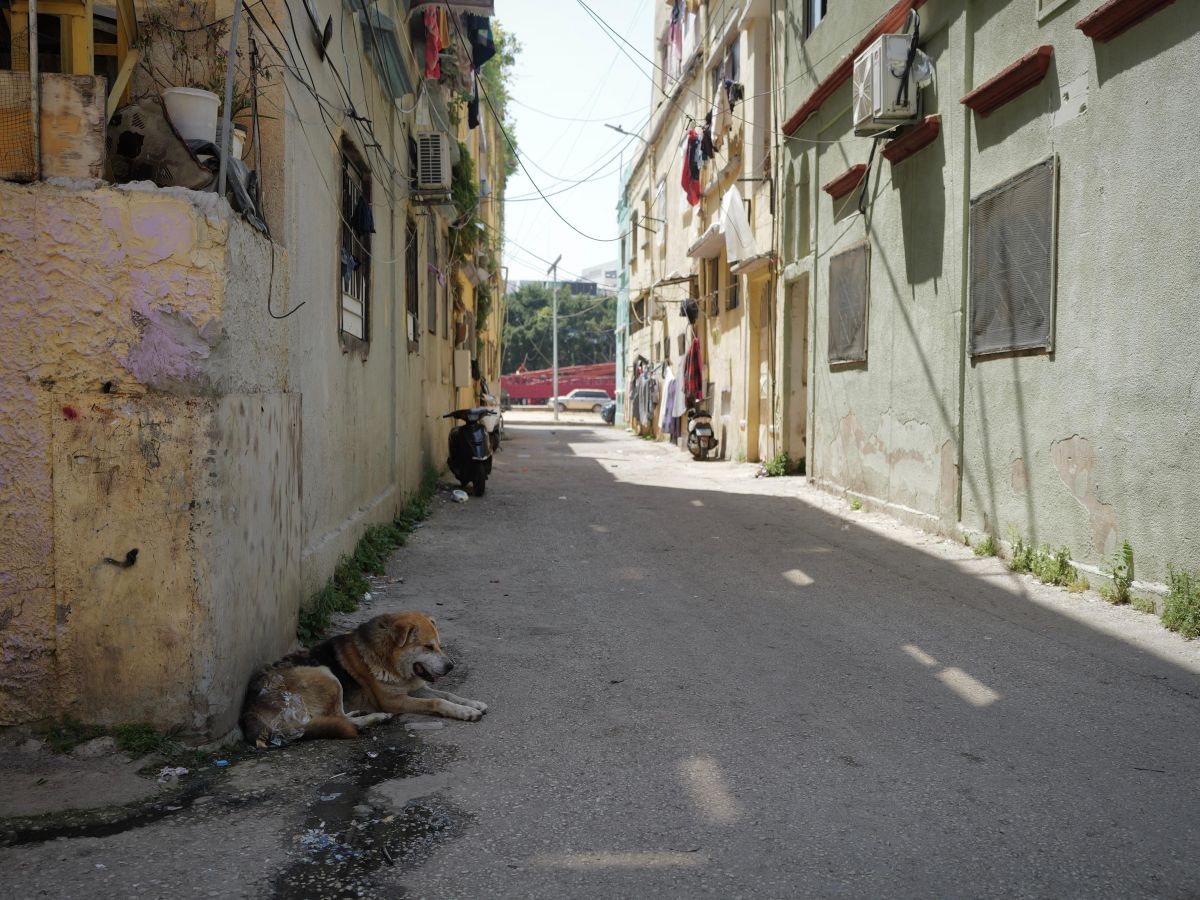
A street in the Karantina district, at the northern entrance to Beirut, June 4, 2024. (Credit: Matthieu Karam/L’Orient Today.)






BEIRUT — On Wednesday, MPs Melhem Khalaf and Najat Saliba, born of the protest movement, urged government action over the storage of 150,000 tons of asbestos-contaminated waste in Beirut’s Karantina district.
These concerns are shared by the World Bank, which put in place a program in 2022 to address this waste.
In a letter sent to the cabinet of Nawaf Salam, shared on Khalaf's X account, the two MPs sounded the alarm over "the ongoing storage of 150,000 tons of waste contaminated with carcinogenic asbestos" at the so-called "Bakalian" site. This land, owned by the municipality, is named after the nearby Bakalian flour mill buildings, in the same neighborhood. The site is used to sort waste and debris resulting from the twin explosions of Aug. 4, 2020, at the Port of Beirut.
A 'direct threat' to residents of Beirut’s suburbs
The two MPs recalled that these materials, "scientifically classified as hazardous and carcinogenic, remain piled up at the site and pose a direct threat to residents" of Beirut’s suburbs, due to the presence of asbestos particles, a group of fibrous minerals used to reinforce and fireproof materials, which are carcinogenic.
In this context, they demanded to know what measures and timetable the government has regarding this issue, calling for the organization of a "health screening" program for affected residents. "The presence of these materials, in such quantities, in the heart of the capital, constitutes an environmental and health time bomb," they warned, demanding a response from the executive within 15 days.
The World Bank launched in 2022 the "Beirut Critical Environment Recovery, Restoration, and Waste Management Program." According to a World Bank document published last May, the project aims to "support immediate environmental control measures in response to the impacts of the Beirut port explosions in August 2020 and to plan for longer-term environmental restoration efforts in the city of Beirut."
As part of this project, initially funded with $10 million, the World Bank has devoted an initial section to the "Bakalian" site and the "safe management of the 150,000 tons of asbestos-contaminated rubble" stored there, which constitutes, according to the institution, a "threat to the health and environment of neighboring populations."
The World Bank had recommended "in situ" elimination of the contaminated rubble, in a special "cell," but this option was rejected by the Beirut municipality — which was not immediately available for comment on Wednesday. As an alternative, the World Bank said a quarry site had been identified for the safe disposal of the rubble in coordination with the Environment Ministry, without specifying the location. So far, according to the World Bank document, the details of this option have not been finalized. This should be completed by the end of October.
The twin explosions at the Port of Beirut, caused by the storage of hundreds of tons of ammonium nitrate without adequate safety measures, killed at least 235 people, wounded thousands more — some of whom still bear the scars — and destroyed entire neighborhoods of the Lebanese capital.

 7 p.m. recap: Netanyahu seeks mastermind behind Flydubai incident; Washington sanctions 2 French nationals; Ben Gvir's 'I want to kill you' threat