





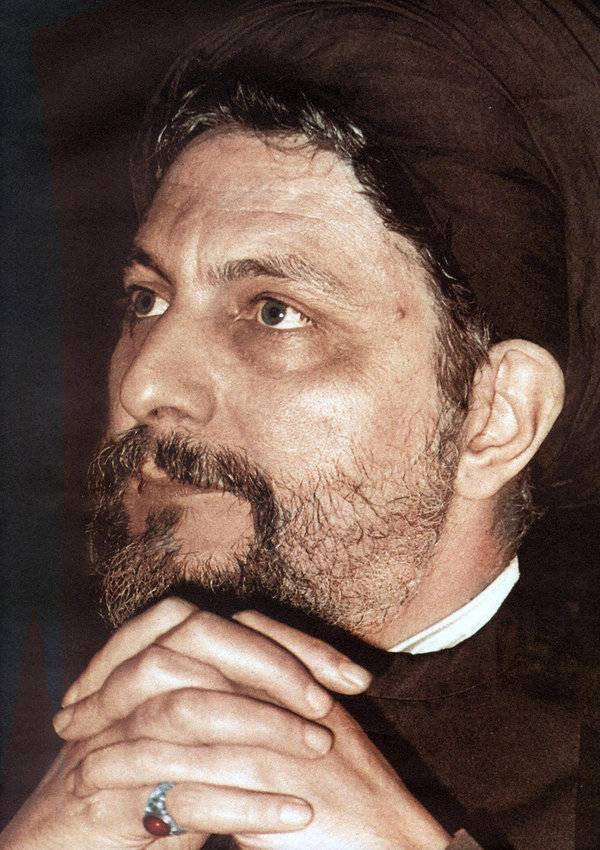
Lebanese Shiite figure Musa Sadr. (Credit: AFP/File photo)






BEIRUT — A new investigation by the BBC used "deep face recognition" on a 2011 photo taken by an investigative journalist in a secret morgue in Libya's Tripoli.
The results, according to the British public broadcast's article published Tuesday, strongly suggest that the body in the photograph could be that of Lebanese Shiite cleric Musa Sadr, who disappeared in 1978 during a visit in Libya.
These conclusions were however rejected by Sadr's family and the Amal movement that he founded in Lebanon.
Sadr, a prominent religious and political figure who founded the Amal Movement in the 1970s, vanished after being invited by then Libyan leader Muammar Gaddafi. Libyan authorities at the time claimed he had flown to Rome, a statement widely discredited.
In its report, the BBC interviewed former Libyan justice minister Mustafa Abdul Jalil, who said that on the second or third day after Sadr’s disappearance, they falsified his papers, claimed he went to Italy, and killed him inside Libya’s prisons. He added that Gaddafi had the first and last word in all decisions.
Lebanese-Swedish investigative journalist Qassem Hamadeh, who traveled to Libya shortly after the fall of Gaddafi’s dictatorship in 2011, says that he saw 17 corpses. "Only one resembled Sadr,” he said, noting the man's “unusually tall” height and facial features similar to Sadr, who was 1.98 meters tall.
“The person looked executed,” Hamadeh said, describing what he believed was a skull injury, either from a blow or a gunshot, above the left eye. Hamadeh said he photographed the body and collected hair samples, which he later handed to senior officials in the Amal Movement for DNA testing.
However, no results were released, and Lebanese judge Hassan al-Shami, assigned to investigate the case, told the BBC that Amal officials claimed the sample was “lost due to a technical error.”
In March 2023, a BBC team attempted to revisit the morgue location with Hamadeh in Tripoli. Hamad identified a building near a hospital as the location, but after filming the exterior and requesting access, the team was detained the next day by men later identified as Libyan intelligence agents. The journalists were held in solitary confinement for six days and released following international pressure from the U.K. government.
To further examine the photo, the BBC submitted the image to a team at the University of Bradford in the U.K. The group used “deep face recognition” software that compares facial structures, even in degraded images. The comparison between the morgue photo and four verified images of Sadr returned a match score in the 60s. A score over 70 is considered a direct match. In the 60s, it is likely to be him or a close relative. Additional tests against six images of Sadr's relatives and 100 unrelated Middle Eastern men produced weaker results, with the comparison to Sadr’s own photos remaining the strongest, the BBC explained.
Sadr’s family and Amal reject the conclusions
However, both Sadr’s family and the Amal Movement reject the conclusions. His son, Sadr al-Din al-Sadr, told the BBC that “it is obvious” the corpse in the photograph is not his father. He said the image contradicts other information the family has received since 2011, indicating that Sadr may still be alive and detained in Libya. The BBC noted that it found no evidence to support this claim.
Elements of the media's investigation, including the image analysis and Hamadeh’s morgue testimony, have been dismissed by Amal officials, who maintain that the person shown in the photograph does not resemble Sadr. The BBC contacted the office of Parliament Speaker Nabih Berri, the current head of the Amal Movement, for comment, but received no response.
Each year on Aug. 31, Amal commemorates the disappearance and reiterates demands to know Sadr’s fate. On Sunday, Lebanon marked the 47th anniversary of the incident. President Joseph Aoun reaffirmed the state’s commitment to uncovering the truth. One of the theories explored in the Sadr case is that Iranian hardliners may have influenced Gaddafi to eliminate Sadr, alarmed that Sadr was about to obstruct their objectives for the Iranian Revolution. the BBC recalled.
According to Iranian affairs expert Andrew Cooper, Sadr’s moderate political stance threatened the Islamist goals of Iran’s revolutionaries in 1978.
Libya remains fragmented between rival administrations and armed groups. Its intelligence services reportedly retain elements loyal to the Gaddafi regime, many of whom may oppose efforts to expose the truth about Sadr’s fate.
Human Rights Watch recently called for the release of Hannibal Gaddafi, the son of Muammar Gaddafi, who has been held without trial in Lebanon since 2015. Lebanese authorities accuse him of concealing information related to Sadr’s disappearance, even though he was only two years old at the time. Hannibal was kidnapped at the Syrian border and later detained by Lebanese security forces.

 Evening recap: Netanyahu announces West Bank offensive; 7 killed in Jordan church shooting; tents burned in south Lebanon
 US strike on Iran this weekend? ‘Absolutely,’ says Barrack; ‘I have no idea,’ says Trump