






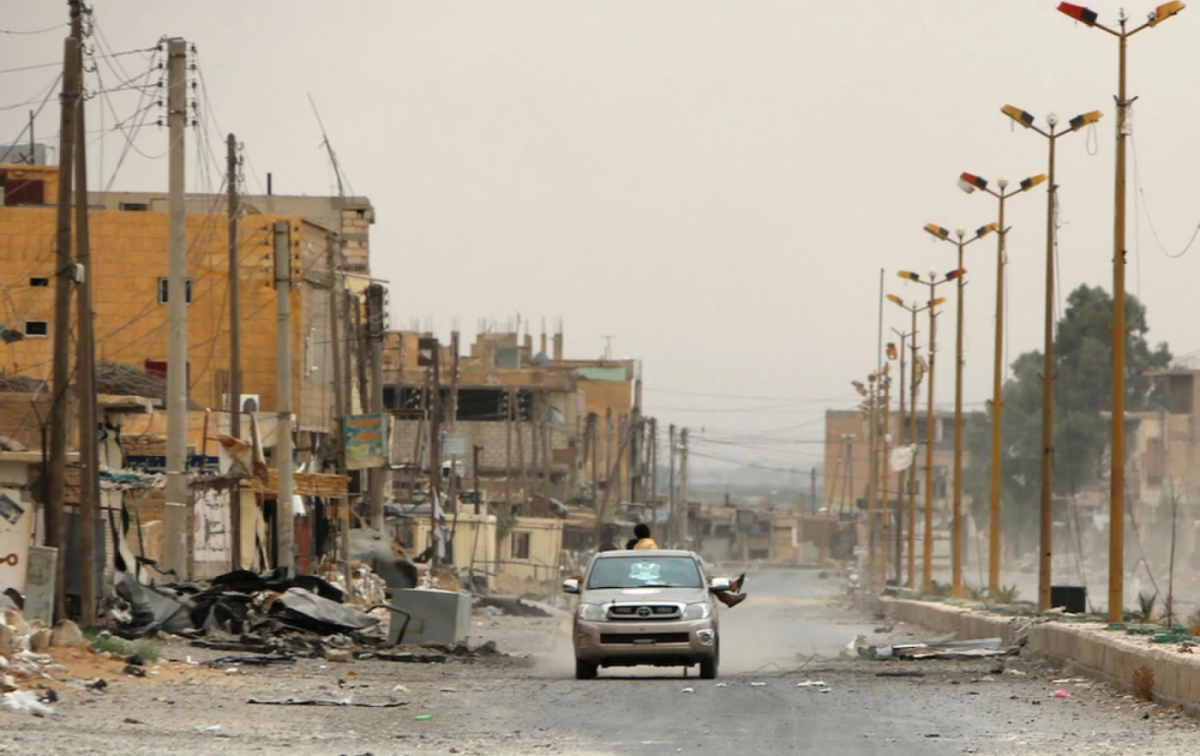
A car drives along a damaged street on the outskirts of Deir al-Zor, Sept. 24, 2017. (Credit: AFP)






The International Atomic Energy Agency (IAEA) has found traces of uranium in Syria during its investigation of a building destroyed by Israel in 2007, which the agency had long suspected of being an undeclared nuclear reactor, it said Monday in a report to member states.
The government of former Syrian President Bashar al-Assad, now ousted, had claimed that the Deir al-Zor site, where the building once stood, was a conventional military base.
The IAEA concluded in 2011 that the building was "very likely" a secretly built reactor that Damascus should have declared to the agency. Since then, the agency has sought to reach a definitive conclusion and, as part of a new initiative launched last year, it was able to take environmental samples from three unidentified locations "that were believed to be functionally related" to Deir al-Zor, according to a confidential report.
The agency found "a significant number of particles of natural uranium in the samples taken from one of the three locations. Analysis of these particles indicated that the uranium is anthropogenic in origin, that is, it was produced as a result of chemical processing," the report said.
The term "natural" indicates that the uranium was not enriched. The document does not conclude as to the meaning of the traces found. "Current Syrian authorities have indicated they have no information that could explain the presence of such uranium particles," the text notes, adding that the government allowed the IAEA to access the site again last June to collect additional environmental samples.
During a meeting that same month between IAEA Director General Rafael Grossi and Syrian President Ahmad al-Sharaa, "Syria agreed to cooperate with the Agency in full transparency, in order to shed light on its past nuclear activities," the report continues. Grossi requested Syria's help to return to Deir al-Zor "in the coming months to conduct further analyses, access relevant documentation and interview individuals involved in Syria's past nuclear activities."
The report states that the IAEA still plans to visit Deir al-Zor and will evaluate the results of environmental samples collected at the other site. "Once this process is completed and the results are assessed, it will be possible to clarify and resolve the outstanding safeguards issues related to Syria's past nuclear activities and close the file," it concludes.
