






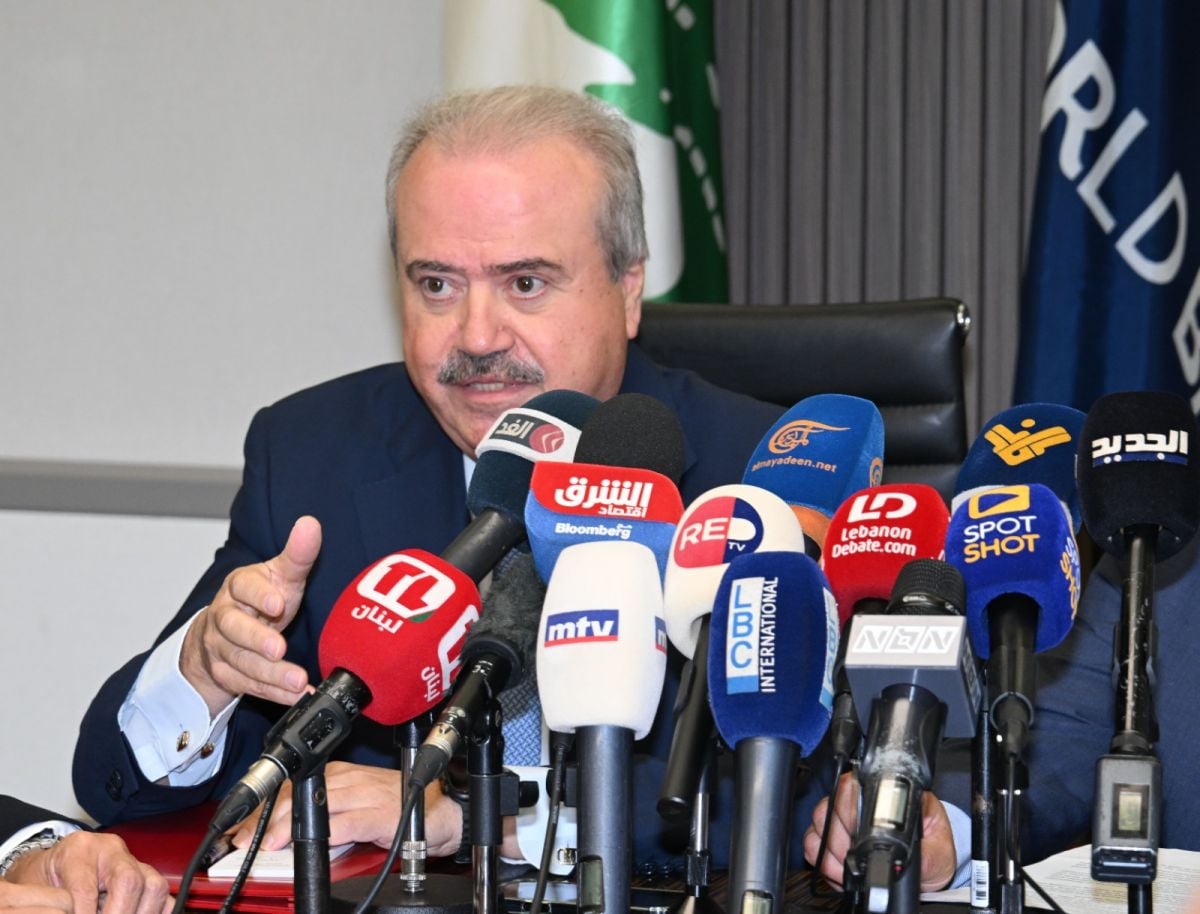
Finance Minister Yassine Jaber, at the ministry, on Aug. 26, 2025. (Credit: Finance ministry.)






BEIRUT — Lebanese Finance Minister Yassine Jaber announced Monday in a televised interview with Al-Hadath, the content of which was relayed by Al-Arabiya, that part of the deposits frozen in Lebanese banks since the crisis at the end of 2019 "can only be returned in the form of securities," thus indicating that the government is favoring the bail-in method to resolve the issue.
"No banking system can return depositors' money all at once," he stated.
Bail-in is a method of internally rescuing banks, where depositors agree to forgo a portion of their deposits in exchange for a stake in the struggling bank. This solution is rejected by some banks and large depositors, who are pushing for a bailout — that is, when the institution is rescued by the state — arguing that the crisis is systemic.
The banking system has been paralyzed since 2019 due to a solvency problem for some and a liquidity problem for others, leading banks to unilaterally and outside the legal framework restrict tens of billions of dollars of clients' foreign currency deposits. Authorities looked the other way, and only since the formation of Nawaf Salam's government earlier this year has Lebanon made some progress on the reforms urged by its partners and the International Monetary Fund to clean up the country's liabilities and get the banking system back on its feet.
Following the banking secrecy law adopted in April and the law setting the framework for bank resolution passed this summer, the government and then Parliament must now agree on a bill organizing the distribution of losses — and thus the question of deposit repayment — among the state, the central bank, and the banks.
This law on restoring financial balance and returning deposits could "be ready before the end of the year," said Secretary General of the Association of Banks in Lebanon, Fady Khalaf, on Aug.25. The banks and the central bank have hired consulting firms in anticipation of potentially tough negotiations over deposits and other assets held by the country's banks with the central bank.
In 2020, Lebanon defaulted on paying its Eurobonds, worth over $30 billion, a little over $5 billion of which is held by the central bank, with the remainder shared by Lebanese banks and private investors — some of whom arrived after the beginning of the crisis.
Al-Qard al-Hassan and the monopoly on weapons
Meanwhile, Jaber emphasized that the central bank is currently seeking to resolve "the issue of the al-Qard al-Hassan foundation," a microcredit organization affiliated with Hezbollah. The branches of this institution, already under U.S. and several Gulf countries' sanctions, are accused of funding Hezbollah's operations and were targeted by Israeli strikes last autumn.
In mid-July, the central bank reminded licensed financial institutions that they are prohibited from any direct or indirect contact with this foundation, reiterating an obligation in principle imposed since the first round of U.S. sanctions in 2007. Last July, the U.S. State Department imposed new sanctions on seven senior officials and one entity linked to al-Qard al-Hassan.
On the political front, Jaber, a member of the Amal movement's quota — a Hezbollah ally within the government — said he would attend Friday's Cabinet meeting, aimed at approving an army plan to restore the state's monopoly on weapons and disarm the militia party. Jaber had previously distanced himself from Hezbollah and Amal regarding this plan, openly expressing support on Aug. 12 for the arms monopoly.