


The musical residency “Sonic Sessions” by Tashattot is intended as a laboratory of ideas, a sound factory where notions of identity, exile and memory are redefined. (Credit: Maryan Sayd)






Three Lebanese diaspora members reunited in Belgium, motivated by the same desire: to create a shared memory from exile. In Ghent, Charbel Khoury, Rami Moukarzel and Gaelle Khalifeh founded the collective Tashattot — a name that, in Arabic, means "dispersion" — as both a poetic and political way to respond to the scattering their generation has faced.
Their artistic journeys, cultivated in Lebanon through photography, music and performing arts, led them to a simple, fundamental goal: to unite creative voices from the diaspora and give them a space for dialogue, creation and resonance.
"We try to recreate in Europe an artistic scene similar to what we had known in Lebanon," said Charbel — a lively, transgressive scene, vibrating with stories and plural identities.
Article not published.
First crossing
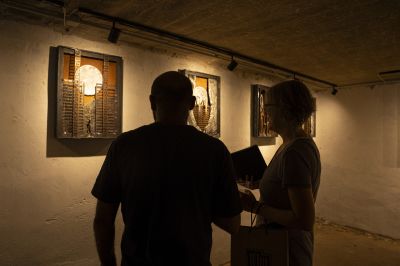
Their first exhibition, opening in January 2022 at the KIOSK art center on the Ghent university campus, marked the beginning of this collective journey.
Funded by the university, the event brought together about 15 artists from the Arab world living in Europe over a span of two months, focusing on themes of exile, memory and belonging.
The works, which include photography, experimental video and sound installations, didn’t just explore distance; they examined what it really means. What does it mean today to be scattered? What do we hold on to, and what do we reinvent when we leave?
Since then, Tashattot has kept building connections. Faithful to its founding principle — to create a space for others and never focus on itself — the collective has become a part of Belgium’s cultural scene as a powerful force, increasing collaborations with both local and international organizations.
One of its flagship projects is the musical residency "Sonic Sessions," with the second edition scheduled between 2025 and 2026. This cycle, successfully launched in 2024-2025 in partnership with Globe Aroma and Ancienne Belgique, features electro-experimental artists from the SWANA region (South West Asia and North Africa).
Far from just a simple musical project, the residency aims to be a laboratory of ideas, a sound factory where notions of identity, exile and memory are redefined.
Here, music becomes a shared language and a sense of kinship. It considers politics, explores narratives and reshapes the understanding of self in the context of both personal and collective history.
Breaking silences
In 2026, a new exhibition will take place at FOMU (Fotomuseum Antwerpen) in Antwerp.
The collective will explore questions of gender and sexuality in the Arab world. These topics are still often silenced, and the invited artists will address them with strength and nuance.
With Tashattot, exile isn't just something from the past; it turns into a lively present, a changing space of exchanges and interconnected stories. In dispersion, people search for and create a common language, and art remains its steady anchor.
This article was translated from L'Orient-Le Jour.

 7 p.m. recap: Netanyahu seeks mastermind behind Flydubai incident; Washington sanctions 2 French nationals; Ben Gvir's 'I want to kill you' threat