





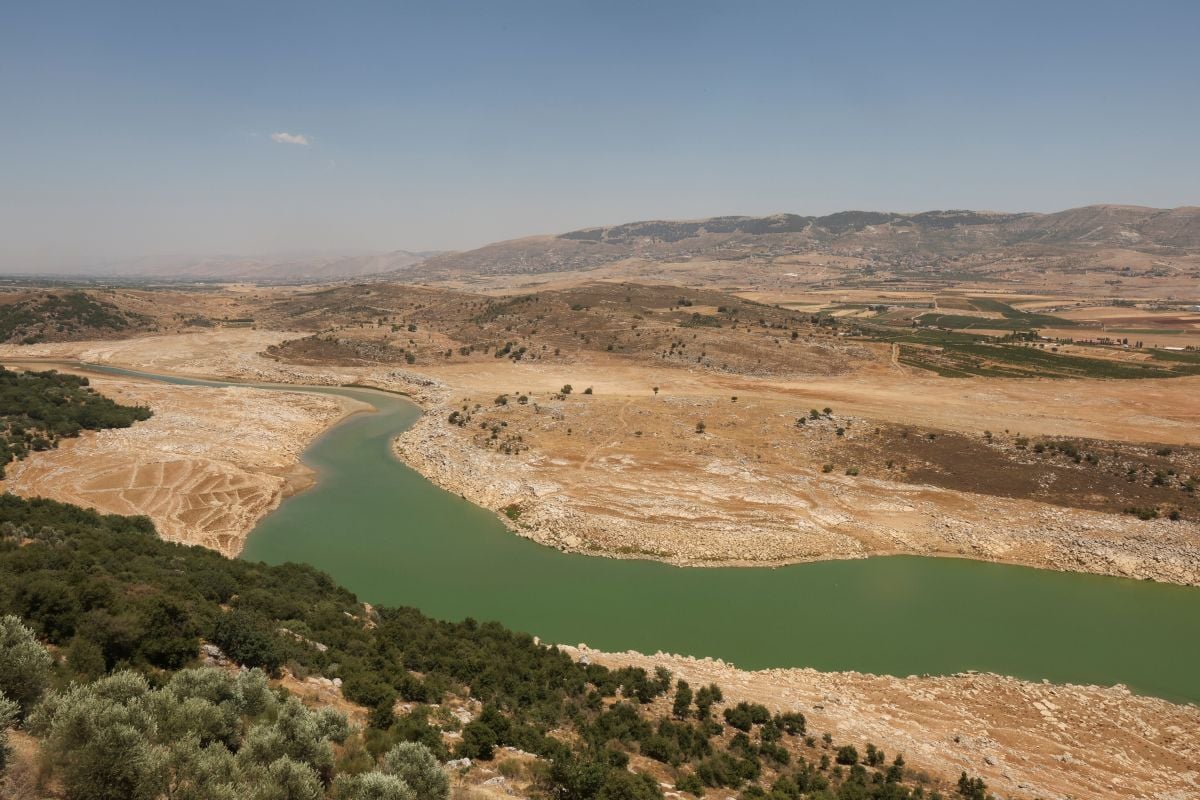
Lake Qaraoun, the largest reservoir in Lebanon, near the village of Qaraoun, Lebanon, July 9, 2025. (Credit: Aziz Taher/Reuters)






The director of the National Litani Authority, Sami Alawieh, told Reuters on Monday that there is a "water shortage in all regions and water basins in Lebanon." Water levels at Qaraoun Lake, the largest natural reservoir in Lebanon, located on the Litani River, have dropped to "historically low" levels, which he warned threaten agriculture, electricity generation and the supply of drinking water.
The National Litani Authority also stated that inflows to Qaraoun Lake during the 2025 wet season did not exceed 45 million cubic meters— a fraction of the annual average of 350 million cubic meters. Last year, the figure was 230 million. "There were drought years in 1989, 1990 and 1991, but this year is the driest," Alawieh said. What’s more, "the water currently available in Qaraoun Lake — about 61 million cubic meters — is unusable due to severe pollution," he added.
Hydroelectric power plants connected to the Litani basin have been shut down, the official noted, which has resulted in financial losses and exacerbated the electricity rationing imposed by the public supplier, Électricité du Liban. "Two factors are in play: lower rainfall and pressure on underground aquifers," he explained. Supply in some areas has also been reduced from 20 hours to 10 hours per day. And in the fertile region around the village of Qaraoun, in the Bekaa plain, farmers are already feeling the impact, the investigation reveals.
Suzy Hoayek, adviser to the Energy and Water Ministry in Beirut, announced the upcoming launch of a national campaign in 10 days to raise awareness about reducing consumption. "The most important thing is to manage demand," she said, as quoted by Reuters.
Meanwhile, Environment Minister Tamara al-Zein said on June 10, during the opening of the "Weaving Fever" exhibition at the National Litani River Authority Center, that she had "spoken with the agriculture minister about the issue of water and the shortage affecting agriculture, the environment and tourism," according to our correspondent Sarah Abdallah. Al-Zein added that they discussed the "repercussions [of the drought], including fires," which have been frequent in Lebanon lately.
Qaraoun Lake is not the only body of water affected by the shortage following Lebanon’s 2024-2025 winter: Available resources in other regions, including the Shabrouh Dam in Faraya, are also dwindling this summer.

 7 p.m. recap: Iran warns Egypt, Israeli soldiers vote in south Lebanon, Haret Hreik responds to Kataeb