





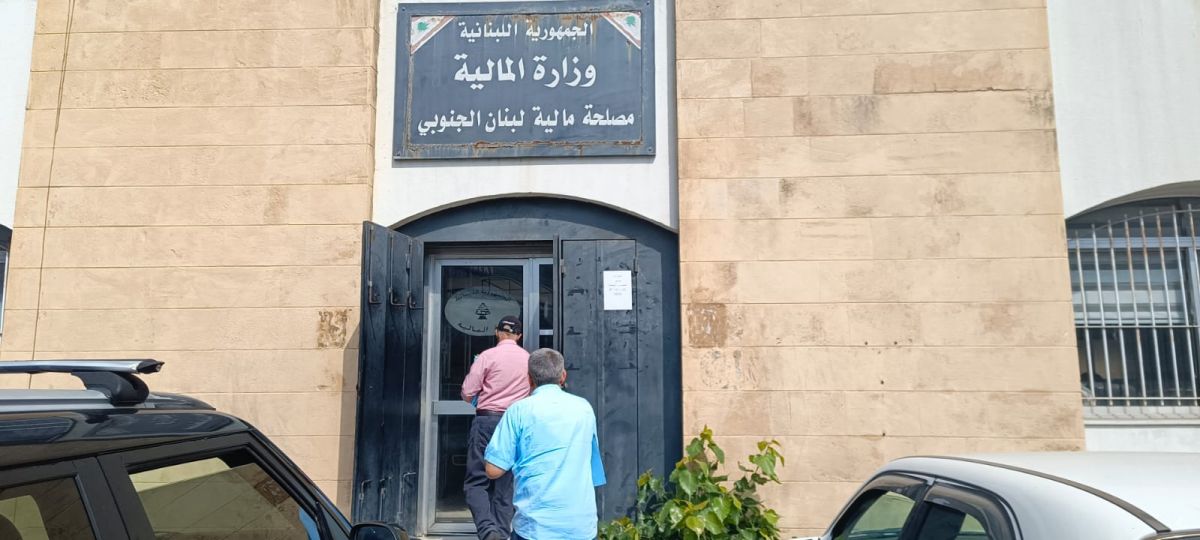
The office of the Ministry of Finance in Saida, July 14, 2025. (Credit: Mountasser Abdallah.)






BEIRUT — The general strike launched by the League of Public Administration Employees, joined by the Committees of Judicial Assistants, was not unanimously observed across Lebanon on Monday, according to the state-run National News Agency (NNA).
Employees from various administrations had staged a work stoppage from July 1 through 4, a move that was relatively respected throughout Lebanon. Last week, a new two-day strike extended the mobilization.
The Committee of Civil Servants of the State Employees' Cooperative announced a total work stoppage for Thursday, July 17, 2025, as a show of support for the general warning movement. This action came as “the suffering of employees and beneficiaries has reached its peak, without any serious signs from the authorities of a willingness to correct this unjust trajectory,” the committee said in its statement.
“We affirm that this movement will bear fruit. It constitutes a first warning. If it is not met with at least a minimal response to our legitimate demands, all escalation options will be considered in the coming days, including an indefinite work stoppage,” the committee continued.
Judicial assistants' committees launch three-day strike
This unrest among public sector representatives follows, in particular, the Council of Ministers' signing of a decree last week approving a series of salary increases for a range of high-ranking officials, from 626.5 million Lebanese pounds ($7,000) to 805.5 million LL ($9,000) per month.
The Committees of Judicial Assistants, for their part, announced in a statement a total work boycott on Monday, Tuesday, and Wednesday, during which “all activities will cease in the judicial registries, except on the last day of legal deadlines, which will be handled.”
This decision was made “in response to the policy of blatant discrimination” and the “deliberate disregard practiced by the authorities towards public sector employees, following the meeting with the labor minister,” since “the Lebanese government has never cared about the suffering of the civil servant,” they explained.
They added that this boycott is only a first step in a series of escalating measures to come if the government persists in its humiliating policy of favoritism and seasonal bonuses granted only to certain administrations, while ignoring the fundamental rights of judicial assistants, who form the foundation of the judicial system.
Lack of coordination at the Saida Serail
At the Saida Serail, the disunity between the League and the Gathering of Administration Employees has compromised the momentum of the work stoppage for the past two weeks, according to our regional correspondent. This lack of coordination has resulted in contrasting scenes in the various services at the Saida Serail, with some departments partially active, others completely halted, or operating only at minimum service.
The Health Services chose to prioritize the continuity of care and the health security of citizens, while reaffirming their “adherence” to union demands. By contrast, employees in the local offices of the Industry and Agriculture directorates decided not to join the movement, considering it necessary to wait for “a common position between the League and the Gathering.”
The Social Affairs, Labor, Public Works, and Civil Status departments only handled emergencies, while the regional education directorate remained mobilized for the follow-up of official Lebanese baccalaureate exams. The cadastral office was awaiting a decision from headquarters, unlike the land registry which observed the strike, while still handling urgent matters.
The Environment administration and the inspection teams of the Economy Ministry observed the strike from their offices in support of the movement, as did the governorate employees. The Finance Department, on the other hand, was active this morning, following an internal decision supporting the Gathering's call to stop work every Wednesday, Thursday, and Friday.
Plunged into a severe economic and financial crisis since 2019, Lebanon has seen its national currency collapse, leading to an erosion of wages and purchasing power, while inflation has soared. Before the crisis, the minimum wage stood at 675,000 LL—about $450 at the official rate of 1,507.5 LL to the dollar. At the end of June, the Council of Ministers approved a 50% increase in the minimum wage, raising it to 28 million pounds ($312, a 56% increase), starting next month. But many unions also consider this increase insufficient.

 7 p.m. recap: Iran warns Egypt, Israeli soldiers vote in south Lebanon, Haret Hreik responds to Kataeb