






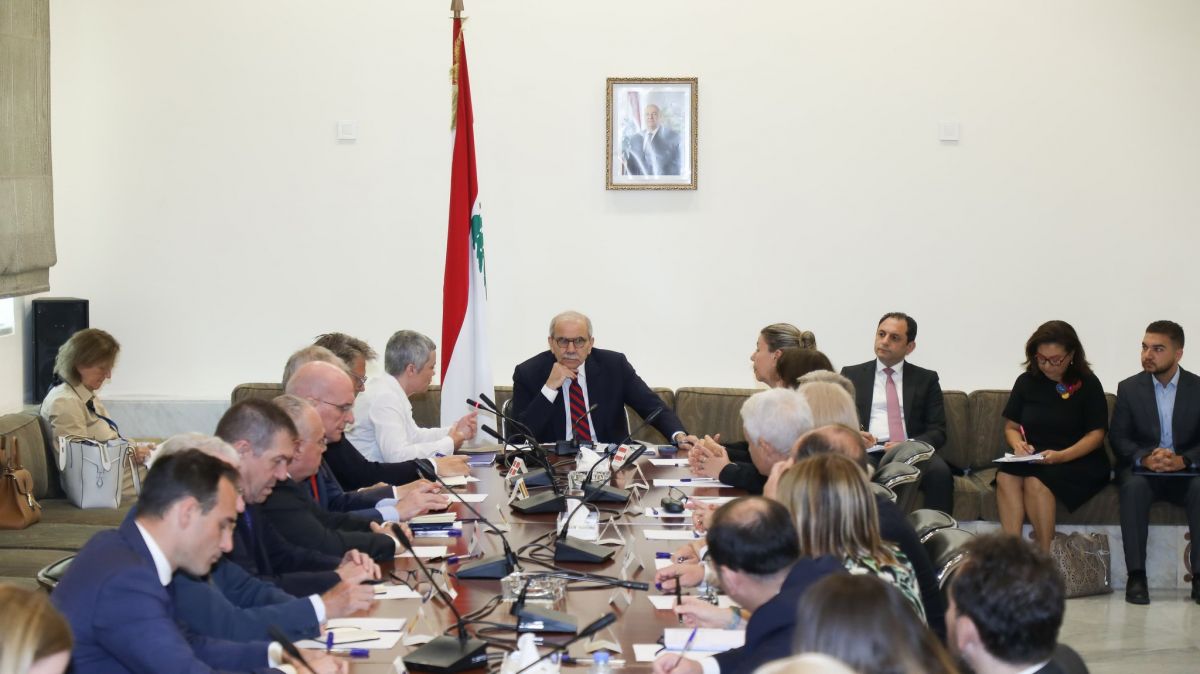
Prime Minister Nawaf Salam in a meeting with EU ambassadors on July 11, 2025. (Credit: Grand Serail)






BEIRUT — Prime Minister Nawaf Salam briefed European Union (EU) ambassadors on Friday on the ongoing reforms and what is expected to be implemented in the coming weeks and months, according to a statement released by the Grand Serail.
In a meeting with the ambassadors and in the presence of the EU Ambassador to Lebanon, Sandra de Waele, the prime minister emphasized Friday that the "state is continuing to extend its authority over its entire territory, as stipulated in the Taif Agreement and the ministerial statement."
On Thursday, President Joseph Aoun also received a delegation from the EU in Baabda, where he discussed many issues, including the security situation in Lebanon in the light of the cease-fire agreed in November 2024 to end the war between Hezbollah and Israel.
The disarmament issue takes center stage in Lebanese and international politics. U.S. envoy Tom Barrack visited Beirut this week to promote Washington’s “roadmap” for disarming Hezbollah.
Salam also praised Friday for the contribution of more than $600 million by the EU countries to the areas affected by the recent war between Hezbollah and Israel, saying that this "support is a key pillar to strengthen the resilience of the population and maintain stability."
Moreover, Salam stressed the importance of renewing the mandate of the United Nations Interim Force in Lebanon (UNIFIL) for an additional year, given its pivotal role in promoting stability in the south and implementing UNSC Resolution 1701.
Lebanon had officially sent a letter to the United Nations requesting the extension of UNIFIL's mandate for an additional year ending on Aug. 31, 2026.
For their part, the ambassadors reiterated the EU's firm commitment to supporting Lebanon. They emphasized their continued support for the reform process, particularly in the economic and financial spheres, as well as the independence of the judiciary. They also expressed their support for steps that facilitate the safe and sustainable return of displaced Syrians to their country.
More than six million Syrians have fled their country since the outbreak of the conflict in 2011, mainly to Turkey, Lebanon and Jordan. Lebanon, which hosts about 1.5 million Syrians for a population of some 4 million Lebanese, is the country with the highest number of refugees per capita in the world.
On Wednesday, Reuters reported that thousands of Syrian refugees are scheduled to return to their home country from Lebanon this week as part of the first U.N.-backed program offering financial incentives for their return.
