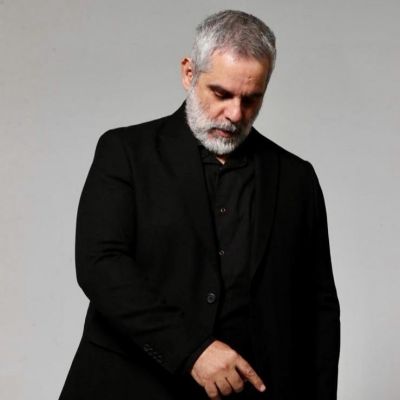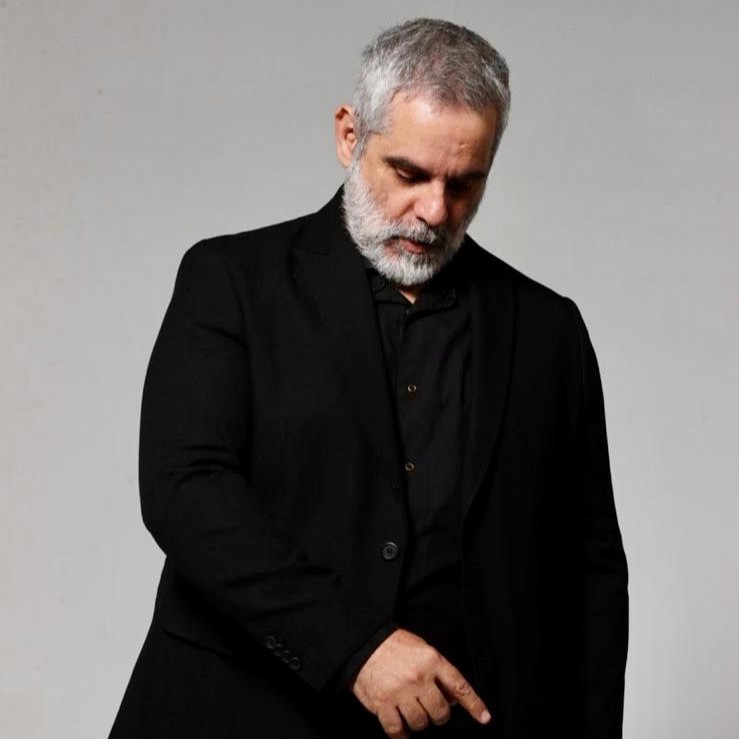
Joe Kodeih, the enfant terrible of modern Lebanese theater, has matured. (Credit: photo provided by artist.)






A slightly grayer beard, a slightly more serious look under red round glasses, but the same sharp mind, Joe Kodeih makes his grand return to the stage with his latest creation al-Ossa Kella (The whole story).
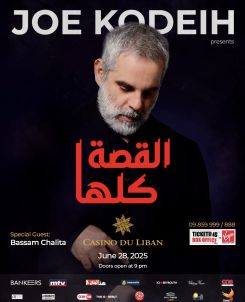
A solo performance he interprets this Saturday, June 28 at Casino du Liban (Lebanon Casino,) much to the delight of his fans and despite what his critics may say.
The author, actor, and director who had pulled back a bit in recent years for a multitude of reasons, which he will share if you attend his show, presents it as follows: "Five years of crisis, chaos, and comedy summarized in an 80-minute monologue sprinkled with musical interludes." In other terms, a play with "one man, one musician, and no filter," he declares.
Everything the Lebanese have endured
"It is actually a play in which I unfold both what the Lebanese have endured in recent years and what I have personally been through. I provide a brutally honest vision of life in Lebanon, while discussing my fears, desires, past, and outbursts [...] I am accompanied by Bassam Chalita on the piano, as I have staged it in the form of a visit to the psychiatrist, whose responses to my logorrhea are expressed through his piano playing. And of course, as always with me, it is all presented in a humorous and self-deprecating manner," reveals the man who has often played the entertainer to more effectively deliver his blunt truths on stage.

This is evident in his repertoire, which, without sparing himself, has long been exposing the societal flaws of his compatriots. From his Ana (Me), a play where he recounts memories of his youth as a troublemaker, to his big hit Hayet al-Jagal so3bé (Jules' Life is Hard), through JoCon (self-explanatory title) or even Abou al-Ghadab (key character of his hilarious chronicle of the war years), Kodeih has always managed to hold an amusing reflective mirror to his Lebanese audience.
This kind of convex or concave mirror that reveals your weaknesses without offending you.
In his latest creation, he also slips in excerpts from these four aforementioned plays. "This is the way I found to tell al-Ossa Kolla," he states. His entire story, in short, those key moments of his life narrated through this intertwining of subjects. And if this work signaled a major turning point?
For, over the past five years, the enfant terrible of modern Lebanese theater has matured. This comedian who trained under the guidance of Jalal Khoury has often hidden his classical theatrical culture under jokes considered sometimes too crude.
He used to add bawdy laughs and cheeky remarks to his plays, but now he has calmed down. He has taken the necessary step back to reflect on his journey. He has conducted a self-assessment, he assures. He also dedicated himself to writing a book titled "The Four Reasons" (Saer al-Mashrek Editions), a compilation of some of his plays. A task that has undoubtedly allowed him to separate the wheat from the chaff in his work.
Using humor to combat taboos
Having, as you might have guessed, gone through painful times, Kodeih now reveals much more of his reflective and emotional facets.
Although he has never shied away from addressing delicate topics, the comedian who claims to have absorbed the lessons of life has decided now to favor humor that serves to defuse traumas and change perceptions of certain taboos, "those linked to illness first," rather than merely poking fun at ridiculous situations.
And if this artist, a regular on Beirut stages, chose for his return to perform at Casino du Liban, "it is because this hall, with its mythical history, is the Mecca or the Vatican of every respectable Lebanese actor. I had never performed there before. I wanted to do it at all costs, if only for one night. It was now or never," he declares, with the passion of someone coming to (re)play his life.
"El-Ossa Kolla" by Joe Kodeih, this Saturday, June 28, at 9 p.m., at Casino du Liban. Tickets on sale at Virgin Ticketing.
This article was originally published in French by L'Orient-le Jour.