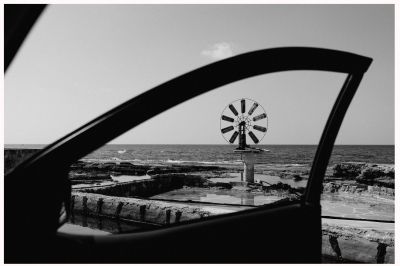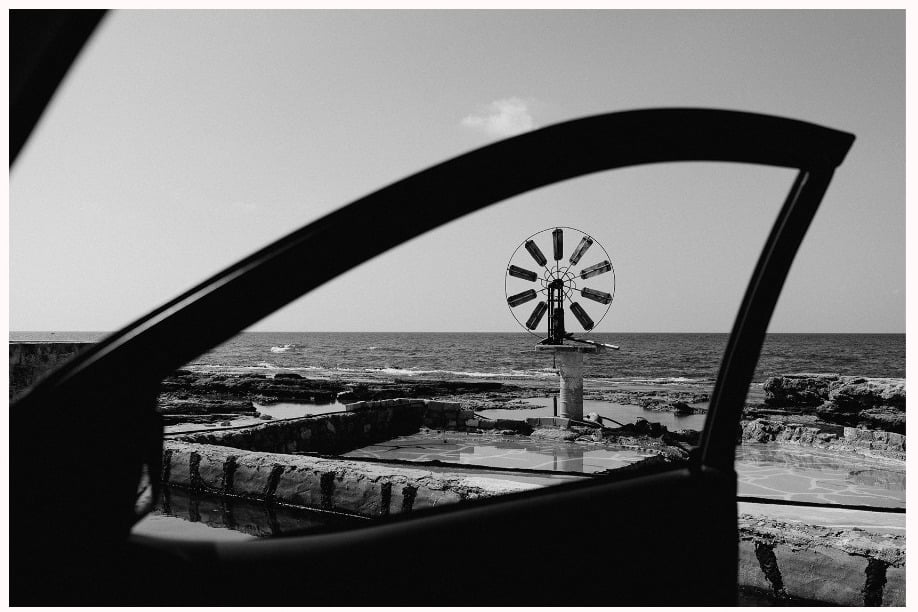
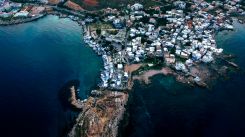
Anfeh, known for its archaeological site, complex of salt basins carved into the rock, its caves and its picturesque chalets painted in white and blue. (Credit: Pascale Feghali)






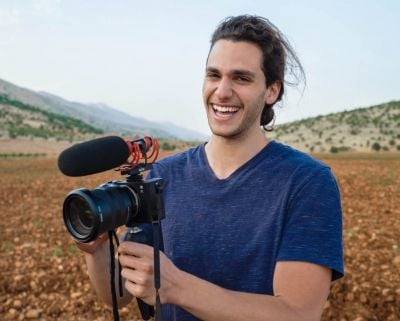
The Archaeological Museum of the American University of Beirut (AUB) will present on Wednesday, May 28, at 5:30 p.m. the 55-minute film "Hima Anfeh." It was directed by sociologist, anthropologist and filmmaker Pascale Feghali and Gabriel Ferneini, photographer and graduate in political science and international relations.
They stayed for three months in Anfeh on the north coast of Lebanon. Anfeh is known for its archaeological site, rock-cut salt basins complex, caves and picturesque white and blue-painted cottages, earning it the nickname "Greece of Lebanon." There, the "Hima Anfeh" model was introduced by the Society for the Protection of Nature in Lebanon (SPNL) and became a community initiative supported by the municipal council and the active engagement of residents. It was brought together with the assistance of archaeologist Nadine Panayot Haroun, director of the Archaeological Museum in AUB and initiator of Anfeh's archaeological excavations.
Cinema-vérité
As a lecturer at the institute of performing and audiovisual studies (IESAV) at Saint Joseph University of Beirut, an associate researcher at the French National Centre for Scientific Research (CNRS) and the University of Lausanne, Feghali was trained by one of the pioneers of the new wave of ethnographic cinema and promoter of 'cinema-vérité' Jean Rouch, whose working method she adopted. To explore the various aspects of human life, such as rituals, customs, beliefs and social structures, she uses the camera as a means of investigating, documenting and communicating of her research findings.
For the anthropologist filmmaker, art and science are more closely linked than one might believe. "The former is often associated with creativity and imagination; science is characterized by logic, observation and empirical evidence. But they share a deep connection that transcends their apparent differences," she said. It is with a "visual anthropological" approach that her camera focused on the daily life of the locality's residents, featuring archaeologist Haroun, who could easily brandish the slogan "We have excavated; here is your history."

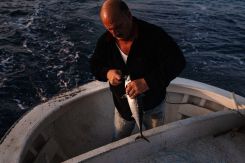
Between the generational know-how and the preservation of their cultural and natural heritage, the locals have rallied strongly around a common policy: "Hima Anfeh." The community includes Gergy al-Dayaa, a fisherman whom Feghali and Ferneini accompanied one night at sea to document his life, Johnny Semaan, artist-in-residence, Omar Jreige, architect and artist, Soumaya Merhi, entrepreneur, Imad Malek, salter at his salt shop, Lara Issa, vice-president of the municipality, architect Georges Sassine, passionate about caves and salt marshes, Mosbah Allawi from Tallet al-Ghir and an ancient windmill blacksmith Abou al-Ramah (90 years old), as well as Hafez Jreige, founder of the Salt Museum showcasing the history and traditional techniques of producing this 'white gold' that continues to shape local identity.
"Our objective is to capture man in his natural state, that is, to apprehend him in his psychological and social dimensions. We followed their rhythm and respected how they chose to tell their stories," said Feghali.
Legends and real stories
The narratives of the 'actors' offer a journey between past and present, where the imaginary and the real intertwine. "Because often stories are associated with legends," said the anthropologist. "Unlike verifiable historical facts," she added, "these legends, the veracity of which is often difficult to determine, may be based on real events, but distorted, or entirely imagined, while having a social and cultural function." Thus, the caves of Anfeh, natural cavities stretching along the beach for about two kilometers, are a home to myriads of legends, tales and oral traditions passed down through generations. This brings back to memory an elderly woman: "a cave once reserved for children deemed of small stature for their age. Swimming in this cavity would correct their growth disorders."
Another story reveals that the child's head had to be held by the ankles and dipped into the water. Another rock shelter called 'sheq' is considered the most important because it revealed a prehistoric dwelling. The land on which it is located belongs to architect Georges Sassine, who, since 2004, has been working on its rehabilitation into a museum dedicated to the tools used by man throughout the ages. In another underground cavity called 'al-kahf' [the cavern], the Sassine family celebrates on October 22 each year the memory of the first human groups that occupied it. Ber Saydeh, submerged, and the adjacent caves each have their own legend. But it matters little whether some stories are based on real events or on imagination or fiction: They enrich the unique character of the places.
Feghali is not new to documentaries. A specialist in the urban world, she has directed about 30 films in different countries — notably in Greece and Africa — where her husband, the Spanish ambassador Jesús Ignacio Santos Aguado, was stationed before being based in Beirut. Thus, she produces a report on the daily life of a neighborhood in Athens, and another about Malian refugees settled at the border of Mauritania, made for the United Nations. In Guinea, while walking down a street, she discovers young street jugglers whom she follows in their evolution, thus establishing a relationship of trust. "Their performance opened doors abroad."
But that's not all. In the 2000s, the anthropologist filmmaker lived in Ras Beirut, more precisely in Sanayeh, where four years of research and film exploration allowed her to render a vivid and vibrant portrait of the arts and crafts neighborhood: An itinerary of discoveries whose landmarks are the social practices of the residents, their use of space and their relationship to the place. The study, which combines text and film, was published in 2009 by "Les Cahiers de l’Ifpo" and prefaced by writer and intellectual Elias Khoury.
Memories of the soil
Anfeh, or Naufin from the time of the Crusades, continues to reveal its secrets. From 2010 until today, the excavations initiated and directed by Haroun, in collaboration with the Department of Archaeology and Museology at the University of Balamand, have revealed the history of the locality.
Basing her work on the research of Haroun, Anis Chaaya, Bettina Fisher-Genz, Levon Nordiguian, Mohamad Ouerfelli and Grace Homsy Gottwalles, medieval archaeologist Patricia Antaki stated in an article that the site was primarily occupied during the prehistoric era, the Bronze Age, and then the Byzantine period. She noted that German archaeologist Dirk Leder identified about 20 sites, both open-air and in the form of caves and rock shelters. The name Anfeh appears six times under the name Ambi in the Tell-Amarna tablets of the 14th century B.C. The peninsula is also mentioned in the seventh century B.C. under the name Ampa by the Assyrian king Esarhaddon. Traces of a water cistern network dating back to this period have been revealed on the site of the Saydet al-Rih Church, as well as pottery shards from the Hellenistic and Roman periods.
Furthermore, recent excavations led by Haroun have uncovered an impressive section of the 12th and 13th-century Crusader fortress, described by Masson as "a massive wall preserved over more than three meters in height and over 20 meters in length. An adjacent structure, a passage pierced in a thick wall, leads to a vaulted stair that descends into the depths. This staircase, composed of three flights of around 40 steps, leads to the bottom of the second ditch, through a door pierced in the jut of a monumental wall. This postern, currently being cleared, is the first complete entrance to the fortress; its preservation is due to its burial under tons of debris."
The excavated sites have also yielded abundant pottery, mostly dated to the 13th century, except a few rare containers from the Fatimid period and others from the Mamluk period. The Frankish pottery consists mainly of glazed tableware, with monochrome and polychrome decorations, as well as graffito. Most were imported from Beirut, Saint-Jean-d'Acre, Cyprus, Constantinople, the Aegean region and Italy. Coins minted under the reign of Raymond III of Tripoli at the end of the 12th century have been found on several sites in Anfeh. The religious monuments attributed with certainty to the Crusader period are the Saint Catherine Church, the Saydet al-Rih Chapel or Our Lady of the Winds, built on an older Byzantine chapel, and the Saints Michael and Simeon Church, rebuilt in the Ottoman era, but retaining traces that betray Frankish origins.
This article was translated from L'Orient-Le Jour.