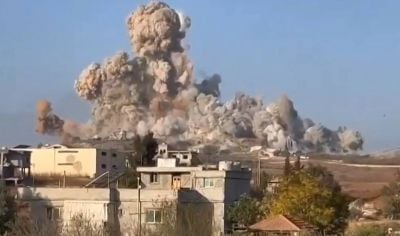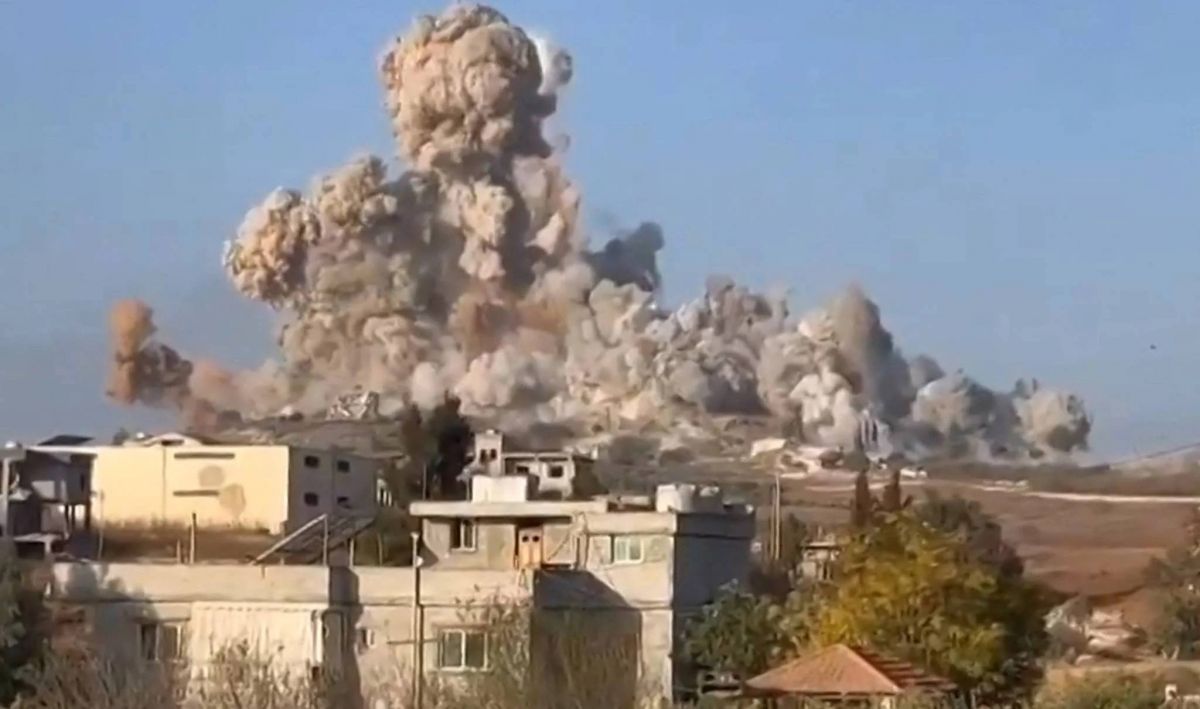
Screenshot of a video posted on social media showing the explosion in the village of Mhaybib by the Israeli army, Oct. 16, 2024. (Credit: AFP)






When Qassem Jaber saw the images appear on his smartphone screen, shared widely on social media and WhatsApp groups across Lebanon, his first reaction was denial: ''When I watched that video for the first time, I didn’t want to believe it. I told myself it was impossible, that what I was seeing exploding couldn’t be Mhaybib,'' recounted the mokhtar (a local official responsible for records) of this small border village, reduced to ashes on Wednesday by an Israeli army division, the Alexandroni Brigade, using several tons of explosives scattered throughout the village.
''The worst part is hearing them celebrate,'' the official fumed. ''You need to send this to the UN! They attacked a sanctuary over 2,000 years old!'' he exclaimed. The sanctuary in question, the Maqam, was built before the Christian era in honor of the youngest son of the prophet Jacob, Benjamin, mentioned in both the Old Testament and the Quran. Its name is also the origin of the small village’s name, which only this piece of heritage could lift out of obscurity. Looted in 1948 by Israeli soldiers — who allegedly stole a rock bearing Hebrew inscriptions, according to several sources, after committing a massacre in the Lebanese village of Houla — the Nabi (prophet), as the villagers call it, likely did not survive this time. ''So far, I haven’t been able to get any details on what hasn’t been destroyed,'' explained Qassem Jaber. ''No one has been able to go to the site to verify, as everyone has left except for a few farmers. But based on the images, I think there’s nothing left...''
'In an instant, everything vanished'
Perched atop a hill overlooking Mais al-Jabal, in the Marjayoun district, this small Shiite village is usually home to around 300 residents year-round. Some had already fled in October 2023, with the rest following suit after Sept. 23, the start of the Israeli escalation that forced over 1.4 million people to leave their homes. Located just a few hundred meters from the Blue Line, the village had already suffered heavily after a year of cross-border fighting between Israel and Hezbollah, having been targeted around 50 times by Israeli strikes. It appeared on Oct. 6 on the long list of localities south of the Litani River mentioned in one of the many evacuation notices regularly issued by the Arabic-speaking spokesperson for the Israeli army, Avichay Adraee.
While not spared in the previous conflict of July 2006, it had never been decimated to this extent, similar to other villages in southern Lebanon like Yaroun, where a mosque and a Melkite church were bombed, or Aita al-Shaab, the Lebanese village most frequently targeted since Oct. 8, 2023, after already being wiped out in 2006. ''I can’t comprehend that the scenery I grew up in is gone,'' said Fatmeh Jaber, a 25-year-old medical student and pharmacist from Mhaybib. ''It's as if a lifetime of memories just went up in smoke. It’s an indescribable feeling.''
In a lengthy message posted on her Facebook account, the young woman lists all the things that used to bring life to the “four or five alleys” that made up the village, too narrow for “more than one car” to pass at once: “Yesterday, Israel blew up our village, and in an instant, everything vanished. We can no longer say ‘under the water tank,’ ‘under the mulberry tree,’ or ‘near the Nabi.’ We won’t walk down the little alley near Mrs. Kamel’s house anymore. Mrs. Moussa won’t wait for me in the morning in front of her house to ask me to bring her medicine. Hoda and Mona won’t be our neighbors anymore. We won’t go down to the orchard to pick mint and parsley. We won’t stop by my grandfather’s house every evening to drink tea and eat ka'ak (cake or biscuit)…”
Other comments take a more defiant tone, framing the loss as the price of the “resistance”: “In 2006, the enemy destroyed our homes, but we returned. In 2024, the enemy took revenge by blowing everything up, but once again, we will return to rebuild the village and make it more beautiful than it was before. We have sacrificed our homes and ourselves for the resistance.”
'The villages of Lebanon will become deserted'
One of Hezbollah's fighters, Moustafa Jaber, who was killed on Jan. 6, 2024, in an Israeli raid near Odaisseh, was originally from Mhaybib. The Israeli army, on its part, claimed that the village served as a "combat management center in southern Lebanon" for the party. "On site, Alexandroni Brigade fighters discovered ammunition depots, explosives, advanced observation devices and a basement containing residential units," the army stated, without providing direct evidence for these claims. A video resembling the description in this statement was released a few days ago by the Israeli army, though no precise location was given.
In addition to deliberately filming the destruction of Mhaybib, soldiers from the 7012th Infantry Battalion, a member of the same brigade that was part of the Jewish militias of the Haganah before 1948, photographed themselves occupying homes that had been emptied of their owners. They were also seen setting up a "sukkah," a temporary hut used during the Jewish holiday of Sukkot, outside a house in the Mais al-Jabal area.
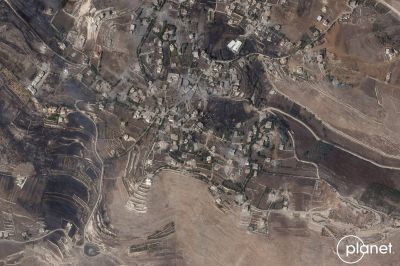
Also deployed in Gaza, where it has carried out similar explosions in residential areas, the Alexandroni Brigade is part of the 91st division of the Israeli army, known as the 'Galilee' division, one of the most active in leading Israeli ground incursions in southern Lebanon since Oct. 1. According to an Israeli army mental health official, cited by Israeli public radio, the new commander of the Alexandroni Brigade, Colonel Moshe Pesel, reportedly stated at the end of August that he wanted his fighters to "commit genocide" in Lebanon. "The villages of Lebanon will become deserted, and the roads impassable," he allegedly wrote in a document sent to the soldiers. "Whenever we told someone we were from Mhaybib, no one knew where that was. Now, everyone knows that our village was in the wrong place..." laments Fatmeh Jaber.
This article was originally published in French in L'Orient-Le Jour.