



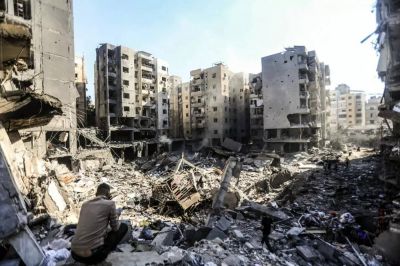
A man walking in Beirut's southern suburbs, where buildings have been heavily damaged by Israeli airstrikes, Oct. 6, 2024. (Credit: Mohammad Yassin/L'Orient Today)






BEIRUT — On Oct. 8, one year after it opened a front against Israel in support of Hamas, Hezbollah launched more than 85 rockets into the northern Israeli city of Haifa, marking the largest barrage since the war began.
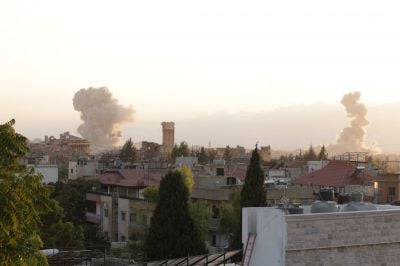
The strike comes amid ongoing Israeli air raids on Beirut's southern suburbs and the announcement of expanded ground operations in southern Lebanon, in an unprecedented escalation of the all-out war that started on Sept. 23.
This escalation coincided with a speech by Hezbollah Deputy Secretary-General Sheikh Naim Kassem, who emphasized the group's “resilience,” despite the blows inflicted on the party, most notably the assassination of its long-time leader, Hassan Nasrallah, on Sept. 27 in a massive Israeli bombardment on Beirut's southern suburbs that leveled four residential buildings.
One statement from Kassem drew particular interest among analysts: that Hezbollah's firepower would not be "limited to missiles or assault drones," hinting that different weapons not yet used by the party could potentially make an appearance.
This statement was accompanied by the publication of a video by the party's military media outlet on Oct. 8, marking the one year anniversary of Hezbollah's support front, which remained for nearly a year, a war of attrition mostly contained to the border area.
The last few seconds of the video, which was circulated heavily on various social media platforms, showed a trap door opening in the ground, hinting at a possible missile launch site. It raised speculation about whether Hezbollah may have, and could soon use, new military capabilities. But to what extent is this likely?
الثواني الأخيرة في هذا المقطع تحمل رسالة وتلويح بورقة أخرى سيستخدمها حزب الله قريبآ ..#يا_داحي_باب_خيبر pic.twitter.com/Otpvy9Q02g
— مصدر مسؤول (@fouadkhreiss) October 8, 2024
'Hezbollah's arsenal of weapons seems limited'
"The videos Hezbollah is releasing are propaganda, intended to deter Israelis," Mohanad Hage Ali, researcher at the Malcolm H. Kerr Carnegie Middle East Center, told L'Orient Today. "However, they have failed to prevent Israeli attacks and have raised expectations among their supporters. There is a sense of shock among the organization’s backers, and their people are waiting for a response."
As Hage Ali sees it, in the last year of cross-border fighting, there haven't been any "major surprises" or the sophisticated use of different types of drones. The few instances of the "advanced use" of its drones has diminished, since Israel targeted and destroyed suspected warehouses, Hage Ali said.
"It’s unclear what is restraining them. Only the party knows. Hezbollah's arsenal of weapons seems to be limited at this stage." For the Carnegie researcher, an unexpected move on the part of Hezbollah would "genuinely surprise him."
But, "enough time has passed that we can judge what we’ve seen so far, and it doesn’t look promising for the party," he noted.
Kassem Kassir, an analyst close to Hezbollah, told L’Orient Today that Hezbollah might use new weapons "if Israel targets the city of Beirut or vital installations like Beirut international airport or the Port of Beirut."
Israel has attacked Beirut four times since the start of the escalation: once on Sept. 29, again on Oct. 2, and then twice on Oct. 10. The first instance was an airstrike on an apartment building near the Cola bus station, which killed three members of the leftist nationalist Palestinian party, Popular Front for the Liberation of Palestine.
The second attack targeted a medical center in central Beirut's Bashoura neighborhood, near the upscale Beirut Digital District and not far from the Grand Serail, the Cabinet's presidency headquarters. Nine paramedics were killed in the strike, suspected by some to have been carried out by an Israeli warship, with 14 people wounded. The center was operated by the Islamic Health Association, a medical organization affiliated with Hezbollah.
The third and fourth strikes occurred shortly before the publication of this article. Footage show smoke rising from two locations in Beirut's central Ras al-Nabaa neighborhood. One of the buildings struck was engulfed in flames. As of the time of publication, six people were killed and several injured.
'Only Hezbollah itself knows its capabilities'
Kassir said that any conclusions drawn from the image of the trap door in the video “is mere speculation on the group’s capabilities and not something we can know for sure to build on.” Kassir noted the possibility of the party using advanced weaponry, but emphasized that specifics remain unclear.
Military expert Riad Kahwaji insisted for his part that only “Hezbollah itself knows its capabilities and that videos released by the party don’t necessarily show the party’s capabilities on the ground.”
Still, Kahwaji told L’Orient Today that he is not convinced that Hezbollah has “new weapons left.”
“There is nothing left," he said. "The party used weapons as big as ballistic missiles. This is all talk to raise morale and to appear strong and defiant. Israel has crossed all red lines in scale of bombardment and type of targets and incursion in the South.”
Kahwaji also pointed to the supposed degradation of the party's firepower as a result of various weapons depots being "blown up daily." While claims of these depots being targeted come from Israel alone, Hezbollah has announced the deaths of several high-ranking military commanders, which Kahwaji believes are also "disrupting their operations."
Hage Ali agrees: "Many launching capabilities have been attacked and severely damaged. While they may have new rockets, it appears their effectiveness has been compromised.
“Israel has maintained continuous attacks and air raids that have prevented the party from regrouping or gaining any momentum,” Kahwaji insisted, noting that “they are on the defensive, seeking a cease-fire that is not likely in the near future.”
Kassir believes, however, that Hezbollah is waiting for a significant escalation from Israel, such as strikes on key Lebanese infrastructure, before revealing its full capabilities.
Hezbollah did not respond to L'Orient Today's requests to comment.