






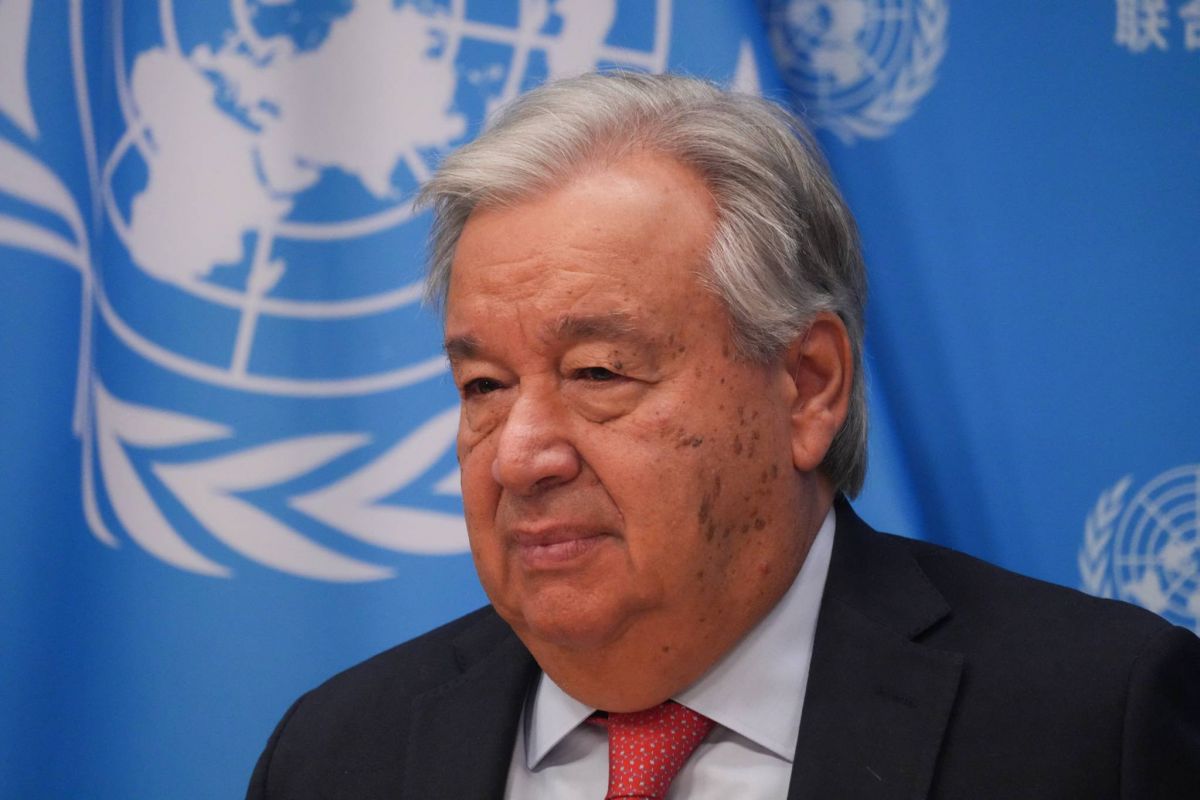
United Nations Secretary-General António Guterres, speaking at a press conference before the opening of the 79th session of the U.N. General Assembly on Sept. 18, 2024, in New York. (Credit: Bryan Smith/AFP)






Following a tumultuous week during which several Israeli attacks against Hezbollah in Lebanon brought the country to the brink of total war, international reactions, particularly from Western nations, called for restraint and a cease-fire, expressing concern over escalating tensions between the Shiite group and the Israeli state.
On Tuesday and Wednesday, thousands of explosions from communication devices in the hands of Hezbollah activists resulted in dozens of deaths and thousands of injuries. The Islamist group and the Lebanese government attributed the attack to Israel. On Friday, an Israeli raid in southern Beirut killed several senior officials from the party's elite military unit, while also resulting in numerous civilian casualties.
In this context, U.N. Secretary-General Antonio Guterres expressed concern on Sunday that Lebanon could become "a second Gaza." The Palestinian enclave is currently devastated by a war that has already claimed over 40,000 lives, following Hamas's "Deluge of al-Aqsa" operation on Oct. 7, 2023. The Lebanese front was opened by Hezbollah the following day, Oct. 8, 2023.

"What worries me is the possibility that Lebanon could become a second Gaza," he alarmed on CNN in the lead-up to the U.N. General Assembly week in New York.
Antonio Guterres also noted that it was "clear" that neither Israel nor Hamas "really want" a cease-fire in Gaza. "It's a tragedy because this is a war that needs to end," he lamented.
For her part, U.N. representative in Lebanon, Jeanine Hennis-Plasschaert, warned of an "imminent catastrophe" in the Middle East, asserting that the solution to the escalation between Hezbollah and Israel could not be military. "As the region is on the brink of imminent catastrophe, we cannot say it enough: there is NO military solution to make either side safer," she wrote on her X account.
The escalation "is not in Israel's interest," stated John Kirby, a spokesperson for the White House, emphasizing that military escalation is not beneficial for Israel. He assured that the United States shares this sentiment "directly" with their "Israeli counterparts." Kirby noted that there remains "space" for a "diplomatic solution" to the conflict. "That's what we are working on," he added, without providing further details. In the evening, President Joe Biden expressed concern over the tensions in the Middle East and assured he is doing "everything possible" to prevent the conflict from widening.
The European Union (EU) expressed similar concerns, stating it is "extremely worried about the escalation in Lebanon following Friday's attacks in Beirut," according to a statement on Sunday from EU foreign policy chief Josep Borrell. He called for a "cease-fire along the Blue Line," which has separated Lebanese and Israeli forces since 2000, "just as in Gaza." "Civilians are paying a heavy price, and they will be the ones who suffer the most in a total war, which must be avoided, including through renewed intense diplomatic efforts," he added.

British Foreign Secretary David Lammy has called for "an immediate cease-fire" between Israel and Hezbollah in light of "worrisome escalation" in the situation. "In recent days, we have witnessed concerning escalation between Israel and Lebanese Hezbollah. Our message to all parties is clear: we need an immediate cease-fire (...) to achieve a political resolution," he added.
The German Foreign Ministry stated on X that "once again, the entire region is holding its breath, which is why we urgently need concrete measures in the Middle East to de-escalate the situation and avoid further civilian casualties." German government spokesperson Steffen Hebestreit concluded by asserting that "a diplomatic solution to the conflict must be possible."
Meanwhile, Egypt expressed fears on Sunday of a total regional war in the Middle East due to escalating violence between the Iran-backed Shiite Hezbollah and Israel, a conflict that undermines diplomatic efforts for a truce in the Gaza Strip. "There are many concerns (...) about the possibility of escalation in the region leading to total war," said Egyptian Foreign Minister Badr Abdelatty at the U.N. headquarters in New York, warning of "negative effects" from this conflict at the Israeli-Lebanese border on cease-fire negotiations between Israel and the Palestinian movement Hamas in Gaza.
Egypt has been heavily involved in negotiations for a truce in Gaza.