


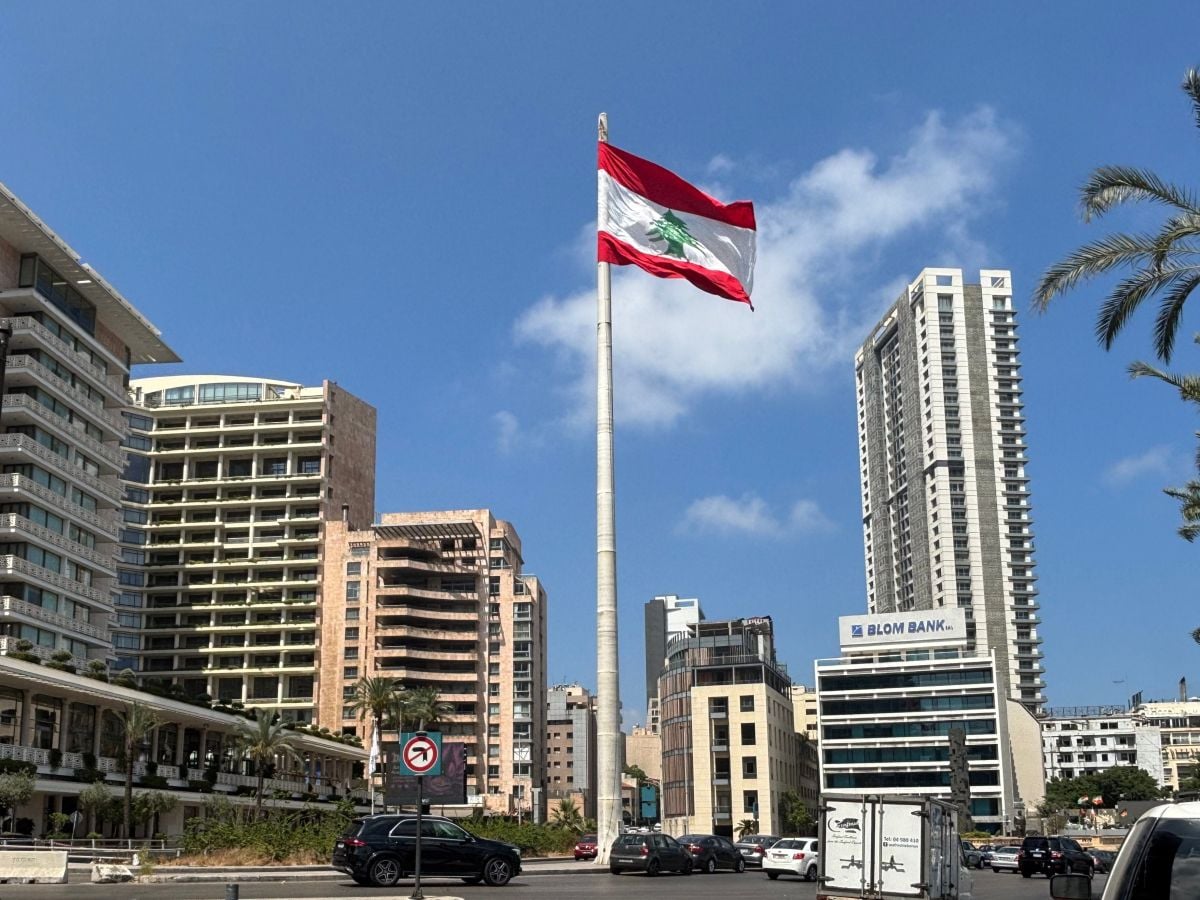
Ain al-Mreisseh, in downtown Beirut, on July 21, 2026. (Credit: Philippe Hage Boutros/L’Orient-Le Jour)






BEIRUT — The morale of Lebanese businesses remained above the 50-point threshold in September, buoyed by domestic consumption and several other relatively positive signals. These, however, did not entirely overshadow the uncertainty linked to the war between Hezbollah and Israel, the broader regional conflict in which it is embedded, and its impact on fuel prices and electricity costs for Lebanese households.
At 50.5 points, the purchasing managers' index compiled monthly by BLOM Bank among 400 companies rose by four-tenths of a point, remaining on the positive side of the scale. The 50-point threshold marks the boundary between expansion and contraction.
"The BLOM Lebanon PMI climbed to 50.5 in September 2026, up from 50.1 in August, marking a fourth consecutive month of expansion (...) mainly supported by stronger domestic demand, with output and new orders seeing their fastest growth since February, while export orders remained weak amid persistent regional instability," said Jana Boumatar, an analyst at BLOM Bank.
The PMI component measuring output rose from 49.9 to 50.7 points between August and September, while the new orders component increased from 49.6 to 50.8 points. However, the export new orders component fell by two-tenths of a point to 45.7.
Input price inflation
Boumatar added that business morale "may also have benefited from Parliament's renewed confidence in the government in mid-September, strengthened economic relations with the United Arab Emirates between late August and September, Lebanese-Syrian discussions on trade and investment, notably through the first Lebanese-Syrian investment forum in Beirut, as well as continued progress in banking sector reforms."
The latter remains subject to debate, as President Joseph Aoun referred the matter to the Constitutional Council to challenge Article 3 of the resolution law adopted Aug. 12, whose wording did not take into account objections from the central bank.
"Businesses nevertheless remained cautious, with employment slightly declining and purchasing activity dropping, while input cost inflation reached its highest level in three and a half years due to rising import, fuel, food, construction, maritime transport and insurance costs," all of which are linked to the regional security situation, Boumatar said.
"Looking ahead, if domestic activity remains resilient, persistent geopolitical uncertainty, weak external demand and high cost pressures are likely to continue weighing on business confidence."
The PMI component measuring purchasing managers' 12-month expectations also rose in September, from 39 to 40.9 points, but remained in the contraction zone.
