


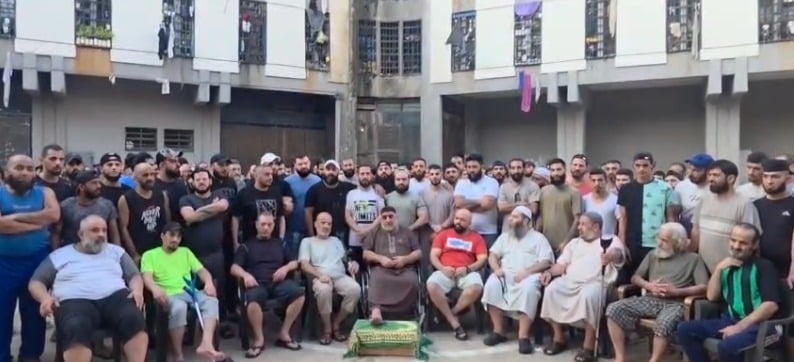
Inmates at Roumieh Prison holding a protest on Sep. 14, 2026. (Screenshot of a video sent to L'Orient Today by the Committee of Prisoners’ Families in Lebanon)






BEIRUT — Inmates at Roumieh prison, including Islamist detainees held on ""terrorism charges" began an open-ended hunger and water strike Monday, refusing to take medication, according to a statement sent by the Committee of Prisoners’ Families in Lebanon to L'Orient Today.
The prisoners are protesting the suspension of Lebanon’s general amnesty law, caused by the Free Patriotic Movement's parliamentary bloc appeal on Wednesday to the Constitutional Council. The law was passed on Aug. 12, and President Joseph Aoun had promulgated it last week.
In a video, also sent by the Committee, dozens of detainees appear gathered inside Roumieh’s courtyard. One prisoner described the personal toll of his years behind bars.
"I left my son when he was one year old. He is now 15. Allow us to get out of prison, reintegrate, see our mothers and raise our children. Help us reintegrate into society," he said. The prisoners said in the statement they were protesting the "deprivation of their freedom" and being prevented from returning to their families and communities.
They accused political actors of turning the general amnesty file into a tool for "political bargaining" and partisan interests, and held FPM head Gebran Bassil responsible for obstructing the law and for their lives.
After filing the appeal, Bassil said that he's challenging the law for "justice, the victims, whether military personnel or victims of crimes, and ... Islamist detainees who have not been tried."
The prisoners also thanked officials who had worked to give them "a chance to coexist and leave," while condemning those they said were obstructing the law. They rejected being used as a "scapegoat" or as a pretext for political agendas at the expense of their suffering and their children’s lives. They called on residents of Beirut, Saida, Tripoli, Akkar, Arsal, the Bekaa, and other Lebanese regions to take part in demonstrations in support of their cause.
They also appealed to the Syrian people to support them and "raise their voices" alongside them, saying they had stood by Syrians "in the face of injustice" and that their causes were one. The appeal comes as Lebanon and Syria have been working on the fate of Syrian nationals held in Lebanese prisons. Lebanese Justice Minister Adel Nassar and Syrian Justice Minister Mazhar al-Wais have been involved in efforts to address the issue, including a February agreement to transfer around 300 convicted Syrian prisoners to Syria.
The law followed months of discussions, particularly over the inclusion of Islamist detainees, an issue that had divided the Sunni community.
The inmates said they were refusing medication, including those suffering from chronic illnesses such as heart disease, diabetes and high blood pressure.
'You start imagining the moment the door opens'
For detainees at Roumieh, the uncertainty over Lebanon’s general amnesty has turned years of waiting into a cycle of hope and disappointment.
Four Islamist detainees who spoke to L’Orient Today say they were accused of "terrorism" but never convicted. They declined to disclose the specific circumstances of their arrests.
"Some detainees in Roumieh have stitched their mouths shut with a needle and thread while on hunger strike, calling for their release, Hussein* told L’Orient Today by phone from Roumieh prison Monday.
Hussein* said some Islamist detainees who could afford it "had paid $40,000 or $50,000 in bribes and gotten out. Those who remained are the poor ones,” he said.
The prospect of release briefly brought celebration to his family. “My family started distributing baklava to our relatives,” he said. Hussein has 11 grandchildren, all born while he was in prison. “Sometimes exceptions are made and we are allowed to see them, but I have refused. I don’t want to see them in prison. I will see them when I am outside,” he said.
For Ahmad, another Roumieh detainee, every postponed release means having to let go of that hope again. “When you hear that there is hope of getting out, you start imagining the moment the door opens and you meet your family. What I miss most outside is bringing my family together again, I want to apply for a job once I'm out,” he said.
Abdelrahman, 37, from northern Lebanon, is afraid of missing out even more from his children’s lives. “I want to hug my children and my wife, sit beside them without barriers or visiting hours, and live an ordinary day with them. Because an ordinary day has become a dream for me."
Protests and unrest at Roumieh
The strike comes two days after protests and unrest at Roumieh, Lebanon’s largest prison, following the Constitutional Council’s suspension of the law’s implementation.
On Friday, Prosecutor General at the Court of Cassation Rami al-Hajj met with prosecutors, the gendarmerie commander, and the director of prisons to discuss practical steps to implement it and reduce sentences, according to information obtained by L'Orient Today.