


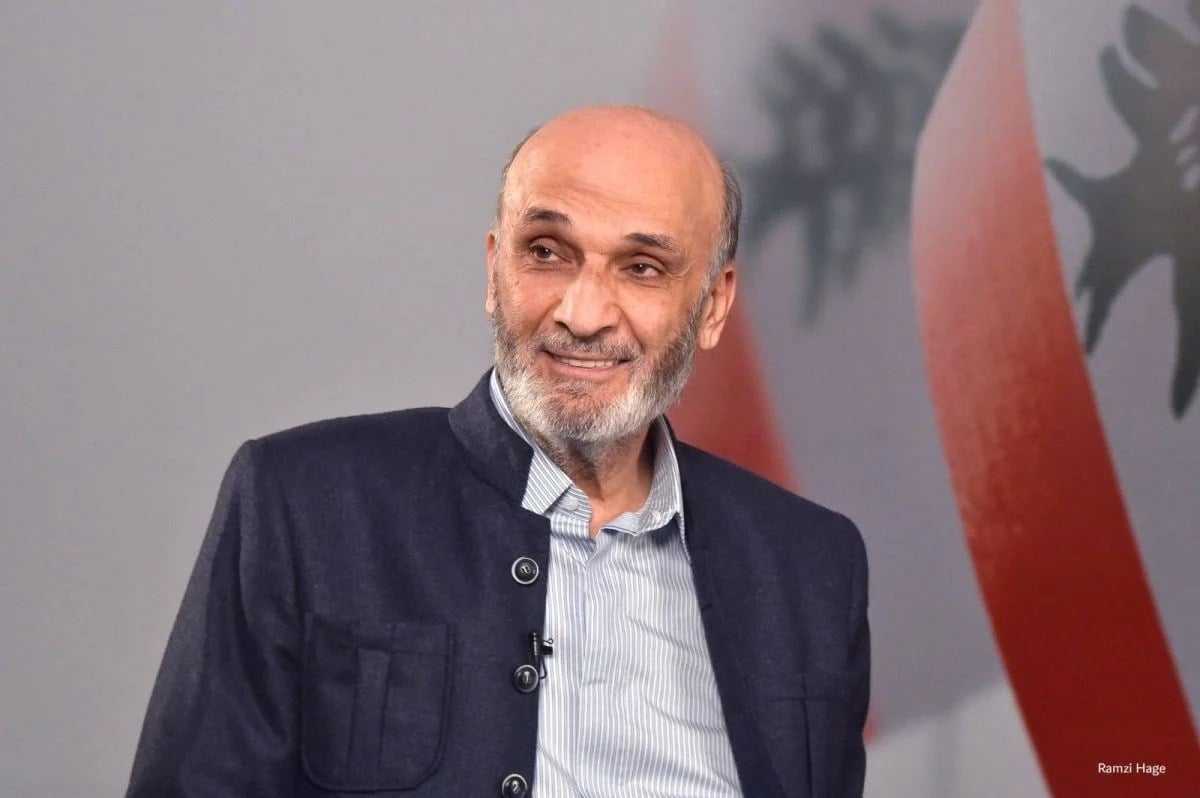
The leader of the Lebanese Forces, Samir Geagea. (Credit: Photo distributed by his communications office)






Lebanese Forces leader Samir Geagea said Saturday that Lebanon's political divide is "not sectarian" but centers on competing visions for the state, during a meeting with Iraqi lawmaker Kaldo Ramzi Oghana, head of the Christian Sobyana parliamentary bloc, the state-run National News Agency reported.
The two discussed ways to strengthen cooperation between the Lebanese Forces and Oghana's bloc, as well as the situation of Christians in Iraq and the wider region. They also explored ways to support Christians' presence in their homelands and reinforce the principles of citizenship, partnership and pluralism.
Geagea stressed the importance of Christians maintaining a political presence in the Middle East and reaffirmed his support for the resilience of Iraq's Christian community and for preserving its presence in the country.
For his part, Oghana praised Geagea's political and historical standing, describing him as one of the leading Christian figures in the Middle East whose political experience is worth learning from, particularly amid the region's current challenges.
He said Lebanon's strength and stability represent "a source of hope for all Christians in the region" and demonstrate that there remains "an Arab country that embraces diversity and gives it an active role in national life."
Geagea also said Lebanon's political life is currently defined by a confrontation between "the path of building the state, institutions and legitimacy" and "the path of weapons and corruption."
"Both camps include Lebanese from different sects, which confirms that the division is not sectarian but rather one over principles, values and the vision of the state," he said.
He added that the Lebanese Forces work with all those who believe in the state, institutions and the rule of law, regardless of sectarian affiliation, and oppose those who do not share that vision.
Oghana said political choices in Iraq should likewise be based on principles and national values, calling for alliances with forces that share those foundations rather than regional alignments and political polarization. He said such an approach would serve Iraq's national interest and strengthen Christians' role in public life.
Chaldean Patriarch Mar Paulos III Nona arrived in Beirut on Tuesday evening for a pastoral visit focused on spiritual renewal, ecclesiastical unity, and strengthening the Christian presence in the Middle East amid growing regional challenges.
The meeting comes as Chaldean Patriarch Mar Paulos III Nona concluded a multi-day visit to Beirut this week focused on strengthening the Christian presence in the Middle East. Lebanese Prime Minister Nawaf Salam is scheduled to visit Iraq on Sunday.
In Baghdad, new Prime Minister Ali al-Zaidi—who came to power with U.S. backing—faces pressure similar to Lebanese authorities to disarm pro-Iranian Iraqi armed groups. The groups are accused of launching hundreds of attacks on U.S. infrastructure in Iraq during the wider Middle East war triggered by joint Israeli-U.S. strikes against Iran in late February. Establishing a state monopoly on arms remains a key priority for the Lebanese government.
According to the European Centre for Law and Justice, at the beginning of the 2000s, there were still 1.5 million Christians in Iraq. Today, only 140,000 remain, divided between federal Iraq and the autonomous region of Iraqi Kurdistan.

 7 p.m. recap: Netanyahu seeks mastermind behind Flydubai incident; Washington sanctions 2 French nationals; Ben Gvir's 'I want to kill you' threat