





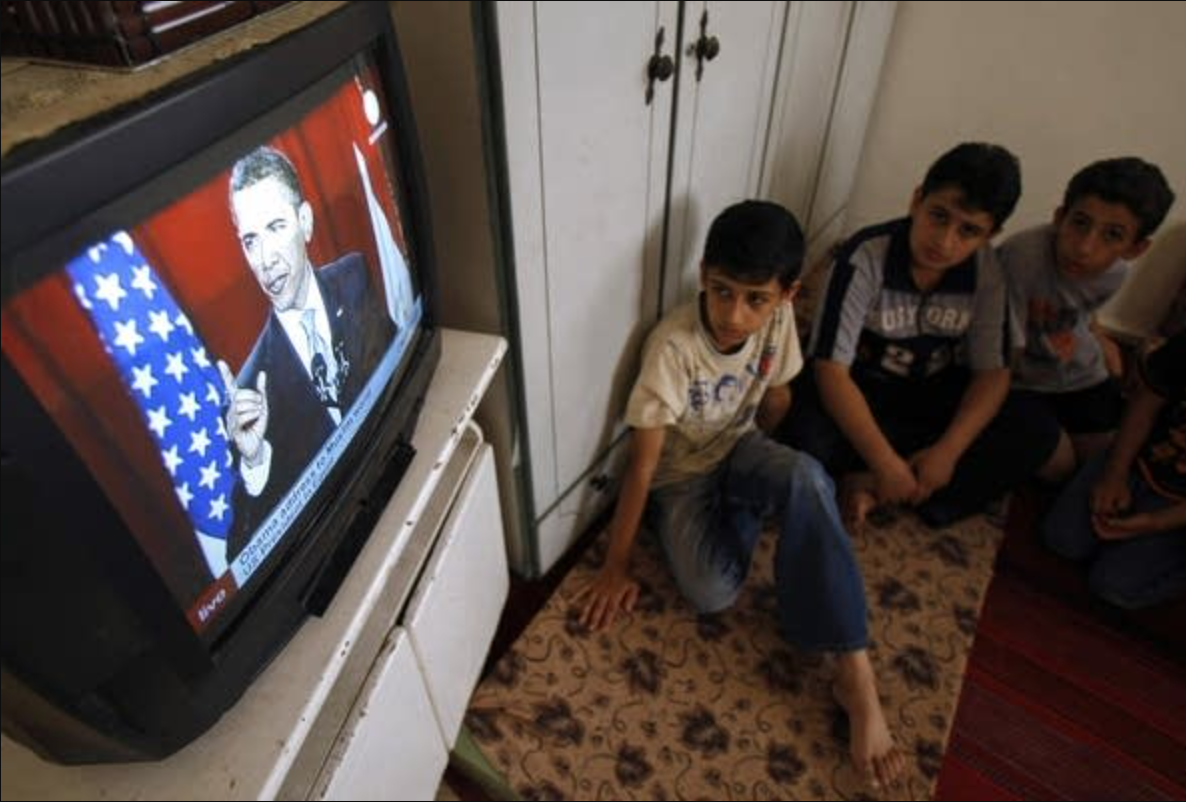
Palestinian children listen to U.S. President Barack Obama deliver a speech at Cairo University from their home in Rafah, a city in the southern Gaza Strip, on June 4, 2009. (Credit: Said Khatib/AFP)






What had to change over there for the U.S. to be safe at home?It was through this opening that the neoconservative project advanced. Throughout the 1990s, the United States sought to manage the Middle East by containing Iraq, isolating Iran, protecting the Gulf monarchies, and mediating between Israelis and Palestinians. The “post-9/11 environment” strengthened the neoconservative worldview within the administration, which tended to believe that the U.S. could bring about political change in the region in favor of democracy, and thereby neutralize future threats to the U.S. from failed states or authoritarian regimes, according to David Lesch, a professor of history at Trinity University in San Antonio, Texas. Read more The sea, faith, and oil: Beginnings of the American spiral (1/3) The Sept. 11 shock also transformed the U.S. ...
What had to change over there for the U.S. to be safe at home?It was through this opening that the neoconservative project advanced. Throughout the 1990s, the United States sought to manage the Middle East by containing Iraq, isolating Iran, protecting the Gulf monarchies, and mediating between Israelis and Palestinians. The “post-9/11 environment” strengthened the neoconservative worldview within the administration, which tended to believe that the U.S. could bring about political change in the region in favor of democracy, and thereby neutralize future threats to the U.S. from failed states or authoritarian regimes, according to David Lesch, a professor of history at Trinity University in San Antonio, Texas. Read more The sea, faith, and oil: Beginnings of the American spiral (1/3) The Sept. 11 shock also transformed the U.S....

 Evening recap: Netanyahu announces West Bank offensive; 7 killed in Jordan church shooting; tents burned in south Lebanon
 US strike on Iran this weekend? ‘Absolutely,’ says Barrack; ‘I have no idea,’ says Trump