






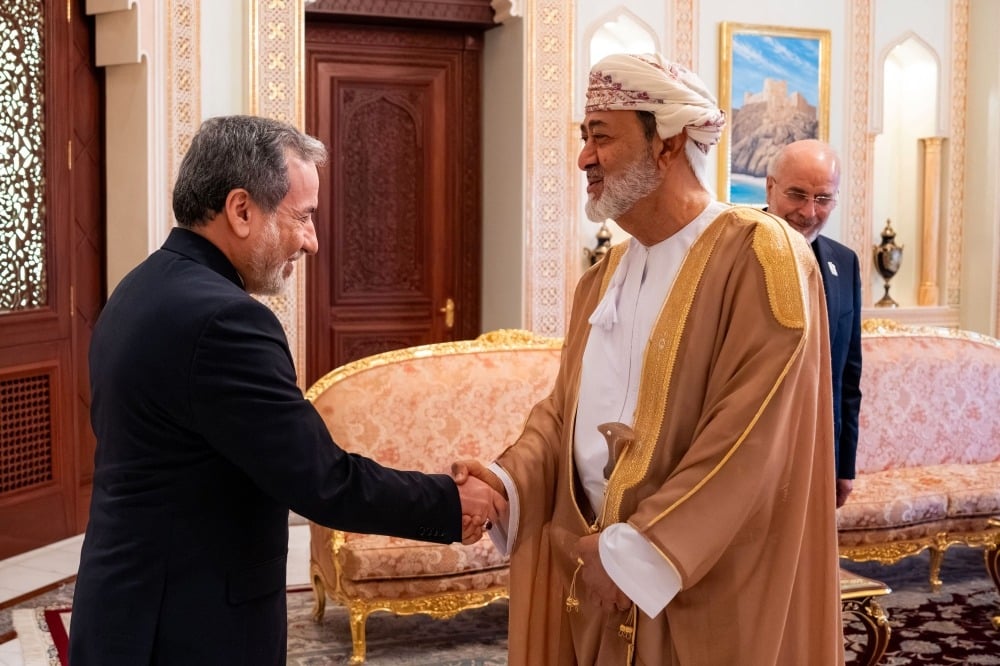
Oman's Sultan Haitham bin Tariq receives Iranian Foreign Minister Abbas Araghchi and Iran's chief negotiator, Mohammad Bagher Ghalibaf, in Muscat on June 23, 2026. (Credit: Archival photo from Oman News Agency/AFP)






U.S. officials believe Israel had planned to assassinate the main Iranian negotiators, including Parliament Speaker Mohammad Bagher Ghalibaf and Foreign Minister Abbas Araghchi, The New York Times reported Friday.
According to the newspaper's sources, Israel intended to thwart talks between Iran and the United States.
The article noted that Israel's strategy has long been to eliminate senior Iranian officials, but that "American fears over the targeting of two Iranian officials, specifically Araghchi and Ghalibaf, were at their height during the delicate Iran-U.S. talks that began in April."
It added that, according to some officials, the United States, fearing such assassinations would doom ongoing efforts to advance the negotiations, went so far as to ask other countries in the region to warn Iran about the potential Israeli targeting of the two figures.
Israel and the United States have jointly carried out strikes on Iran since Feb. 28, 2026, with the stated goal of toppling the regime.
Former Iranian Supreme Leader Ali Khamenei, as well as a large number of officials from the ayatollahs' regime, were assassinated by Israeli airstrikes on the first day and in the days that followed.
But as time passed and it became clear that the Islamic Republic's regime was not about to fall, divisions between the two allies grew.
While the United States declared a cease-fire after about 40 days of war, signs of Israeli dissatisfaction multiplied.
Distrust grew between the Americans and Israelis, so much so that Israel was excluded from the talks launched with Iran in March.
Report: U.S.-Israel divisions traced to Larijani assassination
According to The New York Times, U.S. officials believed Ghalibaf and Araghchi, as senior Iranian officials, "were legitimate targets for Israel during the period of active war, when the goal was to overthrow the radical Iranian government," but that "any attempt to assassinate them during the negotiations would have put an end to those talks and reignited the fighting."
Similar information was reported by The Washington Post (WP). "If these two men are killed, the pragmatists would be gone," an anonymous U.S. official told the newspaper.
"This illustrates the divergence in war aims between the United States and Israel, as well as the Israeli prime minister's fundamental willingness to torpedo any negotiation the United States might conclude," Aaron David Miller, a former State Department official who advised both Republican and Democratic administrations, told WP.
The newspaper noted that Israel's embassy in Washington declined to comment on the allegations.
According to WP, the differences between the allies began before the negotiations, with Israel's mid-March assassination of senior Iranian official Ali Larijani, whom the United States had hoped would serve as a potential interlocutor.
Israel, which has strongly opposed the provisional agreement signed by the United States and Iran in June, paving the way for 60 days of talks toward a final deal, has previously targeted negotiators during negotiations. The article cited Israel's attempt to assassinate senior Hamas negotiator Khalil al-Hayya in Doha during talks aimed at ending the Gaza war in September 2025.

 7 p.m. recap: Iran warns Egypt, Israeli soldiers vote in south Lebanon, Haret Hreik responds to Kataeb