


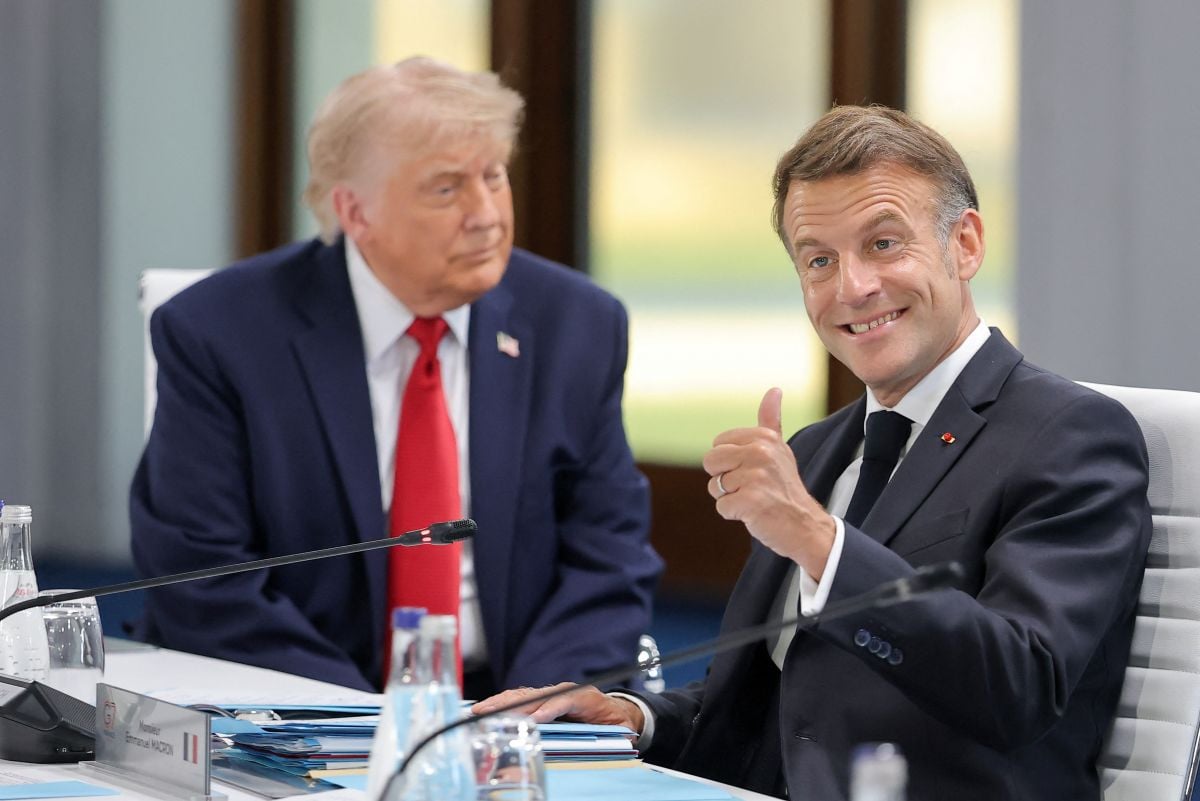
U.S. President Donald Trump and French President Emmanuel Macron during a G7 meeting in Evian-les-Bains, France, on June 17, 2026. (Credit: Christian Hartmann/Reuters)






The leaders gathered at the G7 summit in Evian, France, supported in a joint statement released Wednesday the implementation of an "immediate robust" cease-fire in Lebanon and the disarmament of Hezbollah, three days after a deal was announced between Iran and the United States.
The seven leaders (Germany, Canada, the United States, France, Italy, Japan, and the United Kingdom) declared their support for "the Lebanese leadership’s efforts to achieve the disarmament of Hezbollah and the monopoly of arms, and to protect Lebanon’s territorial integrity and sovereignty with the appropriate international security guarantees."
Their statement on global geopolitical issues also welcomed the agreement between Tehran and Washington, which offers a "historic opportunity to prevent Iran from acquiring any nuclear weapon," adding that the group’s countries are "ready to contribute to its implementation."
"We reaffirm that the right of transit passage without restrictions or tolls is the bedrock of international trade," it added, referring to the Strait of Hormuz, highlighting that France and the UK's independent defense initiative can play an important role in facilitating the resumption of maritime traffic in the Gulf, mainly through demining operations.
"We strongly support a robust and comprehensive diplomatic follow-on agreement to the Memorandum of Understanding secured by President Trump that can bring peace and security for all in the region," the statement read. "We underline the need for the negotiation to this end to address the threats posed by Iran in the region and beyond and ensure that they never obtain a nuclear weapon."
The memorandum of understanding between Iran and the U.S., set to end the war triggered by U.S.-Israeli strikes on Iran on Feb. 28, is set to be formally signed between the United States and Iran in Switzerland on Friday. The signing will launch a two-month negotiation period, with the highly anticipated first step being the reopening of the Strait of Hormuz.
The agreement also includes the end of the war on all fronts, including Lebanon, where Hezbollah and Israel have been at war since March 2. U.S.-Israeli attacks on Iran have killed over 4,000 people, and Israeli attacks on Lebanon have killed over 3,850.
G7 leaders are set to address the issue of artificial intelligence on Wednesday with global tech leaders, before a dinner bringing together the French and American presidents at Versailles.
On digital issues, the United States aligns with Germany, Canada, France, Italy, Japan, and the United Kingdom on the principle of protecting minors and banning social media for those under 15 or 16 years old. A statement is expected to be released to this effect on Wednesday. The G7 countries, however, differ on digital taxation and regulation.
In their statement, the seven leaders also committed to "increase the pressure on the Russian war economy" through sanctions, notably targeting its hydrocarbon exports. They also agreed to increase "delivery of air defense capacities, additional systems and interceptors, and long-range capabilities."
Alongside a declaration on digital policy, a joint statement is also expected on the thorny issue of critical minerals, which are essential components for large segments of the global economy and for which the seven advanced economies remain highly dependent on China.

 7 p.m. recap: 1 person killed near border with Lebanon; 200 kilos of explosives carried by mules; Riyadh shuts its airspace