






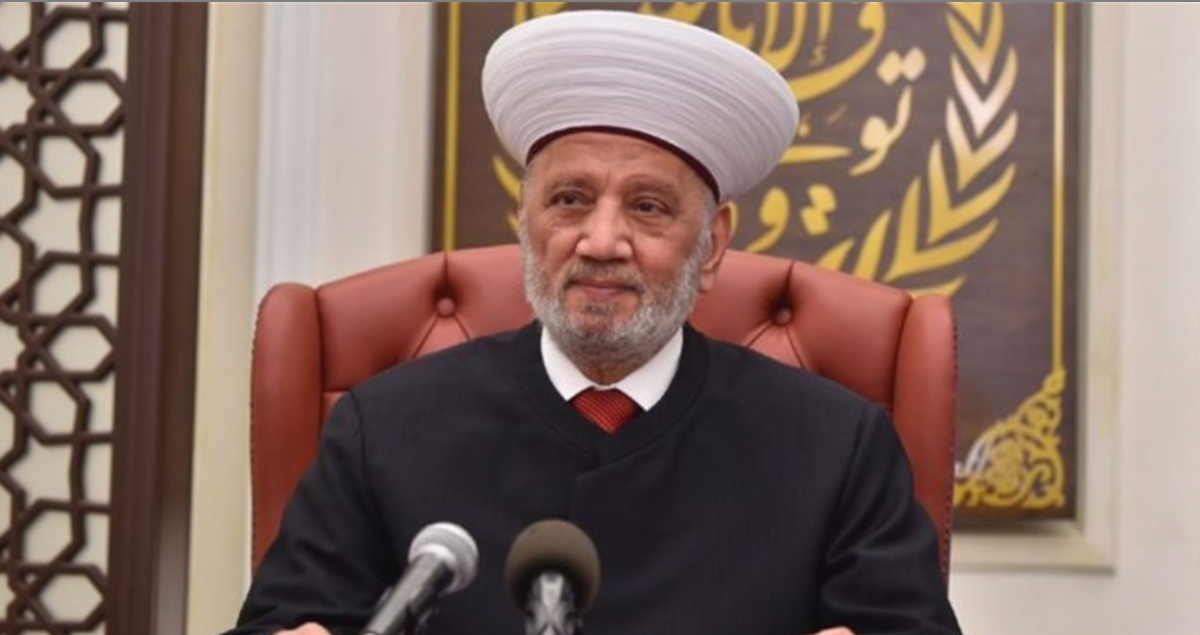
The Grand Mufti of the Republic, Abdellatif Derian. (Credit: National News Agency)






Lebanon’s Grand Mufti Sheikh Abdellatif Derian on Monday reiterated his support for the Lebanese state entering direct negotiations with Israel, ahead of a security meeting scheduled in Washington on Friday between the two sides.
He also sharply criticized Hezbollah, without naming it directly, for rejecting direct talks with Israel and refusing to hand over its arsenal.
“Turning to negotiation is a political and religious act,” he said, according to the state-run National News Agency.
Derian said “no one among us is convinced anymore by the methods adopted to confront the enemy or to seek help and solidarity,” adding that “with each confrontation, we lose more land.”
His remarks echoed those of Prime Minister Nawaf Salam, who said earlier this month that Lebanon had “five still-occupied points” before the war that began March 2, 2026, and that Israel now controls 68 villages. Despite a cease-fire that took effect in late November 2024, Israeli forces remained on at least five hills near the border before launching a ground offensive in March 2026, following Hezbollah’s entry into the regional war triggered by the Israeli-American offensive against Iran.
Derian said the pattern of war followed by destruction and cease-fires had repeated itself over time, arguing it had become “a repetitive, absurd method” that leads to destruction and occupation.
He said state-led negotiations to secure a cease-fire and Israeli withdrawal were “a political and religious act worthy of praise,” as they reduce losses and allow residents of the south to return to their towns and villages.
He also voiced support for President Joseph Aoun and Prime Minister Nawaf Salam, saying Dar al-Fatwa stood with the presidency and government to implement the inaugural address and policy statement aimed at addressing Lebanon’s crises, including the issue of the state’s monopoly on arms.
“The danger of unrest and wars will remain as long as weapons are not limited to the hands of the state and as long as the state is not responsible for decisions of war and peace,” he said, adding that “weapons outside the framework of the state create imbalance and weaken state institutions.”
He added that while Lebanon’s Sunni community is traditionally hostile to Israel, only al-Jamaa al-Islamiya, a small Muslim Brotherhood-affiliated party aligned with Hezbollah, has openly opposed direct talks.
“In our situation in Lebanon, or in Gaza and Palestine, where it is obviously impossible to rely on the enemy’s [Israeli] assessments, all that’s left for us is to think about what we can do to avoid harm, preserve unity, and think about our lives, our children and our future,” he said.

 Evening recap: Netanyahu announces West Bank offensive; 7 killed in Jordan church shooting; tents burned in south Lebanon
 US strike on Iran this weekend? ‘Absolutely,’ says Barrack; ‘I have no idea,’ says Trump