


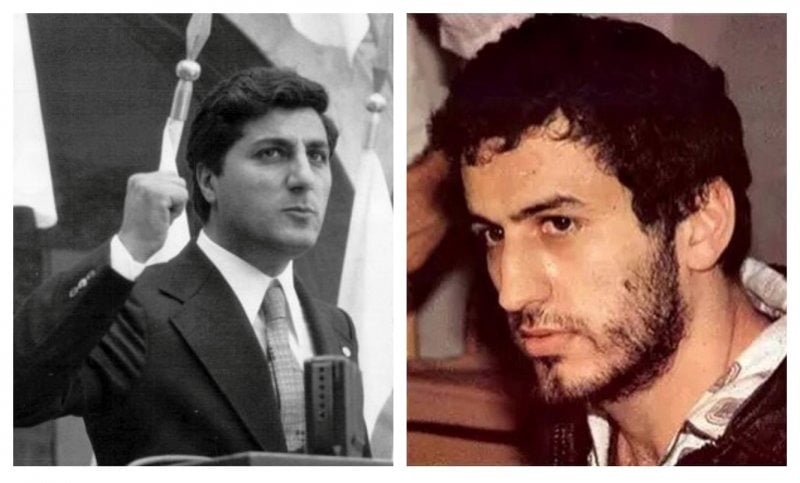
On the left, the elected president Bachir Gemayel, assassinated on Sept. 14, 1982 by Habib Shartouni; on the right, Shartouni, a member of the Syrian Social Nationalist Party. (Credit: L'Orient-Le Jour archives; Facebook)






While debates on the general amnesty law have been postponed in Parliament due to lack of prior political agreement and following tensions in committee sessions, the Syrian Social Nationalist Party (SSNP) has demanded that Habib Shartouni, one of its members convicted for the 1982 attack that killed former elected president Bachir Gemayel, be included in the list of those to be amnestied.
Meanwhile, the head of the Free Patriotic Movement (FPM), Gebran Bassil, has laid out his own conditions for supporting the bill, specifically rejecting any amnesty for "drug traffickers and killers of soldiers."
The SSNP issued a statement calling on the Lebanese state to include the Shartouni case in any upcoming amnesty law, arguing that other cases from the time of the civil war have long been closed.
Shartouni was sentenced to death in October 2017 for the assassination of Bachir Gemayel, which marked a turning point in the Lebanese Civil War (1975-1990). SSNP member Shartouni had acknowledged his involvement in the attack in the 1980s and was convicted in absentia after escaping prison in 1990, following eight years of detention.
According to the party's statement, the assassination of Bachir Gemayel must be "understood in the context of resistance to the project of Israelization of Lebanon." It also criticized what it called the "selective treatment" by the Lebanese state, pointing out that authorities had released detainees accused in terrorism-related cases or extradited others abroad, while keeping the Shartouni file open "for political reasons."
Bassil stated in a post on X that "amnesty for the oppressed is a duty, but [that] for drug traffickers and murderers is rejected, just as it is unacceptable to pardon those who have stolen depositors’ money. Amnesty for killers of army soldiers should not even be considered, because we have always been — and will remain — on the side of the army and its martyrs."
The debate over general amnesty in Lebanon remains deeply sectarian, with each community tending to view detainees, collaborators and war crimes through the lens of their own historical experiences, political alliances, and collective grievances, seeking amnesty for different categories of detainees, much to the dismay of others.
While families of Islamist detainees in Lebanon are actively demanding general amnesty, Christian leaders, foremost among them Maronite Patriarch Bechara al-Rai, have called for the inclusion in amnesty of Lebanese citizens residing in Israel. It is in this context that the general amnesty bill, called for to relieve overcrowded Lebanese prisons — particularly of detainees who have never stood trial — sparked heated debate in the parliamentary committee on April 6.

 7 p.m. recap: Netanyahu seeks mastermind behind Flydubai incident; Washington sanctions 2 French nationals; Ben Gvir's 'I want to kill you' threat