





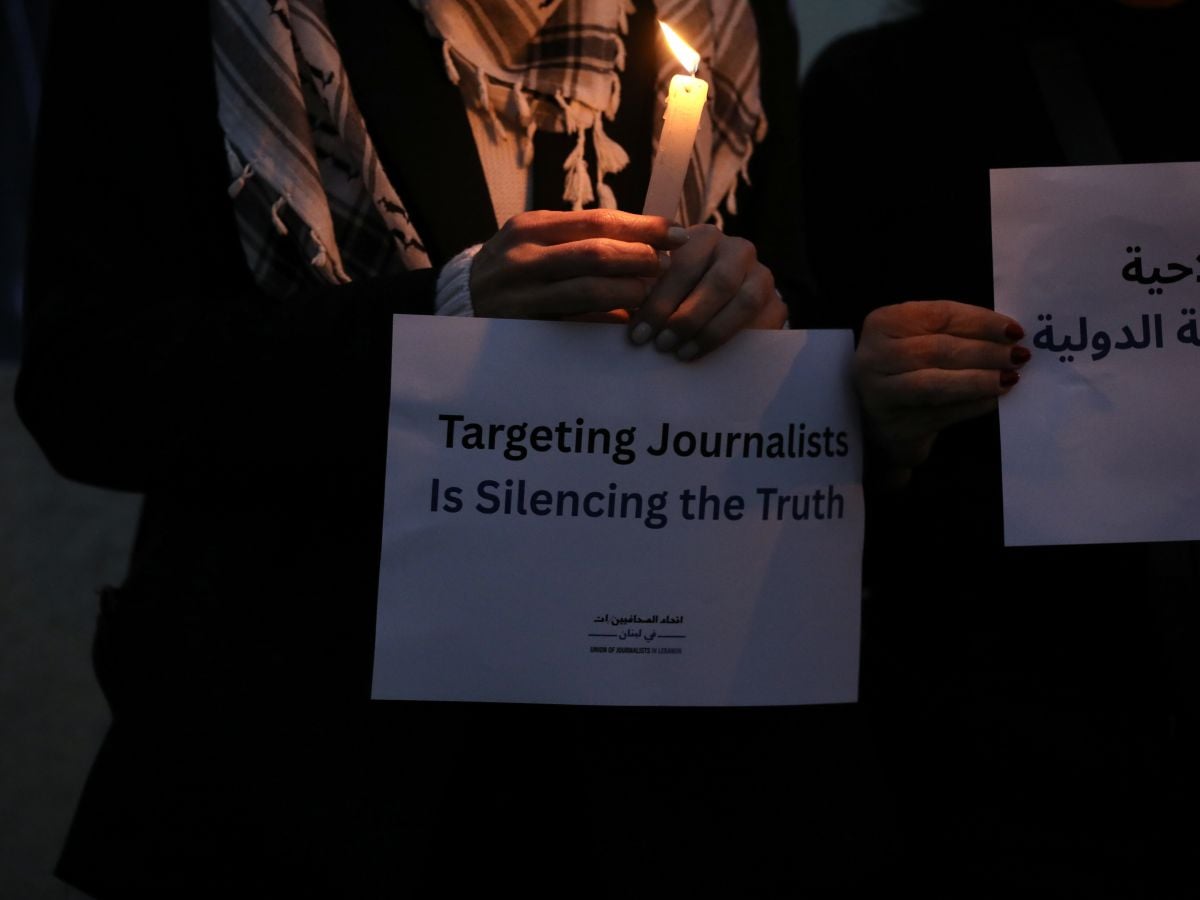
A protester holds a sign in support of press freedom on March 28, 2026, during a sit-in in Beirut following the killing of three Lebanese journalists by the Israeli army in southern Lebanon. (Credit: Matthieu Karam/L'Orient-Le Jour/File photo)






Lebanon has improved in the annual press freedom ranking by Reporters Without Borders (RSF), climbing to 115th place out of 180 countries, up from 132nd in 2025, even as “restrictions imposed on journalists have intensified since Oct. 7, 2023.”
In detail, Lebanon scored 46.49, compared to 42.62 in 2025, despite “the repercussions of Israel’s war on Gaza on Lebanese territory, during which journalists were targeted and displaced.” The report notes that “this continued in 2026 as the Israeli offensive intensified in Lebanon.” “Several journalists have been targeted and killed by Israeli bombardments along the border since 2023. Many others have been forcibly displaced during the war, and some have received direct death threats from the Israeli army,” it adds. More than 20 journalists have been killed in Israeli strikes, sometimes targeted, since October 2023.
Two weeks ago, al-Akhbar reporter Amal Khalil was killed in an Israeli strike on a building where she had taken shelter with a colleague, who survived, after multiple raids on the village where they were reporting.
While the report acknowledges that “genuine freedom of expression exists in Lebanese media,” it points out that the sector “remains controlled by a handful of individuals affiliated with political parties or belonging to local dynasties.”
Globally, press freedom has reached its lowest level in a quarter of a century, according to RSF. “In 25 years, the average score of all countries studied has never been this low,” the organization writes in its accompanying note. RSF partly attributes this decline to the “development of increasingly restrictive legislative frameworks, particularly linked to national security policies” since 2001, the year of the September 11 attacks in the United States.
At the same time, the share of the global population living in a country where press freedom is considered “good” has dropped from 20% to “less than 1%.” Only seven northern European countries, including Norway at the top, fall into this category. France ranks 25th ('fairly good situation').
The United States, which had already slipped from a “fairly good” to a “problematic” situation in 2024, the year of Donald Trump’s reelection, fell seven places to 64th, “while several Latin American countries are plunging into a spiral of violence and repression.” Beyond attacks by the U.S. president against the press — described as “systematic” — the situation in the U.S. has also been marked by the detention and expulsion of Salvadoran journalist Mario Guevara, who had reported on migrant arrests, as well as drastic cuts to funding for U.S. international broadcasting.
The sharpest drop in 2026 was recorded in Niger (120th, down 37 places), symbolizing “the deterioration of press freedom in the Sahel in recent years,” amid “attacks by armed groups and ruling juntas,” RSF said. “Some countries were once flagships of press freedom but have seen it deeply eroded with the arrival of military regimes, such as Mali [121st] and Burkina Faso [110th,]” RSF editorial director Anne Bocandé told AFP.
Saudi Arabia (176th, down 14 places), where columnist Turki al-Jasser was executed by the state in June — “a unique case in the world” — ranks near the bottom alongside Russia, Iran and China, with Eritrea (180th) last in the ranking.

 Midday recap: Hebron attack sparks Israeli crackdown, international meeting in Istanbul for regional 'de-escalation'