







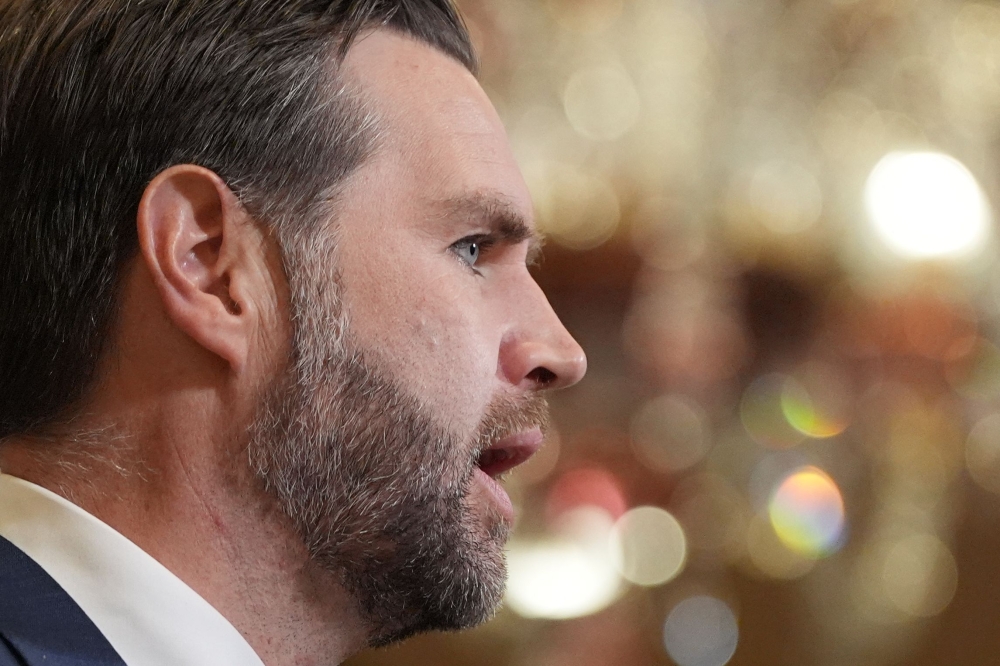
Vice President JD Vance speaks at a press conference after meeting with representatives from Pakistan and Iran in Islamabad, on April 12, 2026. (Credit: Jacquelyn Martin / POOL / AFP)






BEIRUT — Here are the latest developments this Sunday on the situation in the Middle East, as a fragile cease-fire between Iran and the United States enters its fifth day.
Iran’s IRGC claims 'full control' of Strait of Hormuz traffic, warns of 'deadly vortex'
Islamic Revolutionary Guard Corps (IRGC) said it has “entirely under control” maritime traffic in the Strait of Hormuz, according to AFP.
The IRGC added that “all traffic … is entirely under the control of the armed forces,” in a statement from its naval command published on X.
The group also warned that “the enemy will find itself trapped in a deadly vortex in the strait if it makes a mistake,” releasing footage showing ships in its targeting sights.
The IRGC reiterated it could trap its enemies in a “deadly vortex” in the strategic chokepoint, escalating rhetoric amid rising regional tensions.
'We want to take this card from the Iranians'
U.S. officials told Axios that the goal is to remove Iran’s leverage over the strategic waterway, saying: “We want to take this card from the Iranians.” They added that vessels paying Iranian-linked tolls would be “seek and interdict,” as Washington attempts to tighten control over maritime traffic.
US moves toward Strait of Hormuz blockade
The United States has moved to tighten pressure on Iran over the Strait of Hormuz, with Donald Trump announcing that Washington will begin “BLOCKADING any and all ships” after failed talks with Tehran. He said it would take “a little while” to implement, but warned that U.S. forces are “locked and loaded,” adding that “any Iranian who fires… will be blown to hell.”
Pope says he is 'closer than ever' to the Lebanese people
Pope Leo XIV said Sunday he feels “closer than ever” to the Lebanese people, whose protection he described as a “moral obligation.”
“I am closer than ever, in these days of pain, fear and indestructible hope in God, to the dear Lebanese people,” the pope told crowds in St. Peter’s Square after his weekly Angelus prayer. He stressed the “moral obligation to protect civilians from the atrocious effects of war” and called on all parties to seek peace.
Iran says U.S. failed to win trust in talks
The United States was “unable” to win the trust of Iran during peace negotiations, Iran’s parliament speaker said Sunday, hours after talks in Pakistan collapsed.
“My colleagues ... put forward constructive initiatives, but in the end the other side was unable to win the trust of the Iranian delegation during this round of negotiations,” Mohammad Bagher Ghalibaf wrote on X, after leading Iran’s delegation.
UK minister calls it 'disappointing' that US-Iran talks failed
“It’s obviously disappointing that we haven’t yet seen a breakthrough in negotiations and an end to this war in Iran that is a sustainable one," said UK Health Minister Wes Streeting on Sunday on Sky News, after the failure of talks between Washington and Tehran in Islamabad to end the war.
“As ever in diplomacy, you’re failing until you succeed. So while these talks may not have ended in success, [it] doesn’t mean there isn’t merit in continuing to try,” the minister added.
Saudi Arabia: East-West pipeline 'operational again' after attacks
The pipeline running from east to west across Saudi Arabia, a key asset for oil exports during blockages in the Strait of Hormuz, is "operational again" after attacks, Saudi Arabia's Energy Ministry announced Sunday. "The energy facilities and the east-west pipeline damaged by attacks are operational again, improving supply reliability," the ministry said.
The Financial Times had reported that a major drone attack targeted this facility, the Petroline, on Wednesday, despite a cease-fire going into effect between the United States and Iran. Neither the Saudi government nor state oil giant Aramco, the pipeline’s owner, had commented at the time.
'No one expected' an immediate deal, says Tehran
"It was clear from the outset that we should not expect to reach an agreement in just one negotiation session. No one expected that," Iranian Foreign Ministry spokesman Esmaeil Baqaei said Sunday.
Calls to maintain the cease-fire
The mediator of the unsuccessful negotiations between the United States and Iran, Pakistan has called on both sides to continue to observe the cease-fire, decided on Wednesday for two weeks.
"It is imperative that the parties continue to honor their commitment to the cease-fire," said Pakistani Foreign Minister Ishaq Dar.
Tehran criticizes Washington’s 'unreasonable demands'
The "unreasonable demands" of the United States led to the failure of the Islamabad negotiations between Iranians and Americans to end the war in the Middle East, Iranian state TV (IRIB) said Sunday.
No deal, JD Vance announces
"We are returning to the United States without having reached an agreement," U.S. Vice President JD Vance said Sunday at a brief press conference in Islamabad, where Americans and Iranians had been negotiating since Saturday, lamenting the lack of a "firm promise" from Tehran to abandon its nuclear weapons program.
"We leave here with a very simple proposal, an approach that is our final offer and the best we can make. We’ll see if the Iranians accept it," he added.
Confusion over the Strait of Hormuz
Iran has rejected Washington’s claims that two U.S. Navy warships crossed the Strait of Hormuz to clear mines from this strategic waterway, warning that any military vessel attempting to cross the strait "would be met with severe measures."
Earlier Saturday, the U.S. Central Command for the Middle East (Centcom) said that two U.S. Navy destroyers had crossed the Strait of Hormuz to begin "setting the conditions" for mine removal in the waterway, which is controlled by Iran.
The two ships operated as part of "a broader mission to ensure that the strait is completely cleared of sea mines previously laid by Iran’s Revolutionary Guard," Centcom said.
'I don’t care,' Trump says
"I don’t care" if a deal is struck with Iran or not, Donald Trump said Saturday, assuring: "We defeated them militarily." "Let’s see what happens. But as far as I’m concerned, I don’t care," he told the press.
Israel wants peace accord with Lebanon 'that will last for generations,' Netanyahu says
Israeli Prime Minister Benjamin Netanyahu said Saturday evening that his country wants a peace agreement with Lebanon "that will last for generations," ahead of negotiations scheduled to take place in Washington between Israel and Beirut.
"Lebanon has approached us to begin direct negotiations ... I set two conditions: we want the disarmament of Hezbollah and we want a real peace agreement that will last for generations," he said during a televised address.
Netanyahu says Israel has 'destroyed' Iran's nuclear and missile programs
"We have managed to destroy the nuclear program and destroy the missile program" of Iran, the Israeli Prime Minister said during a televised address, adding that the war against Tehran has also weakened Iranian leaders and their regional allies.
"They wanted to strangle us, and now it is us who are strangling them. They threatened us with annihilation, and now they are fighting for their survival," Benjamin Netanyahu added.
