



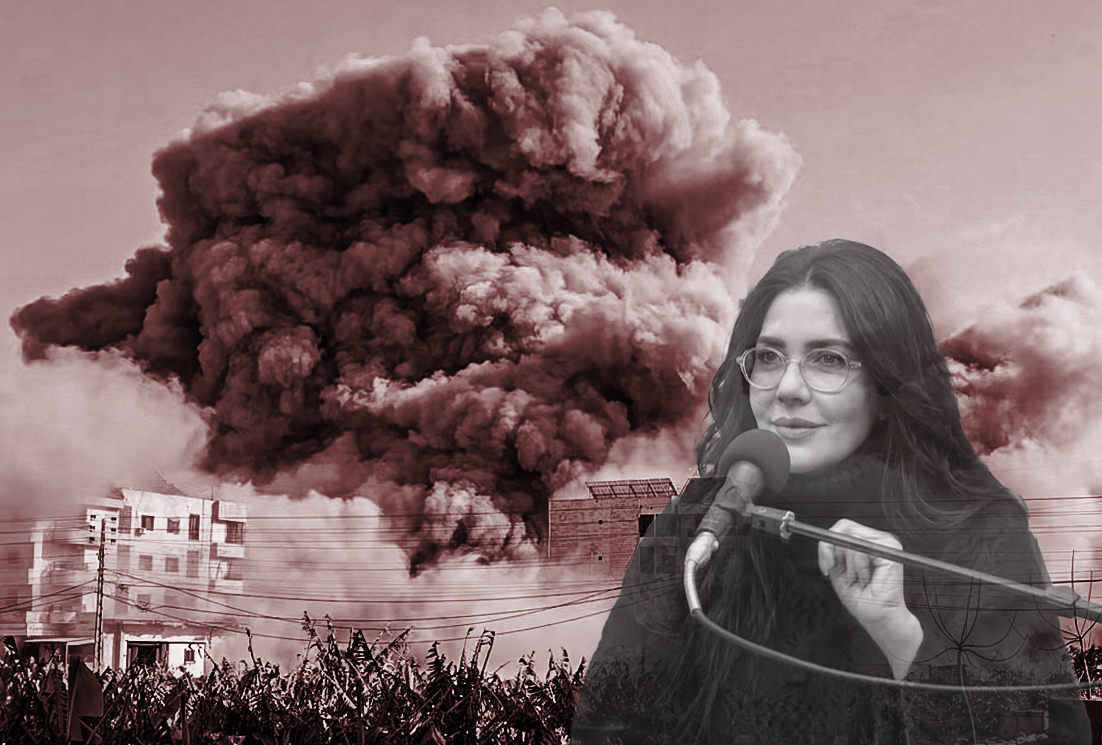
Ghada Dayekh, at the microphone of Sawt al-Farah station. Photo provided by Alwane Charafeddine, owner and director of the station. Illustration Céline Bejjani






Her voice was instantly recognizable to generations of listeners in the city of Sour, in southern Lebanon. A radio presenter for 37 years, Ghada Dayekh, born in 1966, was an experienced journalist who dedicated her career to the local station Sawt al-Farah (The Voice of Joy), which she helped to launch in the 1980s. "I wonder how we can still talk about joy," says Alwane Charafeddine, owner and director of the station, and vice-president of the Sour municipal council.
On that fateful April 8, 2026, Ghada Dayekh was alone in her apartment in Sour, where she had also been working since the destruction of the radio station's headquarters at the beginning of the conflict between Hezbollah and Israel in March. "An Israeli missile hit the building, which collapsed. Ghada is among the many innocent civilian victims killed in this strike," her boss laments. That day of Israeli murderous madness claimed more than 200 victims across Lebanon, including in Beirut.
Ghada deeply loved her port city, which she never left, neither during this conflict nor previous ones. Her listeners will miss her morning show, where she discussed current events. She was always up to date on sporting, cultural or social happenings. Over her long career, she witnessed all the advances that shaped the world of radio, and adapted to them.
She 'embodied the joy of living'
In her photos, the journalist often smiles, in line with her personality, according to Alwane Charafeddine. "She was full of life and loved to joke," he says. "She embodied the joy of living, she lived only for laughter and humor, even when life’s trials came her way," recalls a colleague, who preferred to remain anonymous, with emotion. She continues: "Her credo was art, entertainment, songs, dance... Ironically, while she worked for Sawt al-Farah, she fell victim to hatred and violence."
Ghada also had a humanitarian calling. "Alongside Sawt al-Farah, we founded a humanitarian association, and she was part of its administrative committee," says Alwane Charafeddine. It was not uncommon for the journalist to accompany elderly people, or take care of children from underprivileged families, to whom she distributed toys and took on walks along Sour’s corniche.
At her funeral Thursday in Sour, many mourned her. And her colleague understands why: "She loved people, and people loved her in return. Today, a deep sadness, combined with great anger, overwhelms us."
As for Alwane Charafeddine, he finds it hard to imagine the future of the radio station, whose soul has been so deeply affected. "At the end of the war, we should think about rebuilding the radio’s headquarters. But how do we start again when we have lost one of its pillars?"