







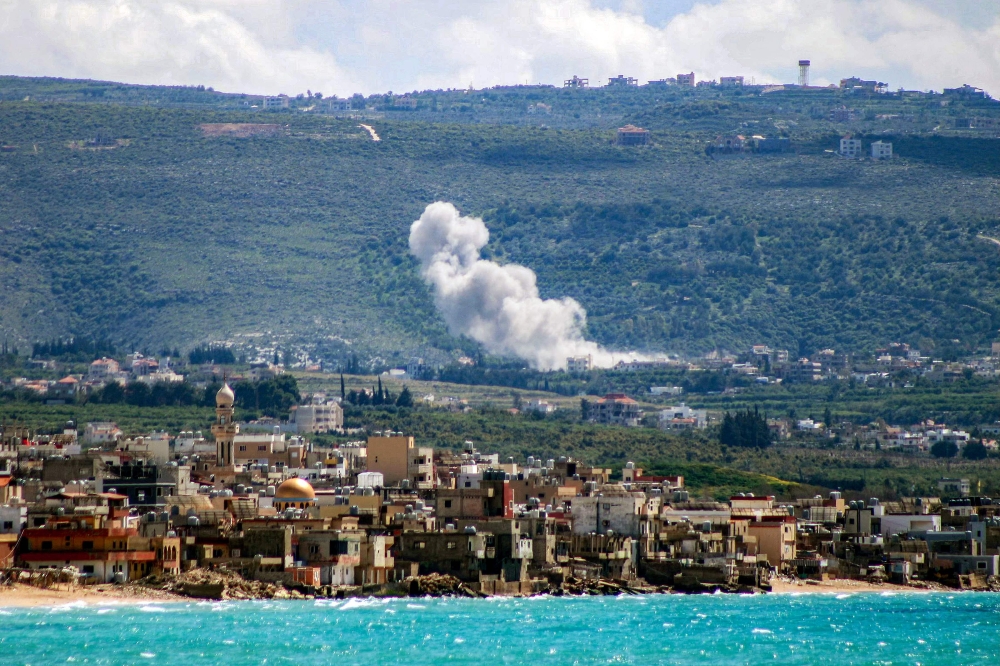
Smoke rises from the site bombed by Israel in the southern Lebanese village of Qleileh, seen from the neighboring city of Sour, on March 25, 2026. (Credit: Kawnat Haju/AFP)






Fighting raged again on Wednesday between Israel and Hezbollah in south Lebanon, especially near the Christian village of Dibil, as the war entered its third and a half week, definitively burying an imperfect cease-fire that had lasted for more than a year.
For Israel, the objective has not changed: It remains to occupy part of Lebanese territory, officially to disarm Hezbollah, as the U.S.-Israeli war launched on Feb. 28 against Iran continues despite scant signs of a possible start of dialogue between Tehran and Washington.
In a meeting with Ministry directors general and northern Israeli local officials, authorities indicated that Israel was expanding its "buffer zone" in Lebanon, mainly to push back the "anti-tank" threat posed by the party’s fighters and to avoid another evacuation of residents from northern Israel, as happened during the previous war in 2023/2024.
According to Israeli Channel 14, Israel has decided to move its "operational defense line" at least 8 km from the border to control the entire area up to the Litani River. The Israeli army also aims to establish 18 outposts "to create a permanent anchor point and prevent Hezbollah from reorganizing its terrorist infrastructures."
According to field information relayed by our regional correspondent, Israel has thus stepped up bombardments on several towns in southern Lebanon, after destroying bridges over the Litani River, 30 km from the border on the coast, and is trying to advance on new fronts.
The Arabic-speaking spokesperson for the Israeli army, Avichay Adraee, called on the inhabitants of Nabi Qassem, Qasmieh, Borgholieh, Burj Rahal, Dahr Amoud and Shabriha to evacuate.
In all, more than 20 cities and villages were bombed during the day on Wednesday and into the evening, sometimes repeatedly. Three members of the same family from the border town of Hanine were killed by an Israeli strike in the house where they were staying. In Baysarieh, in the Saida district, several dozen kilometers from the front, a fourth victim was still in critical condition.
The death toll from Israeli airstrikes in Lebanon has risen to 1,094, the Health Ministry said Wednesday, condemning the Israeli strike the previous day that killed two paramedics in Nabatieh. The Ministry added that 42 first responders have been killed by the Israeli army since the start of the war, which it said “constitutes a deliberate hindrance to rescue operations and a flagrant violation of international humanitarian law.”
At the end of the day, an airstrike hit a chalet on the Srira-Dallafa road, injuring a Syrian worker. The same chalet in Hasbaya was targeted by Israel during the 2024 war. Cameraman Ghassan Najjar and his technician Mohammed Reda, employed by the pro-Iranian Al-Mayadeen news channel based in Beirut, as well as journalist Wissam Qassem from Hezbollah’s Al-Manar TV, were killed there. Another Israeli strike in the locality of Harouf targeted the house of Sheikh Hussein Naji, who was killed along with his wife.
The situation in Dibil
Apparently still blocked in the border localities of Taybeh, Khiam, or Qouzah, the Israeli army attempted a breakthrough on Wednesday via the Christian village of Dibil.
“The Israeli army is approaching the outskirts of our village, as well as those of Qouzah and Aita al-Shaab. We don’t dare stick our heads out. It’s war, nobody understands anything,” a resident told us midday. In a statement, the municipality said the Israeli army was still on the outskirts of the village and had not managed to enter. It also said Lebanese security forces were deployed in the village, which has about 1,770 inhabitants.
At the end of the day, Dibil's mokhtar (local official) denied reports from local media that Israeli soldiers were in the village. “I am standing in front of the Mar Gergés [Saint George] church that the media spoke of, saying there are Israelis, Israeli soldiers. There is nothing of the sort,” he said in a video message, with the sounds of distant bombardment in the background, alongside members of the municipal council. “The village is full of its residents, and we’re bearing the shelling in the surrounding area. We’re waiting for the state to find a solution,” he added.
Hezbollah, which reported a particularly high number of operations on Wednesday (over 70 by 8 p.m. local time) against Israeli territory and soldiers’ positions, said it repeatedly targeted troops attempting to advance toward Dibil, as well as at least eight Merkava tanks near the village’s water reservoir between noon and 8 p.m.
The fiercest fighting likely took place on the Taybeh front. Hezbollah reported several drone attacks on Israeli soldiers, as well as attacks on forces trying to tow destroyed vehicles — including a tank. The party even fired rockets into Israel from the town. Late in the day, the Israeli army was mounting a counter-push, deploying helicopters after carrying out several airstrikes and artillery attacks during the day.
In the evening, our correspondent reported that Israel had conducted an airstrike targeting the area around the town of Zelaya, in the western Bekaa Valley.
Around 11 p.m. on Wednesday, the An-Nahar newspaper reported significant advances by the Israeli army at several points in southern Lebanon, information that we have not yet been able to confirm.
100-rocket salvoes
Less intense but still fierce fighting took place in Qouzah, at an altitude of over 750 meters, and in Khiam, which was also a main front in the previous war.
Among the most notable actions, the pro-Iranian group forced a helicopter sent to evacuate wounded soldiers to retreat at Qouzah. Hezbollah claims to have fired more than a hundred rockets at Israeli soldiers, notably in Qouzah and Naqoura, where Israel is attempting another breakthrough.
The group also fired at Israeli positions in about 10 places, cities, and localities in northern Israel, such as Kiryat Shmona, Nahariya, Karmiel, Misgav Am and the Krayot area north of Haifa.
The Israeli army, for its part, said it had captured a commander of the "resistance brigades," a Hezbollah-linked militia, near Israel’s northern border, and claimed to have “eliminated on the ground” a Hezbollah cell “immediately after the launch of an anti-tank missile at a unit in southern Lebanon.” It also took credit for a strike between Tuesday and Wednesday in Beirut’s southern suburbs, saying it had targeted a Hezbollah command center.
The Israeli army further claimed to have found “internal Hamas documents in the Gaza Strip showing how the movement obtained Hezbollah’s approval to set up operations in various areas of Lebanon, with Hezbollah’s full cooperation and under Iranian guidance,” without disclosing the documents. It added that it had struck aerial and naval weapons factories in Tehran used for Iranian proxies, including Hezbollah.