



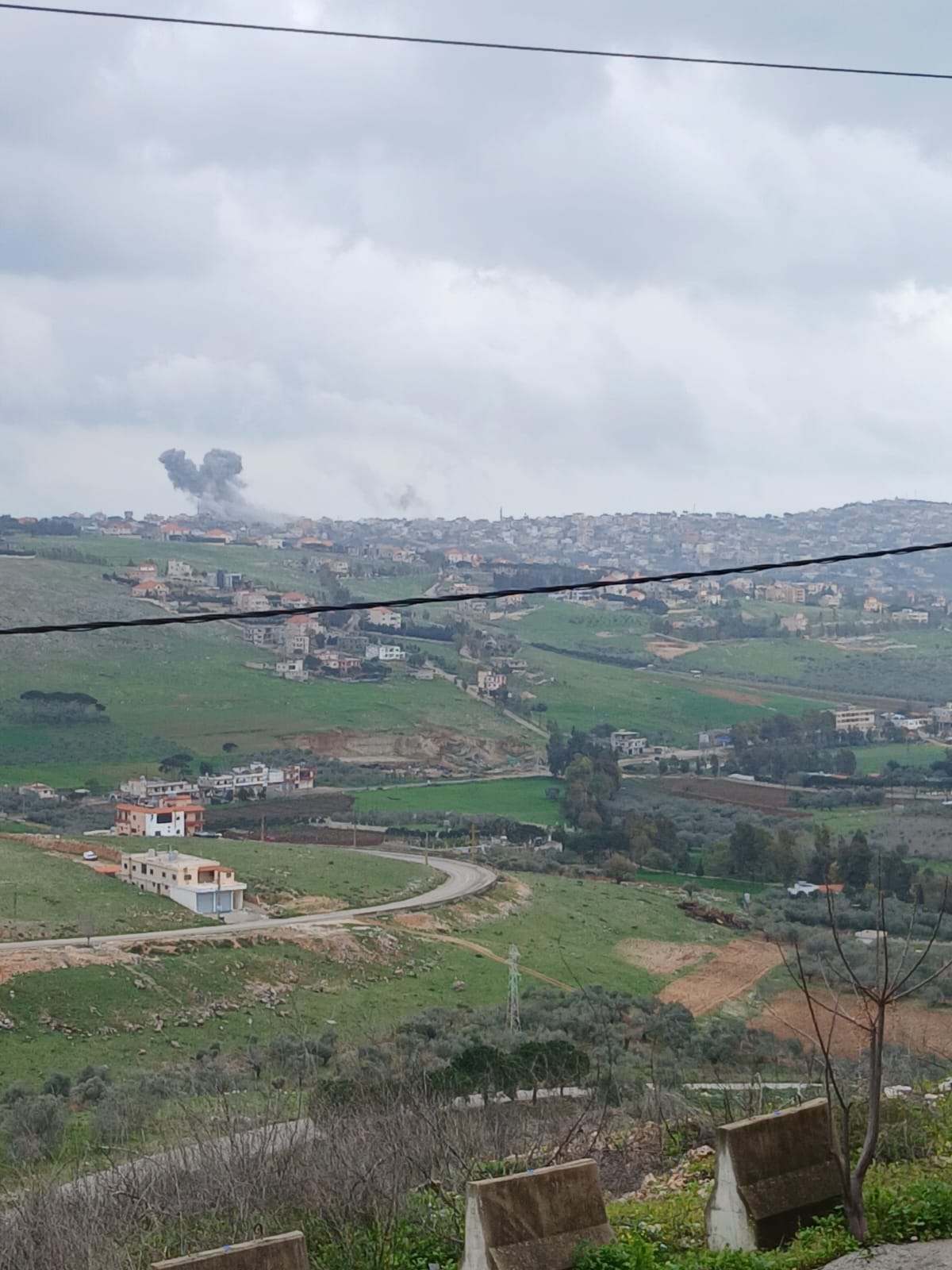
An Israeli strike on the town of Khiam, in south Lebanon, seen on the horizon, March 15, 2026. (Credit: Mountasser Abdallah/ l'Orient Today)






Heavy fighting continued on Sunday between Hezbollah and the Israeli army, which is advancing in Khiam (Marjayoun district), after a night of direct clashes between the two sides in the locality, according to our correspondent.
Israeli strikes across south Lebanon continued throughout the day. According to the latest daily toll published by the Health Ministry, Israeli strikes have killed 850 people, including 107 children. Meanwhile, hundreds of thousands of people displaced by the offensive are sleeping in the streets of Beirut and other major cities such as Saida, which have been battered by a storm since yesterday.
Alongside the fighting in Khiam, where Hezbollah claimed several launches during the night in response to the Israeli advances, this strategic border town was hit by numerous airstrikes and Israeli artillery shelling throughout the day.
Israel relentlessly bombards the South
In addition to the ongoing fighting in Khiam, the Israeli army conducted several air strikes on Sunday on the nearby villages of Zawtar Sharqieh and Yohmor al-Shaqif (Nabatieh district), north of the Litani River.
One of the strikes hit a mosque in Yohmor al-Shaqif, just hours after the hosseiniyeh (Shia congregation hall) in Sharqieh, another village in the Nabatieh district, was also completely destroyed by a similar strike.
This strike occurred as a maintenance team from the Mrad company was working locally to repair failures in the power network. No casualties were reported among the technicians. In the same region, a call allegedly broadcast by the Israeli army prompted residents of Ansar, Doueir, and Sharqieh to evacuate those villages threatened by strikes.
In the district of Sour, two strikes targeting homes in Aitit killed three people and wounded another, according to our correspondent. In addition, the body of a person killed in an attack on a building in the city three days prior was found in Saida today. For the first time, Israeli air force operations struck the Sahel al-Barak area, near the coast opposite Addousieh, in the Zahrani region, south of Saida.
Airstrikes were accompanied by intense artillery fire that targeted numerous areas, notably around Yohmor al-Shaqif, Arnoun, and Zawtar Sharqieh (Nabatieh district), as well as along the Litani River and the outskirts of Kfar Shuba (Hasbaya district). Israeli army drone attacks were also reported, including one on a café in Nabatieh Fawqa and the Kadmous neighborhood north of Sour.
During the night, as dozens of villages in the South were bombarded, a strike on an apartment in Charhabil, in the eastern suburb of Saida, killed a Hamas official identified as Wissam Taha and wounded his three children.
The Israeli army claimed responsibility for killing several militia leaders in Lebanon, including a Palestinian working for Iranian intelligence, and said it had targeted in Beirut a "Radwan Force headquarters," the elite unit of Hezbollah.
The Bekaa also came under fire on Sunday. Two Israeli strikes hit the locality of Zalaya in Western Bekaa, and struck the heights of Yohmor and Qalaya twice in the same region.
Hezbollah statements
Hezbollah, for its part, reported clashes against Israeli army advances in the South, particularly a Merkava tank near Taybeh and Odaisseh (Marjayoun).
Hezbollah also said it had carried out a series of attacks on several targets inside Israeli territory. The first of these hit at 6 a.m. "the Palmakhim air base," located south of Tel Aviv, 140 km from the Lebanese border, using "a sophisticated missile," according to a statement posted to its Telegram account. Two more subsequently hit at 8:30 a.m. an "air defense system" in the town of Ma'alot-Tarshiha and a "military industrial complex belonging to Rafael," on the outskirts of Kiryat. A fourth volley was fired at 12:30 p.m. towards the Israeli town of Nahariya.
Israel questions maritime agreement
Reacting to the security situation, Israeli Energy Minister Eli Cohen said Sunday that the Israeli government was considering canceling the 2022 agreement on the delimitation of the maritime border reached with Lebanon, which had resolved a maritime border dispute in a gas-rich area of the Mediterranean Sea. In an interview with army radio, the minister said that this agreement, signed by a previous government, was "not a real agreement, but rather an act of capitulation," Bloomberg News reported, as picked up by several media outlets. He specified that under the terms of this deal, Lebanon had obtained the entire disputed area in exchange for a "vague" promise to improve Israel’s security.