





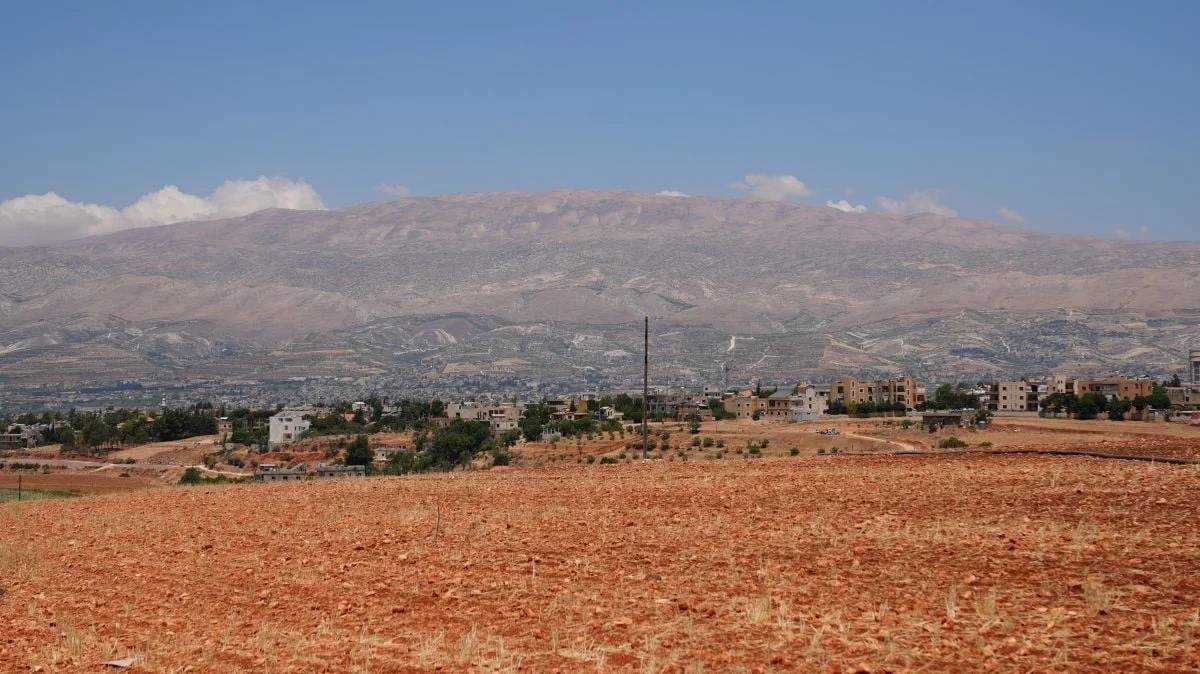
A wheat field in Rayak, with the Anti-Lebanon mountain range in the background, July 2, 2025. (Credit: Ali Baalbaky/L'Orient-Le Jour)






The National Center for Geophysics in Bhannes, affiliated with the National Council for Scientific Research (CNRS), reported Tuesday that it registered a 2.5-magnitude earthquake on the Richter scale at 2:11 p.m. local time today, centered in the West Bekaa region.
On Monday, the center noted that an earthquake in Syria was also felt in Lebanon. "At 5:39 p.m. local time, Monday, Jan. 26, 2026, a 3.1-magnitude earthquake on the Richter scale was recorded in the Serghaya region of Syria. It was felt by several citizens," the center specified. The previous night, another quake, measuring 2.6, was recorded at 12:28 a.m. in Sohmor, in West Bekaa. A week earlier, a 2.4-magnitude tremor on the Richter scale was recorded in Lebanon at 11:55 p.m., its epicenter located in West Bekaa.
Several seismic episodes have occurred in January. On Jan. 18, a magnitude-3.5 tremor on the Richter scale occurred off the coast of North Lebanon. A week before, in the night of Jan. 10 to 11, a series of minor tremors were felt by residents for about ten seconds. According to the U.S. Geological Survey, this was a 4.1-magnitude earthquake with an epicenter about 60 kilometers off the capital's coast, at a depth of roughly ten kilometers. This tremor, which caused no damage, was also felt in Syria and Israel.
In an interview with the press, Marlene Brax, director of the National Center for Geophysics, explained that such events are part of the natural seismic movement in the eastern Mediterranean, stressing that "there is currently no cause for concern."
Lebanon is traversed by the Yammouneh fault, running nearly 200 kilometers under Mount Lebanon. It is part of the larger Levant fault, which extends from southern Turkey to the Red Sea.

 Evening recap: Netanyahu announces West Bank offensive; 7 killed in Jordan church shooting; tents burned in south Lebanon
 US strike on Iran this weekend? ‘Absolutely,’ says Barrack; ‘I have no idea,’ says Trump