


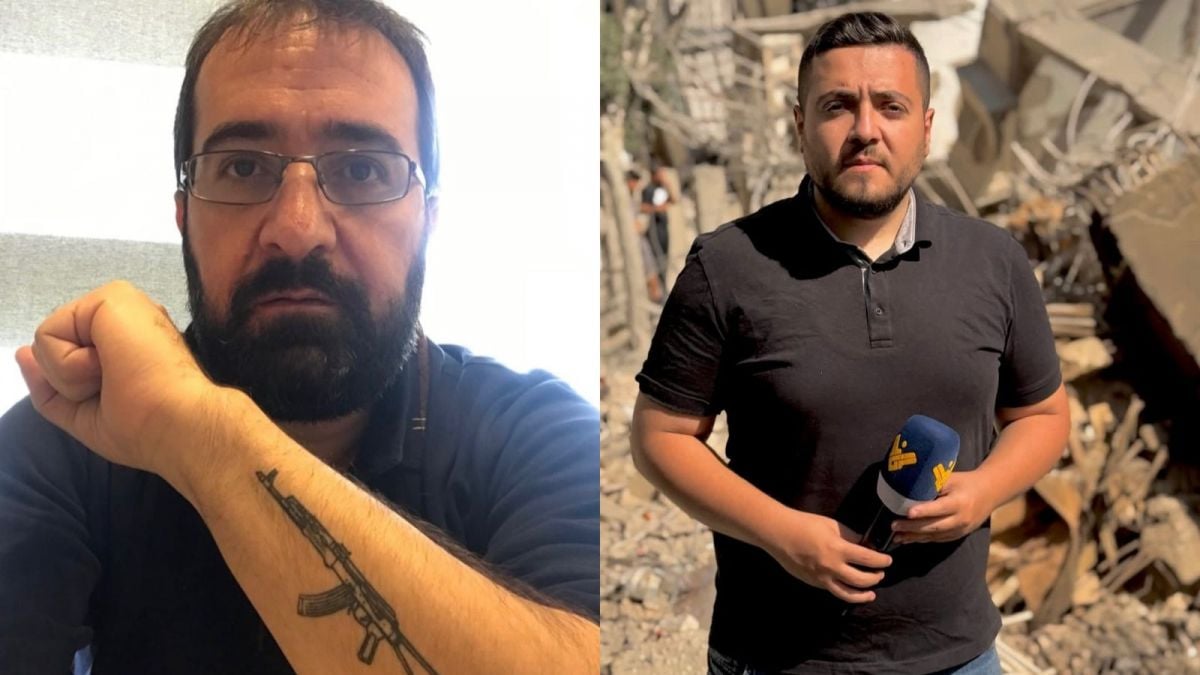
Journalists Hassan Illaik (left) and Ali Berro. (Credit: The journaists' Instagram accounts)






Public prosecutor at the Court of Cassation, Jamal Hajjar, on Thursday initiated legal proceedings targeting journalists accused of insulting President Joseph Aoun.
After issuing an arrest warrant for Ali Berro, a correspondent for the pro-Hezbollah channel Al-Manar, according to Al Jadeed, the prosecutor also summoned journalist Hassan Illaik, expected to be questioned on Friday, following the release of a highly critical video targeting the head of state.
In a first video posted Wednesday night on Instagram and shot on the road leading to the Baabda Presidential Palace, Berro provocatively calls on residents of the South whose homes were destroyed by Israeli bombings to “move into the Baabda Palace,” even if it “needs a bit of cleaning,” as he puts it. “Your houses in the South are cleaner, but this will do,” he says.
In another video shared on the same platform, in an even sharper tone, Berro directly attacks the head of state, challenging Aoun's statements about his accomplishments after his first year leading the Lebanese state.
“Instead of seeing destruction everywhere, you talk about achievements. What achievements?” he asks. “The South was clean because of its weapons, and became sullied when the state arrived,” he says, denouncing what he describes as “Lebanon's humiliation on the diplomatic stage.”
The journalist also rejects Aoun's discourse on sovereignty and security, arguing that the country's protection can only be ensured by “the weapons of the resistance.” “You talk about illegal weapons? If there is legitimacy in this country, it is ours and that of our weapons,” he declares.
“Do you take us for fools, or even idiots?” Berro continues. “You bring up illegal weapons, while everyone knows how political deals were made during Joseph Aoun's election and the appointment of Nawaf Salam,” he says, claiming these choices were dictated by outside parties, referencing the “Abu Omar” affair — referring to Mustafa Hessiane, who posed to politicians and businessmen as a Saudi prince promising Riyadh’s support in exchange for payments.
Finally, the journalist accuses “foreign powers — the United States, Qatar, and Saudi Arabia — of being behind the current political balance, claiming that ‘true legitimacy’ comes, in his view, ‘from the people of this land’ and not from decisions made after international consultations.”
For the record, Judge Hajjar had already issued an arrest warrant for Berro last October for his refusal to appear for the third time in an investigation regarding the illumination of Raouche Rock and for offensive statements he made against Prime Minister Nawaf Salam.
'It seems you have never read a history book in your life, Mr. President'
“You besiege your people, and we stay silent. You prevent reconstruction, and we stay silent. You carry out American order,s and we stay silent,” says Illaik in a video published on the YouTube channel Al-Mahatta.
“It seems you have never read a history book in your life, Mr. President, and have never consulted a newspaper in the past 40 years,” he adds.
In this video, the journalist reacts to a speech delivered on Tuesday by the head of state before the diplomatic corps and international representatives in Lebanon, marking the end of his first year in office.
Addressing Aoun directly, he argues that “if there were a real state, a real law, and real justice in Lebanon,” Aoun should have been “subjected to an investigation rather than elected president.” “What a shame that we have a president who speaks this way,” he continues.
Illaik also reproaches Aoun for not ordering the deployment of the army, even though he headed the military, in the South on Nov. 27, 2024, when a cease-fire between Hezbollah and Israel took effect, arguing that this would have prevented Israeli forces from advancing further into Lebanese territory.
The journalist further criticizes the president's remarks that Lebanon has achieved “what it has not experienced in 40 years,” noting that the South was occupied by Israel 40 years ago and freed in 2000.
“History does not begin with you,” he asserts, adding that Lebanon “has never experienced such poor sovereignty as now.” In his speech, President Aoun had stated that government decisions between Aug. 5 and Sept. 5 aimed to contain weapons and extend the state's authority “exclusively by its own forces” across the entire territory, adding, “in this area, we have accomplished what Lebanon had not seen in the past 40 years.”
Illaik finally reproaches the head of state for failing, in front of foreign ambassadors, to denounce daily Israeli attacks taking Lebanese lives and the ongoing occupation of territory in the South.
He calls statements claiming the Lebanese Army controls the south of the Litani “falsification of facts” and “illusion,” accusing the president of “legalizing Israeli occupation” and “ignoring the Lebanese people.”
The journalist also laments Aoun's tone and choice of words, saying the president “should know how to address people.” “You are not a king. You do not own the people. You are an elected president,” he states, calling on Aoun to “respect the Lebanese and their intelligence.”
These summons sparked a wave of critical reactions across political, civil society, and media circles. MP Mark Daou, a figure from the popular protest movement, wrote on X that he “completely disagrees” with Illaik — though without mentioning him by name — “on substance, position, style, and moral ground,” but emphasized that “freedom of expression is guaranteed and is a fundamental right, above any opinion or criticism, especially when it concerns those in power.”
Activist Ibrahim Majed, for his part, argued that “Lebanon is turning from a democratic system into a system of intimidation.” According to him, “anyone who criticizes a Lebanese official, or refuses to justify or ignore what Israel and the United States do in Lebanon, is increasingly summoned for questioning.”
The Audiovisual Workers' Union also expressed, in a statement, its “regret at the summoning of media professionals for criticizing certain officials or simply expressing an anti-Israel opinion, even though Israel is designated as an enemy under our laws.” The union further suggested that “these journalists be heard at the presidential palace, to present their point of view, rather than being brought before the courts,” emphasizing that “they express the opinion of a significant part of the Lebanese population.”

 7 p.m. recap: Netanyahu seeks mastermind behind Flydubai incident; Washington sanctions 2 French nationals; Ben Gvir's 'I want to kill you' threat