


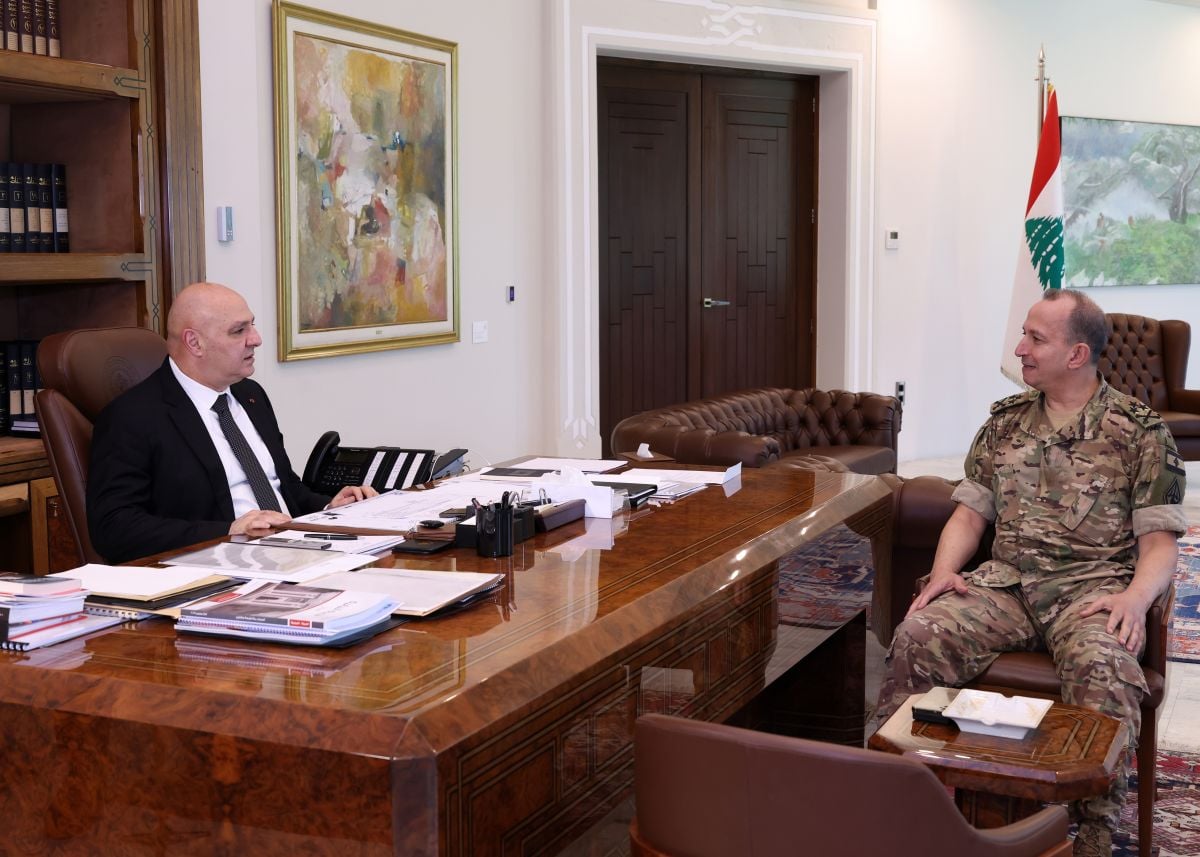
Lebanese President Joseph Aoun at the Baabda Palace with the Commander-in-Chief of the Lebanese Army, General Rodolph Haykal (right), on Dec. 16, 2025. (Credit: Photo taken from the presidency’s X account)






BEIRUT — Lebanese President Joseph Aoun met Lebanese Army chief General Rodolph Haykal at Baabda Palace on Tuesday, issuing directives ahead of a Paris meeting on Thursday focused on the army’s needs.
This meeting will take place in the presence of General Haykal and American and Saudi officials, at a time when Paris and Washington are pressing Beirut to speed up the process of disarming Hezbollah.
The army chief also briefed the head of state on the results of a field tour organized Monday by the Lebanese Army for ambassadors, chargés d'affaires and military attachés, aimed at observing the progress of Hezbollah's disarmament south of the Litani River.
"The diplomats were able to see the measures and arrangements taken by the army as part of the plan to extend state authority" and to disarm militias, according to the state-run National News Agency (NNA).
The last war between Hezbollah and Israel, which ended with a cease-fire in November 2024, left Hezbollah depleted and South Lebanon in ruins.
This agreement stipulates the disarmament of militias including Hezbollah — a task assigned to the Lebanese Army and reinforced by two decisions of the Lebanese government dating from August 2025, which reaffirm the monopoly of arms in the hands of the state.
However, this operation led by the army since summer 2025 has regularly come under criticism, particularly from Israel and the United States, who consider the process too slow or insufficient. It is in this context that the army reportedly organized this tour for foreign diplomats.
Aoun also met with General Edgar Lawandos, director of the State Security Department, with whom he discussed the security situation and the work of his department, especially regarding the fight against corruption within public administrations and institutions.
MP Tony Frangieh, from the Marada Movement, which is politically allied with Hezbollah but has on several occasions voiced support for disarmament, also went to the presidential palace to meet the head of state.
He told the press after leaving Baabda that "what Lebanon is experiencing today is part of a process of rebuilding hope, based on political realities whose results we are now beginning to clearly see."
Frangieh also said that "what the Lebanese Army and the Lebanese State are doing is more than excellent, whether in terms of deployment, arms withdrawal or restraint on the Lebanese scene, which spares the country from any new tension," calling on the "international community to put pressure on Israel to end the aggression."

 1 p.m. recap: Salam in Nabatieh; up to 10,000 more US troops heading to Middle East