


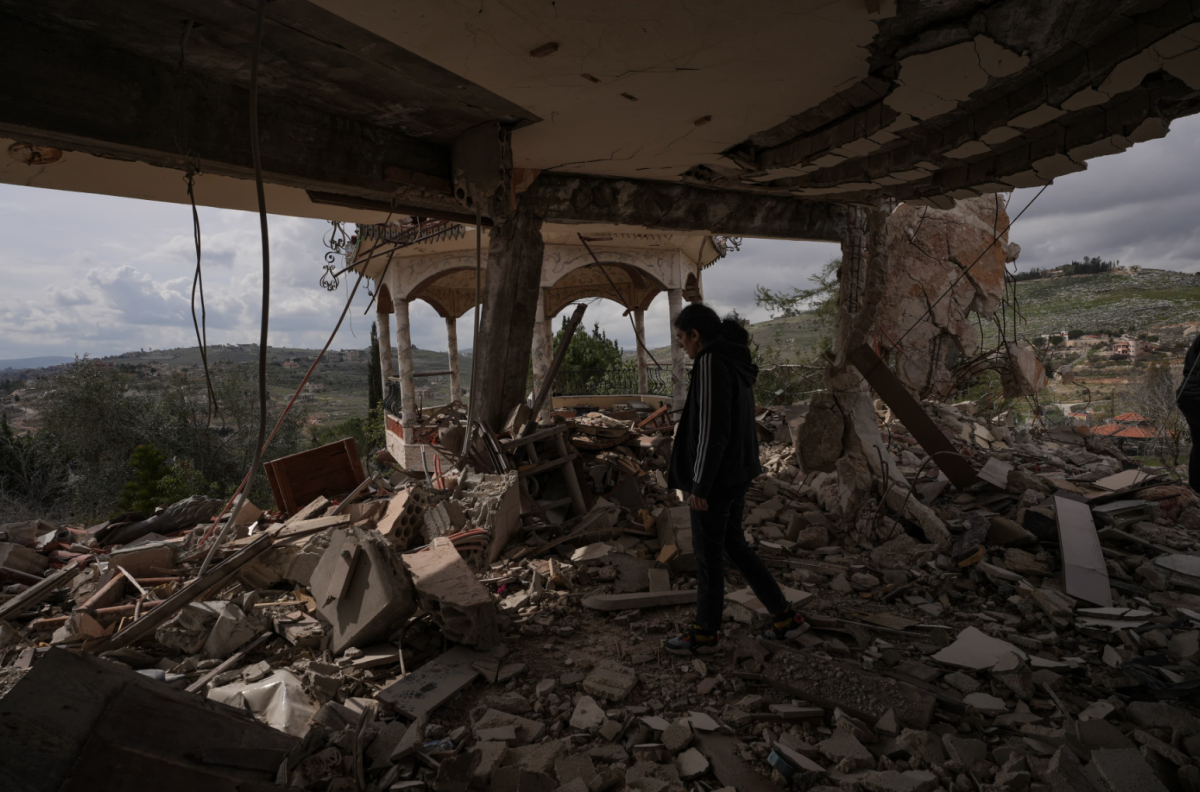
A woman inspects the ruins of her family home in Mais al-Jabal on Feb. 19, 2025. (Photo: Mohammad Yassin/L'Orient Today)






Despite fresh orders for the Lebanese Army to counter any Israeli incursions, the Israeli military infiltrated southern Lebanon overnight from Monday to Tuesday and blew up a house on the outskirts of Mais al-Jabal, according to our south Lebanon correspondent.
This marks yet another Israeli violation of the cease-fire that went into effect at the end of November 2024, prompting Lebanese President Joseph Aoun to once again urge the international community to put pressure on Israel to abide by the agreement.
Shortly after 1 a.m., the Israeli army entered the Kroum al-Mrah neighborhood, east of Mais al-Jabal (Marjayoun), where it blew up a residential home. This is the same area where the Lebanese Army had mobilized the night before in response to a heavy deployment of Israeli soldiers on the other side of the border. Last Thursday, it was ordered to oppose any Israeli incursion into the south after soldiers entered the border village of Blida and killed a municipal employee while he slept in a municipality residence.
Elsewhere, on Tuesday morning the Israeli army fired automatic weapons toward Wadi al-Assafir and the outskirts of the Khiam plain (Marjayoun) from a position it holds on Hamames hill, south of the village. Israel continues to occupy at least six hills on the Lebanese side of the border, even though last year's truce agreement calls for a full withdrawal of its troops.
It is because of these “constant” attacks that President Aoun told Dutch Defense Minister Ruben Brekelmans, who was on a visit to Beirut, of the need for Israel to respect the agreement, “especially as Lebanon has fulfilled all its obligations and continues to do so.” “Lebanon's stability is in Europe's interest,” the president insisted. In his view, negotiations with Israel are inevitable in order to end the attacks and resolve several issues, such as the release of Lebanese political prisoners and pushing the Israelis out of occupied lands.
For its part, Hezbollah continues to push back on the question of disarmament as long as Israeli attacks do not cease. In this context, several Israeli media outlets, including Haaretz, have recently reported on the party’s “efforts” to rebuild its forces after last year’s war. Citing military intelligence officials, the Israeli daily says Hezbollah’s attempts to reconstitute could “prompt Israel to expand its operations.”
According to the newspaper, Hezbollah's reconstruction efforts are focused not along the border strip, but in the part of south Lebanon north of the Litani River, which Israel regularly attacks. Haaretz also reports that Hezbollah has partially restored its supply lines, allowing it to rearm faster before the Lebanese Army manages to confiscate its arsenal. On Monday, a Hezbollah spokesperson denied reports by Israeli outlet Maariv about intensified Hezbollah rearming efforts, calling it Israeli propaganda meant to justify its unlawful attacks.
Asked about the Israeli media allegations, U.N. Interim Force in Lebanon (UNIFIL) spokesperson Kandice Ardiel told L’Orient-Le Jour on Tuesday the force “has not seen evidence of new Hezbollah infrastructure being built south of the Litani River,” its area of operations, since the November 2024 cease-fire agreement.
Since then, UNIFIL “has discovered more than 360 unauthorized weapons caches and military infrastructure sites, none of which appear to be new,” Ardiel said, adding that peacekeepers have shared all these findings with the Lebanese Army.

 7 p.m. recap: 1 person killed near border with Lebanon; 200 kilos of explosives carried by mules; Riyadh shuts its airspace