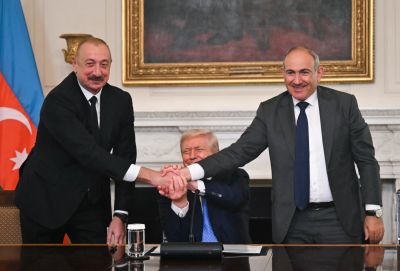
Le président azerbaïdjanais Ilham Aliyev (à gauche), le Premier ministre arménien Nikol Pashinyan (à droite) et le président américain Donald Trump se serrent la main lors d'une cérémonie de signature trilatérale dans la salle à manger d'État de la Maison Blanche à Washington, DC, le 8 août 2025. Photo AFP/ANDREW CABALLERO-REYNOLDS






Iran’s foreign ministry on Saturday welcomed the U.S.-brokered Armenia-Azerbaijan peace deal but warned against foreign intervention after the agreement granted Washington development rights near the Iranian border.
On Friday, Armenian Prime Minister Nikol Pashinyan and Azerbaijani President Ilham Aliyev signed the peace deal at the White House.
The accord, which ended the long-running feud between the two countries, includes the creation of a transit corridor through Armenia to connect Azerbaijan to its exclave of Nakhchivan, a longstanding demand of Baku.
The United States will have development rights for the corridor, called the ‘’Trump Route for International Peace and Prosperity’’ (TRIPP), in the strategic, resource-rich region.
Iran has long opposed the corridor, often referred to as Zangezur, fearing it would cut the country off from the Caucasus and bring a foreign presence to its border.
In a statement, Iran’s foreign ministry welcomed ‘’the finalization of the text of the peace agreement by the two countries’’ but expressed ‘’concern over the negative consequences of any foreign intervention in any way and form, especially in the vicinity of common borders.’’
It added that such a move would ‘’disrupt the security and lasting stability of the region.’’
On Monday, a senior adviser to Iran’s supreme leader, Ali Akbar Velayati, warned that any attempt by regional or outside powers to push the Zangezur corridor would face a ‘’strong response’’ from Iran.
‘’I would like to remind you that any government in the region or outside of it that wants to repeat the previous failed experience will face a strong response from Iran,’’ he said in a post on X.
Christian-majority Armenia and Muslim-majority Azerbaijan have feuded for decades over their border and the status of ethnic enclaves within each other’s territories.
The nations went to war twice over the disputed Karabakh region, which Azerbaijan recaptured from Armenian forces in a lightning 2023 offensive, sparking the exodus of more than 100,000 ethnic Armenians.
Asked what Armenia stood to gain from Friday’s deal, a White House official called the United States ‘’an enormous strategic commercial partner, probably the most enormous and strategic in the history of the world.’’
‘’The losers here are China, Russian and Iran,’’ he said, speaking on condition of anonymity.