





Indian security personnel stand guard in Wuyan, near Srinagar, on May 7, 2025, following border tensions. (Credit: AFP / TAUSEEF MUSTAFA)






India and Pakistan exchanged artillery fire on Wednesday, killing at least 26 Pakistanis and eight Indians in the most serious military confrontation between the two countries in two decades.
Tensions between the nuclear-armed rivals have simmered since gunmen killed 26 men in Indian-controlled Kashmir on April 22. The two countries have been at odds since their partition in 1947.
The conflict escalated from diplomacy to military action late Tuesday into Wednesday. Artillery fire was exchanged along the contested Kashmir border following Indian strikes on Pakistani territory in retaliation for the Pahalgam attack.
During these strikes, "nine terrorist camps were destroyed," Indian Army spokeswoman Lieutenant Colonel Vyomika Singh told reporters. The Indian missiles struck six cities in Pakistani Kashmir and Punjab, and the subsequent exchanges of fire, killed at least 26 civilians and injured 46 others, stated Islamabad Army spokesman General Ahmed Chaudhry.
These strikes also damaged the Neelum-Jhelum hydroelectric dam, he added.
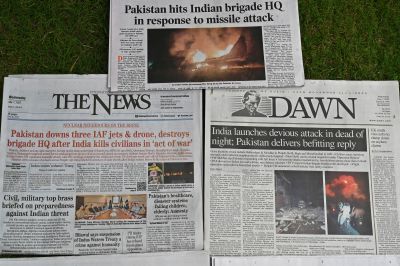
Aircraft grounded
India reported eight deaths and 29 injuries in the Indian administered Kashmiri village of Poonch during artillery fire. The overnight battle continued into the morning with the area targeted by Pakistani shells.
'We were awakened by gunfire, I saw shells falling, I was scared the roof would collapse,' Poonch resident Farooq told the Press Trust of India (PTI).
Earlier in the night, violent explosions were reported around Srinagar, the main city in Indian-controlled Kashmir. By morning, an Indian security source told AFP that three Indian Air Force fighter jets had crashed for reasons not immediately known. The fate of the pilots was not disclosed.
An AFP photographer witnessed aircraft debris in a field in Wuyan, near Srinagar. The downed plane was identified as a Mirage 2000 by an Indian security source.
Pakistani Defense Minister Khawaja Asif told AFP that Pakistan had shot down “five enemy planes,” but gave no further details.
The National Security Committee, which meets only in cases of extreme emergency, convened in Islamabad on Wednesday morning.
India has accused Pakistan of involvement in the Pahalgam attack, which Pakistan has denied.
'A big bang'
One of the sites targeted overnight by the Indian army is the Subhan Mosque in Bahawalpur, in Pakistani Punjab, linked according to Indian intelligence to groups close to the jihadist movement Lashkar-e-Taiba (LeT).
India accuses this group, suspected of the attacks that killed 166 people in Mumbai in 2008, of carrying out the April 22 attack. In Muridke, a city in Pakistan’s Punjab province that was also targeted, resident Mohammed Khourram told AFP he heard “a big boom, very strange.”
"I was very scared, as if it was an earthquake. Then a missile came and struck, and a second one a minute later, three or four followed in the next three or four minutes," he continued.
India's retaliations were welcomed with satisfaction in the streets of New Delhi. Prime Minister Narendra Modi "avenged the deaths [of April 22]," G.B. Rajakumar, a driver in the capital, told AFP.
In contrast, about 200 Pakistanis marched early Wednesday in the southern city of Hyderabad, burning Indian flags and portraits of Modi.
Overnight, U.S. Secretary of State Marco Rubio spoke with his Indian and Pakistani counterparts, urging dialogue to “defuse the situation,” according to the White House.
'The escalation has reached a level higher than that of the last crisis in 2019, with potentially terrible consequences,' warned analyst Praveen Donthi from the International Crisis Group (ICG) think tank.
Water war
In 2019, New Delhi launched strikes following a deadly attack on an Indian military convoy in Kashmir.
China has called on the two countries "to avoid taking actions that would further complicate the situation," while France urged them "to exercise restraint." The Indian army spokeswoman emphasized that the targeted sites were "chosen to avoid any damage to civilian infrastructure or civilian casualties."
New Delhi is set to host Iranian Foreign Minister Abbas Araghchi, who visited Islamabad on Monday as part of mediation efforts. On Tuesday night, Prime Minister Narendra Modi announced his intention to “cut off the water” from rivers originating in India that flow into Pakistan — a threat experts say is not feasible in the short term.
“Water belonging to India was flowing outward. It will now be stopped to serve India’s interests,” Modi said.
The day after the attack, India suspended its participation in a water-sharing treaty signed in 1960 with its neighbor. On Tuesday, Pakistan accused India of altering the flow of the Chenab River, one of the three rivers under its control according to the so-called Indus treaty.

 Evening recap: Netanyahu announces West Bank offensive; 7 killed in Jordan church shooting; tents burned in south Lebanon
 US strike on Iran this weekend? ‘Absolutely,’ says Barrack; ‘I have no idea,’ says Trump